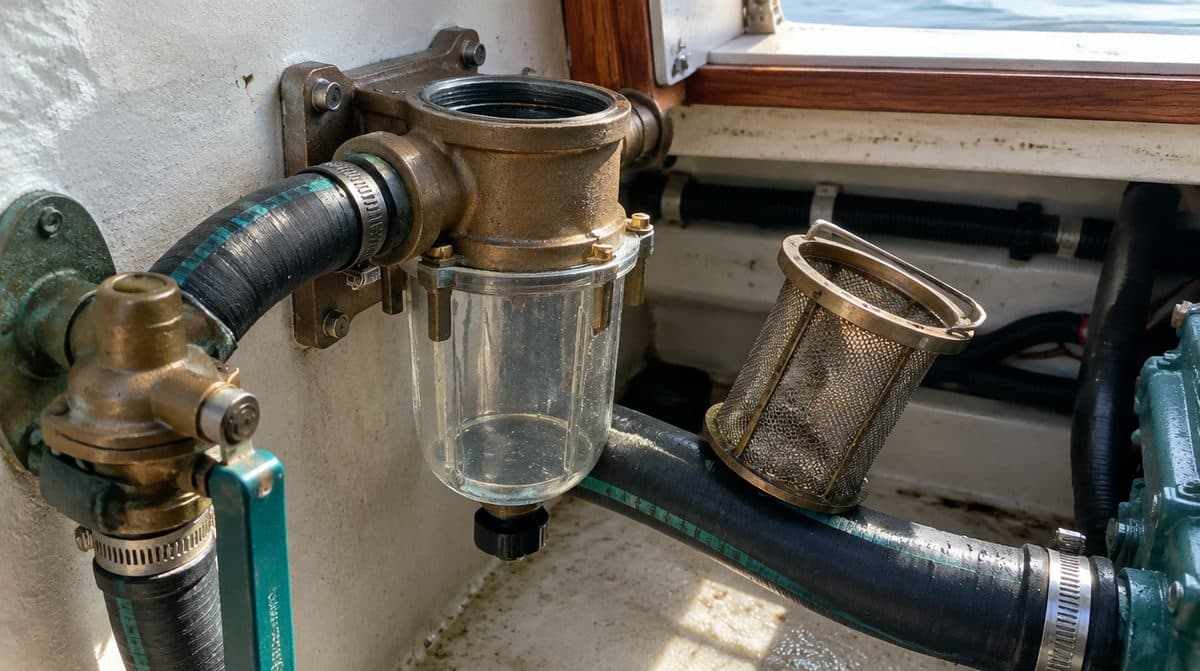
Raw Water Strainers: The Simple Part That Prevents Overheating
A plastic bag can overheat your engine faster than any mechanical failure. How to size, mount, and actually clean a raw water strainer.
A plastic bag or a clump of seagrass can shut down your cooling system in minutes. Your raw water strainer is what stops it. It is one of the cheapest components in your entire cooling circuit, it has no moving parts, and when it is sized and mounted right it will quietly save your engine over and over without you ever thinking about it. When it is wrong, you find out the hard way, usually on the hottest day of the summer with a full cockpit of guests.
What a Raw Water Strainer Actually Does
Most marine engines cool themselves with the water you float in. A seacock lets that water in through the hull, a hose carries it to the engine's raw water pump, and the pump pushes it through a heat exchanger (or straight through the block on raw water cooled engines) before sending it out the exhaust. Everything in that chain assumes the water arriving is just water.
The strainer sits between the seacock and the pump, and its whole job is to catch the stuff that is not water: grass, jellyfish, bag fragments, barnacle shells, the occasional unlucky minnow. Debris that gets past it goes straight into the impeller, and a rubber impeller chewing on a mouthful of eelgrass does not last long. A clogged impeller means no cooling flow, which means an overheat alarm, which means you are drifting while you dig out tools. The strainer is the cheap insurance that keeps all of that theoretical. It also protects more than the engine: the same logic applies to air conditioning pumps, livewell pumps, and washdown systems, which is why larger boats often have several strainers aboard.
Size to Flow and Hose
Match the strainer to your hose size and the flow it must pass. Undersizing restricts cooling water and risks overheating, and it does so sneakily: the engine may run fine at idle and only creep up at cruise, when it needs the most water and the restriction bites hardest.
The sizing logic is simple. Say your engine intake runs on 1 inch hose from the seacock. You want a strainer with 1 inch ports, like a 1 inch ARG series body, so the strainer passes at least as much water as the hose can carry. Going one size up is fine and buys you more basket area, which means longer intervals between cleanings. Going a size down to save a few dollars means you have built a permanent restriction into the system, and no amount of cleaning fixes that.
While you are at it, check the basket mesh. A fine mesh catches more debris but clogs faster; a coarser basket passes more water between cleanings. For weedy or grassy waters, a larger basket with moderate mesh is usually the happier combination.
Clear Bowl and Easy Access
A clear bowl lets you see buildup at a glance. This matters more than almost any other feature, because a strainer only works if someone actually looks at it. A glass or polycarbonate cylinder that shows you a bowl full of grass from three feet away turns an inspection into a glance during your normal engine checks.
Mount it where you can open and clean the basket easily, because a strainer you cannot reach does not get cleaned. That means above the waterline where practical, oriented so the lid comes off without removing other equipment, with enough clearance above it to actually lift the basket out. If you have to empty a locker and lie on a hot engine to reach the lid, be honest with yourself about how often that will happen.
Material
Bronze and marine-grade composite strainers resist corrosion and are the standard choices for raw water duty. Bronze bodies shrug off decades of salt water and physical abuse. Good marine composites avoid galvanic issues entirely and keep weight down.
Check the basket material too. Stainless baskets are tough and easy to clean. Monel baskets resist salt water corrosion exceptionally well. Poly baskets will not corrode at all and are cheap to replace when a hamfisted crew member steps on one. Whatever you choose, carry the right spare: baskets and lid gaskets are the two parts you will eventually need.
Installation Realities
A strainer should be mounted rigidly to a bulkhead or stringer, not hanging off its hoses. Put it downstream of the seacock and close it before you open the lid, or you will learn exactly how fast water comes through an open 1 inch hole. Keep the hose runs short and smooth, double clamp below the waterline, and avoid loops that can trap air. After reassembly, always open the seacock and check for weeping around the lid before you start the engine.
Cleaning and the Signs of Trouble
Make the strainer part of your routine: glance at the bowl every outing, and clean the basket whenever debris covers a meaningful part of it. If your engine temp starts climbing, check the strainer first. It is the easiest fix and the most common culprit. Weak flow from the exhaust tell-tale, a hotter than normal cruise temperature, or visible grass in the bowl are all the same message.
The strainer itself will also age. Replace lid gaskets that have flattened or cracked, baskets that have corroded thin or split, and any bowl that has clouded so badly you cannot see inside. A strainer that will not seal pulls air into the suction line, and an air leak starves the pump just like a clog does. Remember that the next victim downstream is the rubber impeller, and a cooked impeller is a bigger job than a basket rinse; our water pump impeller guide covers that side of the system.
Mistakes to Avoid
- Buying a strainer smaller than the hose it serves
- Mounting it somewhere you cannot open without gymnastics
- Forgetting to close the seacock before opening the lid
- Ignoring the basket material and ending up with a corroded screen
- Treating the clear bowl as decoration instead of checking it
From the Water
If your engine temp starts climbing, check the strainer first. It's the easiest fix and the most common culprit. Keep a spare basket and lid gasket aboard, and you can go from overheat alarm to back underway in the time it takes your drinks to get warm.
Where to Get It
Everything in this guide is stocked at Boat Supplies Direct, the Nautical Network marine parts store.
In stock as this guide goes up: - GROCO ARG-1000 Series 1 inch raw water strainer with Monel basket - GROCO ARG-2000 Series 2 inch raw water strainer with stainless steel basket - Shurflo by Pentair 3/4 inch raw water strainer with bracket and 50 mesh screen
Browse the full range: - Shop strainers - Read the full buying guide, including FAQs
More from the Wire
 Buying Guides
October 18, 2026
Starting vs. Deep Cycle: The Battery Mistake That Strands Boaters
Starting, deep cycle, or dual purpose, and flooded, AGM, or lithium. How to pick the battery type that will not leave you stranded.
Read more Buying Guides
October 18, 2026
The Onboard Charger: Cheap Insurance for Expensive Batteries
Batteries die young when they sit half-charged. How to size an onboard charger by amps, banks, and chemistry.
Read more Buying Guides
October 18, 2026
Battery Switches and Isolators: Never Get Stranded by a Dead Battery
The switch and isolator setup that keeps your starting battery ready while the house bank runs your gear.
Read more