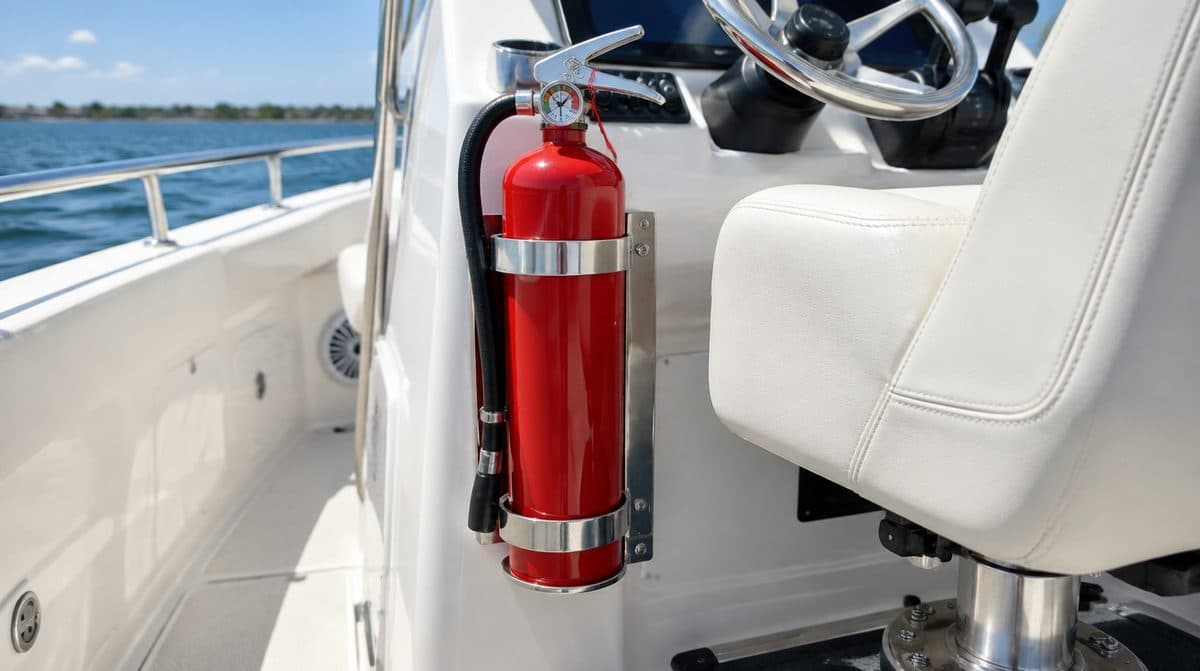
Marine Fire Extinguishers: Required Gear That Saves Lives
A fire on the water leaves you no exit. What the ratings mean, how many extinguishers your boat needs, and where to mount them so you can actually reach one.
Fire on a boat leaves you nowhere to go but the water. The right extinguisher, mounted where you can grab it, buys you time. On land, the plan for a fire that gets ahead of you is simple: get out and let the professionals handle it. On the water, "out" means swimming, and the professionals are a radio call and a long wait away. That is why extinguishers are required equipment, and why treating them as a checkbox item, the dusty canister rolling around a stern locker, misses the entire point. A boat fire is a fight you either win in the first moments or do not win at all.
What Actually Burns on a Boat
Knowing your likely fires tells you what to buy. The big two on a powerboat are fuel fires, gasoline or diesel and their vapors around the engine and tanks, and electrical fires from chafed wiring, overloaded circuits, and corroded connections that heat up under load. Galley fires on boats with stoves round out the list. Each behaves differently: fuel fires flash and spread across surfaces, electrical fires smolder in hidden runs behind panels, and both can reflash after you think you have knocked them down. The right extinguisher handles all of them; water handles none of them, and on a fuel or electrical fire it makes things worse.
Class and Rating
Marine extinguishers must be Coast Guard approved and rated for the fires you face: flammable liquids (fuel) and electrical. Look for the correct class rating and a marine mounting bracket. On the label, the letter B covers flammable liquids and C covers energized electrical equipment, so a marine unit will carry a B:C rating at minimum, often A:B:C to add ordinary combustibles like upholstery and wood. The number in front of the B is a relative measure of firefighting capacity: a bigger number means more extinguishing power, which on the water translates to more seconds of discharge when seconds are the whole game.
The marine bracket matters more than it looks. A household extinguisher clipped into a hardware-store holder will launch itself in a seaway, and an extinguisher that has been bouncing around a locker may not work when you finally need it. Buy marine units with proper brackets and through-bolt them.
How Many You Need
The required number increases with boat length and whether you have an enclosed engine compartment or fuel system. Carry at least the required minimum, and more is better. Check the current Coast Guard requirements for your boat's length and configuration, and treat that number as the floor, not the target.
Placement beats quantity. Mount them where you can grab one fast, not buried in a locker. The working rule: you should be able to reach an extinguisher without crossing the fire to get it. That usually means one at the helm, one near the galley or cabin entrance, and one accessible from the cockpit near, but not directly over, the engine compartment. Think through the scenario where the engine box is burning and you are standing at the helm: which extinguisher do you reach, and does getting it put your hands over the flames? Walk the boat once with that question and the right mounting spots reveal themselves.
If your engine compartment has a fire port, a small labeled hole for discharging an extinguisher without opening the hatch, learn where it is. Opening an engine hatch feeds a fire a lungful of fresh oxygen, and a fire port lets you fight the fire without doing that.
Disposable vs. Rechargeable
Rechargeable extinguishers can be serviced. Disposable ones must be replaced by their date. Check the gauge and expiration regularly either way. Disposables are cheaper up front and lighter, and for small boats they are a fine answer as long as you actually track the dates. Rechargeables cost more initially but can be inspected, serviced, and refilled by a fire equipment shop, which makes them the better long-term answer on boats with multiple stations. Whichever you choose, the gauge needs to read in the green and the pin and seal need to be intact. An extinguisher with a dead gauge is cargo.
The Two Minute Monthly Check
Make extinguisher inspection part of your routine, the same way you check the bilge. Look at each gauge. Confirm each unit is seated in its bracket and the bracket is tight. Check for corrosion around the neck and handle, since salt air works on steel cylinders. Confirm nothing has been piled on top of or in front of any extinguisher. That is the whole inspection, and it takes less time than wiping down the console.
Prevention is the other half of the fire story, and most of it is electrical. Tired wiring and wrong-sized protection start fires that extinguishers have to finish, which is why overcurrent protection done right matters so much. Our fuse and breaker guide covers how to get that layer right.
Mistakes to Avoid
The common failures are all preventable. Mounting every extinguisher in the cabin, so a cockpit fire cuts you off from all of them. Buying one big unit instead of several distributed ones. Letting a disposable age years past its date because the gauge still shows green. Never reading the operating instructions until there is smoke, when the PASS sequence (pull, aim, squeeze, sweep) should already be in your hands. And aiming at the flames instead of the base of the fire, which wastes the few seconds of agent you have.
From the Water
Flip dry-chemical extinguishers upside down and tap them every few months. Vibration packs the powder down over time, and a canister of compacted powder can discharge its propellant without delivering the agent. A few taps with a rubber mallet while inverted, until you feel the powder shift, keeps the contents loose and ready. It is the cheapest maintenance on the whole boat and almost nobody does it.
Where to Get It
Everything in this guide is stocked at Boat Supplies Direct, the Nautical Network marine parts store. Orders ship free all year with Dock Pass, the $49 a year shipping pass.
In stock as this guide goes up: - Shop fire suppression
Browse the full range: - Shop fire suppression - Read the full buying guide, including FAQs
More from the Wire
 Buying Guides
October 19, 2026
Marine Autopilots: Let the Boat Steer While You Watch the Water
The control head is the easy part. The drive unit behind your steering is where autopilots get mismatched, and where the money goes right or wrong.
Read more Buying Guides
October 19, 2026
Boat Horns: Required Gear and Your Voice on the Water
Your horn is required gear, and in fog it is the only way other boats know you exist. Electric vs. air, loudness and tone, mounting, and the signals worth knowing.
Read more Buying Guides
October 19, 2026
Cup Holders and Organizers: Small Upgrades, Big Difference
Loose drinks and sliding gear make every trip messier than it needs to be. Which cup holders actually drain, which organizers hold on in chop, and how to mount both for good.
Read more