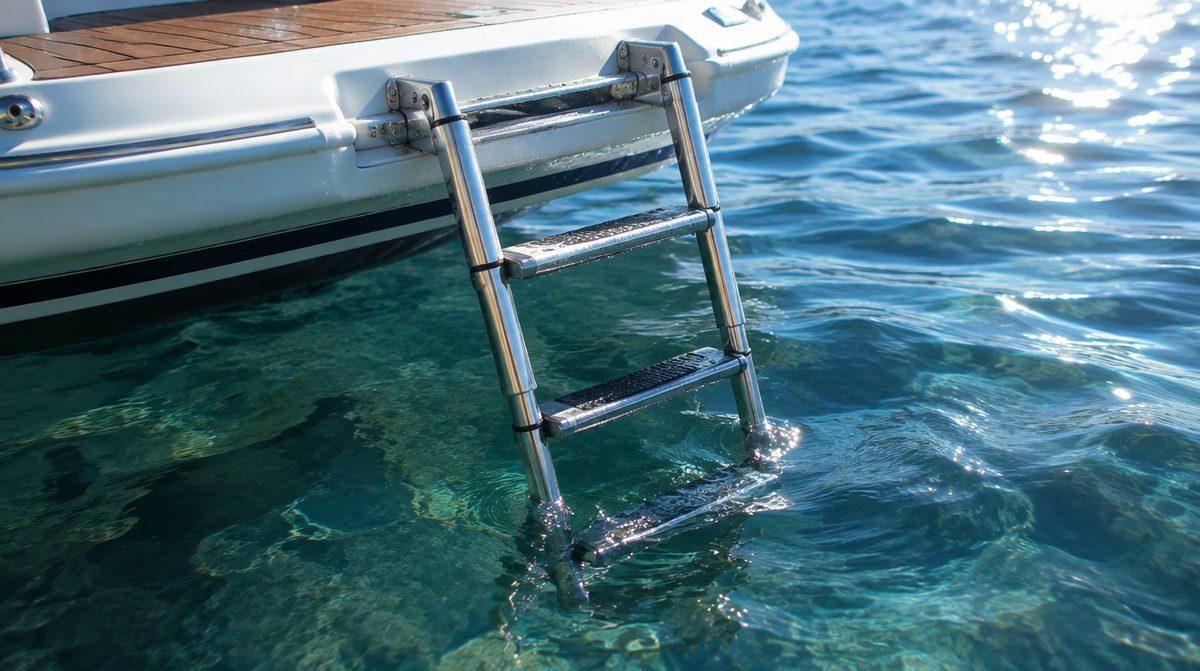
Boarding Ladders: Getting Back Aboard Safely From the Water
The hardest part of any swim is the last three feet. How to size a boarding ladder so you can actually climb it, plus mounts, materials, and the solo-swimmer test.
Jumping in is easy. Climbing back aboard when you're tired, cold, and swimming in wet clothes is where a good ladder earns its keep. A boarding ladder is the kind of gear nobody thinks about until someone is bobbing next to the hull, grabbing at a slick rubrail, wondering why the bottom step is barely underwater. Spend ten minutes choosing the right one and that moment never happens on your boat.
Why the Bottom Step Matters Most
Climbing out of the water is a legs job. Your arms can hold you against the hull, but the muscle that lifts a wet, tired body is in your legs, and legs need something to stand on. When the bottom step sits deep below the surface, you plant a foot while the water is still carrying most of your weight, and the climb feels like walking up stairs. When the bottom step sits at the surface, you are doing a pull-up on wet stainless steel, and most adults cannot manage that after a long swim. Every other feature on a ladder is secondary to this one.
Step Count and Reach
The ladder must reach deep enough below the waterline that someone can get a foot on the bottom step from the water. Count on at least 2 to 3 submerged steps. Higher freeboard needs more steps.
Here's a worked example. Say the top of your swim platform sits about a foot above the water, and you want roughly two feet of ladder below the surface. That's three feet of total reach. If the ladder you're considering spaces its steps about a foot apart, you're shopping for a four-step ladder, not a three-step. Measure your own transom instead of guessing from the product photo, because freeboard varies a lot more between boats than the listings suggest.
Mount Types
- Transom mount: the standard, folds or telescopes against the transom and deploys over the stern.
- Over-platform and swim platform mounts: these integrate with the platform, tucking underneath or on top so the deck stays clear.
- Gunwale and side mounts: hook-over or bolt-on ladders for boarding from the side, common on sailboats and on boats where the stern is crowded by an outboard.
Pick the mount for where people actually enter the water on your boat, not for where the hardware would be easiest to install.
Material and Grip
Stainless steel is the default for boat-mounted ladders: strong, corrosion resistant, and good looking. Aluminum and molded polyethylene show up in dock ladders, where weight and upkeep matter more than polish. Whatever the frame, look hard at the steps themselves. Wide steps with molded or grooved treads are comfortable on bare feet; bare round tube rungs dig in and get slippery the moment algae moves in. Telescoping and folding designs stow compactly, which matters more than you'd think, because a ladder that's annoying to stow has a way of staying home.
Installation Realities
A ladder takes a real load at a lousy angle, so mount it like you mean it. Through-bolt with backing plates or fender washers, never screws alone, and bed every fastener in marine sealant, especially on a cored transom or platform where water intrusion rots the structure from the inside out. Check the swing before you drill: a transom ladder that deploys into the outboard's lower unit is a design failure you only discover once. And add a retaining strap or clip if the ladder doesn't positively lock when stowed, because a ladder that self-deploys underway makes an expensive noise.
Don't Forget the Dock
The same logic applies at the slip. If you swim at the dock, or just want a way out of the water if someone falls in, a fixed or flip-up dock ladder is cheap insurance. Flip-up models keep the steps out of the water when nobody is swimming, which keeps marine growth off and the treads grippy instead of slimy.
Maintenance and When to Replace
Rinse the ladder with fresh water after salty outings, and once a year put a wrench on the mounting bolts. Watch the hinge pins and welds for crevice corrosion: a rust stain that keeps returning after cleaning means corrosion is working inside the joint. Plastic treads chalk and crack with UV. Replace the ladder, or at least its worn parts, when it wobbles under load, when the stand-offs are bent so it no longer sits square against the hull, or when any weld shows a crack. A ladder failing under a climbing swimmer is exactly the wrong moment for discovery.
Mistakes to Avoid
- Buying on price and ending up one step short. The cheap ladder you can't climb costs more than the right one.
- Mounting where the deployed ladder lands against the motor, a trim tab, or the exhaust outlet.
- Choosing a ladder with no grab point above it. Hands need help too, and a rail or handle above the top step makes the last move easy.
- Ignoring the weight rating. Ladders carry real structural loads, and the ratings exist for a reason.
From the Water
Make sure someone in the water can deploy the ladder. If it only lowers from the deck, a solo swimmer can be stranded. Test this for real: on a calm day, stow the ladder, get in the water, and see whether you can reach and release it without help. If you can't, rig a lanyard or pull-strap that hangs within reach of the waterline. And since you're already thinking about recovery, our man overboard gear guide covers the equipment for the day someone goes in when nobody planned it.
Where to Get It
Everything in this guide is stocked at Boat Supplies Direct, the Nautical Network marine parts store. Orders ship free all year with Dock Pass, the $49 a year shipping pass.
In stock as this guide goes up: - Sea-Dog Folding Ladder, 3 Step: a compact stainless folding ladder for transoms and platforms with modest freeboard. - Sea-Dog Folding Ladder, 5 Step: the same design with the extra reach that makes climbing out easy instead of athletic. - Dock Edge Stand-Off Flip-Up 4-Step Dock Ladder: roto-molded polyethylene for the slip, and it flips up out of the water when nobody's swimming.
Browse the full range: - Shop ladders - Read the full buying guide, including FAQs
More from the Wire
 Buying Guides
October 19, 2026
Raw Water Strainers: The Simple Part That Prevents Overheating
A plastic bag can overheat your engine faster than any mechanical failure. How to size, mount, and actually clean a raw water strainer.
Read more Buying Guides
October 19, 2026
Galvanic Isolators: Stop the Dock From Eating Your Boat
If your anodes vanish at the marina but last on the mooring, the dock is the suspect. What a galvanic isolator actually does, and how to size one without giving up your safety ground.
Read more Buying Guides
October 19, 2026
Chartplotter and Fishfinder Combos: What Actually Matters on the Water
Screen size, sonar type, and the transducer under the hull matter more than the badge on the box. How to buy a combo you can read in full sun and won't outgrow in two seasons.
Read more