Chartplotter and Fishfinder Combos: What Actually Matters on the Water
Screen size, sonar type, and the transducer under the hull matter more than the badge on the box. How to buy a combo you can read in full sun and won't outgrow in two seasons.
Walk any boat show and you'll see a wall of glowing screens, each promising more fish and an easier ride home. The truth is most boaters only need a handful of features done really well, and the units that nail those features are not always the ones with the biggest booth. Before you fall in love with a screen, get clear on how you actually use your boat: how far you run, what you fish for, and what you might bolt on later. Those three answers pick your unit for you.
Screen size
Screen size drives both usability and price. A simple rule:
- Under 20 ft or tight dash space: 5 to 7 inch
- 20 to 26 ft: 7 to 9 inch
- 26 ft and up or dual-purpose fishing: 9 to 12 inch or larger
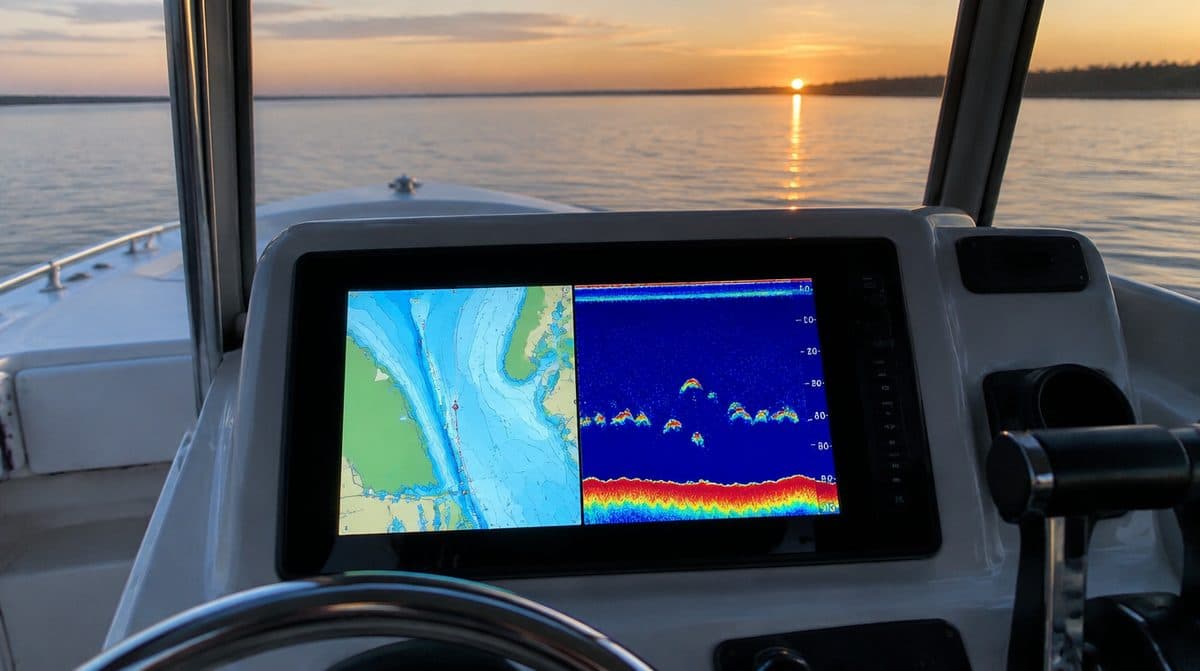
Bigger screens make split views (chart plus sonar) actually readable. If you fish and navigate at the same time, do not go smaller than 7 inches. A split view on a small screen gives you two postage stamps, and you will end up flipping between full-screen pages at exactly the moments you want both. The flip side is dash real estate: measure your helm before you shop, including the depth behind the panel, because a flush-mount unit needs room for the body and the cables, not just the bezel.
One more honest note: you read this screen at arm's length, in sunlight, with spray on it, while the boat moves. Brightness and viewing angle matter more at the helm than resolution numbers on a spec sheet.
Sonar type
- CHIRP sonar gives cleaner fish and bottom detail than traditional sonar and is now standard on most quality units.
- Down imaging shows a photo-like view straight below the boat.
- Side imaging scans out to the sides, which is huge for locating structure and fish in shallow water.
For inshore and freshwater fishing, down and side imaging are worth it. For straight navigation, standard CHIRP is plenty. The practical difference shows up in how you search: CHIRP tells you something is under the boat, down imaging tells you whether it is a brush pile or a rock, and side imaging finds the brush pile you would have idled straight past. If your fishing involves hunting structure, side imaging changes how you spend your day. If your fishing is drop-the-anchor-and-soak-bait, save the money and put it into the screen size instead.
Maps and charts
Check what charts are included and what the unit supports (coastal, lake, or both). Some brands bundle preloaded charts, others require a separate chart card. Confirm coverage for the waters you actually run. This is where identical-looking units quietly diverge in real cost: a bargain unit plus a required chart card can land right next to the price of the model that ships with everything loaded. Also check how chart updates work and whether the unit can record your own sonar logs to refine maps of your home water. For lake anglers especially, the chart ecosystem is half the purchase.
Networking and expansion
If you plan to add radar, autopilot, or a second display later, buy a unit that supports networking (NMEA 2000 and Ethernet). It costs a little more now and saves a full replacement later. NMEA 2000 is the small-data backbone that lets your engine, GPS, wind, and tank sensors all talk; Ethernet carries the heavy traffic like radar and shared sonar between displays. A non-networked unit is a dead end: fine if a single screen is genuinely all you will ever want, expensive if boat ownership does what it usually does to your plans. Our NMEA 2000 networking guide covers how the backbone goes together.
Transducer matters as much as the head unit
The display is only as good as the transducer feeding it. Match the transducer to your hull and the sonar features you want. A great unit with the wrong transducer will disappoint. Transom mounts are simple and cheap and work well on outboard boats at moderate speeds. Thru-hull transducers cost and demand more at install time but deliver the cleanest signal, especially at speed. In-hull units shoot through fiberglass, which keeps holes out of your boat at the price of some sensitivity and no temperature reading.
Pay attention to the bundle: a combo sold with the matched transducer is usually the smart buy, because the transducer unlocks the sonar modes you paid for in the box. Buying a side-imaging-capable head unit and feeding it a basic transducer is like buying a sports car and towing it everywhere.
Installation realities
Plan the install before the box arrives. The unit wants clean, fused power straight from the battery or a dedicated circuit, not a tap off the nearest accessory wire; voltage drop and electrical noise show up on screen as gremlins people blame on the unit. Transducer placement is the other make-or-break: it needs clean water flow, away from strakes, fittings, and prop wash, or your bottom reading will vanish exactly when you get on plane. Leave service loops in the cables, seal every transom hole properly, and if the job is beyond your comfort, it is a half-day visit from a marine electronics installer.
Keeping it alive
These units live a hard outdoor life, and a little care stretches them. Put the sun cover on when you leave the boat; UV is the screen's slow killer. Rinse salt off with fresh water, never a pressure washer into the seams. Keep connector pins lightly protected and seated, and update the software a few times a season, since sonar and chart improvements arrive free long after you buy. When a unit starts rebooting or losing bottom lock, check voltage and connections before condemning it; most electronics problems on boats are wiring problems wearing a disguise.
From the Water
Mount the screen where you can read it standing at the helm in full sun. A gorgeous display you have to squint at is worse than a smaller one you can glance at. Before you drill anything, hold the unit in place on a bright day and check it from where you actually stand, polarized sunglasses on, because some screens darken badly through polarized lenses at exactly the angle you drive from.
Where to Get It Everything in this guide is stocked at Boat Supplies Direct, the Nautical Network marine parts store.
In stock as this guide goes up: - Lowrance Eagle 5 Combo with SplitShot Transducer and C-MAP Charts - Garmin ECHOMAP UHD2 74sv Combo with US Coastal Maps and GT54UHD-TM Transducer (Remanufactured) - Garmin GPSMAP 8610xsv GPS/Fishfinder Combo
Browse the full range: - Shop GPS and fishfinder combos - Read the full buying guide, including FAQs
More from the Wire
 Buying Guides
October 18, 2026
Starting vs. Deep Cycle: The Battery Mistake That Strands Boaters
Starting, deep cycle, or dual purpose, and flooded, AGM, or lithium. How to pick the battery type that will not leave you stranded.
Read more Buying Guides
October 18, 2026
The Onboard Charger: Cheap Insurance for Expensive Batteries
Batteries die young when they sit half-charged. How to size an onboard charger by amps, banks, and chemistry.
Read more Buying Guides
October 18, 2026
Battery Switches and Isolators: Never Get Stranded by a Dead Battery
The switch and isolator setup that keeps your starting battery ready while the house bank runs your gear.
Read more