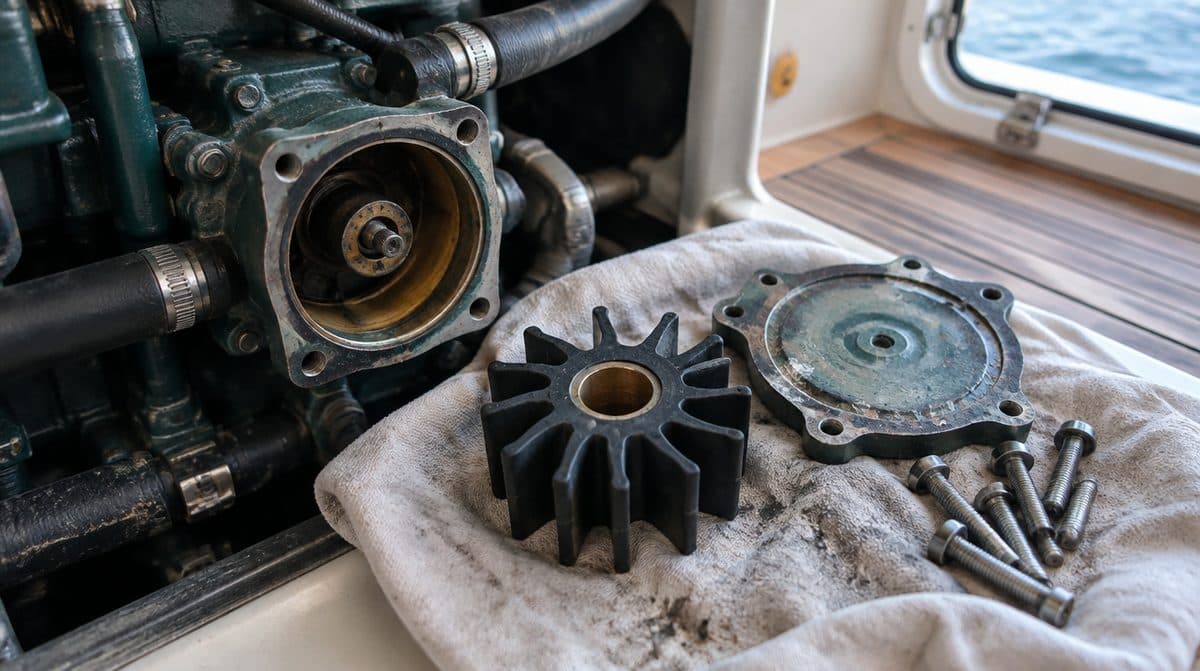
Impellers: The Cheap Wear Part That Overheats Engines
Your engine's cooling system depends on a small rubber wheel that wears out quietly. How to buy the exact right impeller and catch it lying before the alarm goes off.
A worn impeller fails quietly, right up until the temperature alarm goes off. There is no gauge for impeller health and no warning light, just a small rubber wheel spinning in the dark, moving every drop of cooling water your engine gets. It's cheap to replace and expensive to ignore, which makes it one of the best maintenance bargains on the whole boat.
How a flexible impeller pump works
A raw water pump is beautifully simple. A rubber impeller with flexible vanes spins inside a housing that has an offset cam. As each vane sweeps past the cam it bends, and as it springs back it draws in water and pushes it along, which is why these pumps prime themselves and keep a steady flow moving through the engine. The catch is in the materials: the vanes are rubber flexing constantly against metal, lubricated and cooled only by the water they pump. Every rotation is a little wear, every dry second is a lot of heat, and heat is what kills rubber. That is the whole story of why impellers are a wear part rather than a lifetime part.
Buy the exact impeller for your pump
Impellers are specific to the pump model. Match the part to your exact engine and pump, since a close-but-wrong impeller will not seal or pump correctly. Diameter, width, bore size, drive style (keyed, splined, or flatted), vane count, and rubber compound all have to match, and two impellers that look identical on the shelf can behave very differently inside the housing. Buy by the pump's model number, not by eyeball, and buy the kit that includes a fresh gasket or O-ring, because you will want it when the cover comes off.
Neoprene or nitrile
The compound matters as much as the dimensions. Neoprene is the usual choice for plain raw water cooling duty. Nitrile is the one to reach for where the water may carry fuel or oil, because oil attacks neoprene and shortens its life. Your pump maker specifies the compound for a reason, so match what the manual calls for rather than grabbing whichever version the shelf happens to have. If your old impeller came out soft, swollen, or gummy, suspect oil contamination and look upstream for the source while you are in there.
Replace on a schedule
Impellers are wear parts. Replace them on the manufacturer's schedule (commonly once a season or by hours), and any time you lose cooling water flow. Rubber ages even when the boat sits, and an impeller that spent the winter pressed against the cam takes a set, with vanes that stay bent and seal poorly from the first start of spring. Carry a spare and the tools to change it, because the pump does not consult your calendar before it quits. A spare you cannot install is a souvenir, so make sure the screwdriver or socket that actually fits those pump cover screws lives on the boat too.
Changing one without drama
Close the seacock first. Pull the pump cover, note which way the vanes bend (they trail away from the direction of rotation), and work the old impeller out with pliers or a proper puller rather than a screwdriver levered against the housing. Count the vanes on the old impeller, every single one, and if any are missing, go find them downstream before they choke the heat exchanger or oil cooler. Lubricate the new impeller with glycerin or dish soap, never petroleum grease, slide it in with the vanes set in the correct direction, fit the new gasket, and open the seacock before you start the engine. Then stand there and watch for cooling water before you call the job done.
Signs of trouble
Reduced telltale stream, rising temps, or missing impeller vanes (which can lodge downstream and must be found). There are quieter clues too: a telltale that spits and stutters instead of streaming, temperatures that creep at cruise but look normal at idle, and black rubber crumbs showing up in the strainer or pump housing. Never run a dry impeller, even briefly. A dry impeller can ruin itself in seconds, and the damage often hides until it finishes the job later, usually somewhere inconvenient.
Mistakes to avoid
- Running the engine without water supplied, even for a moment on the trailer. Dry seconds cost vanes.
- Reusing a tired gasket or a cover plate worn with grooves. The pump sucks air, loses prime, and the new impeller runs half dry.
- Finding vanes missing and shrugging. They did not evaporate; they are lodged in your cooling system and need to come out.
- Buying a close-enough impeller because the right one meant waiting a day. It will not seal correctly, and you will do the job twice.
- Swapping the impeller but ignoring a scored cam or cover plate. New rubber against chewed-up metal wears out early.
From the Water
Check your telltale every time you start the engine. If the stream is weak or missing, shut down and check the impeller before you leave. Make it a reflex, keys then telltale, the way you check mirrors in a car. The habit costs five seconds and can save the whole engine.
Where to Get It
Everything in this guide is stocked at Boat Supplies Direct, the Nautical Network marine parts store.
In stock as this guide goes up: - Jabsco Impeller Kit, 8 Blade, Nitrile, 1-1/4" Diameter - Johnson Pump F95 Impeller, Neoprene - Jabsco Impeller Kit, 12 Blade, Nitrile, 2-1/4" Diameter
Browse the full range: - Shop impellers - Read the full buying guide, including FAQs
More from the Wire
 Buying Guides
October 18, 2026
Starting vs. Deep Cycle: The Battery Mistake That Strands Boaters
Starting, deep cycle, or dual purpose, and flooded, AGM, or lithium. How to pick the battery type that will not leave you stranded.
Read more Buying Guides
October 18, 2026
The Onboard Charger: Cheap Insurance for Expensive Batteries
Batteries die young when they sit half-charged. How to size an onboard charger by amps, banks, and chemistry.
Read more Buying Guides
October 18, 2026
Battery Switches and Isolators: Never Get Stranded by a Dead Battery
The switch and isolator setup that keeps your starting battery ready while the house bank runs your gear.
Read more