Your Phone Is Not a Safety Plan: The Case for a Marine VHF Radio
Your phone can't call the boat a mile away, and offshore it can't call anyone. What a VHF does that a cell signal never will, and how to pick one.
Cell service disappears a few miles out, and even when it works, it can't reach the boat that's closest to you. A VHF radio can. That's the whole case in two sentences, but it's worth spelling out, because the phone in your pocket feels like a lifeline right up until the moment it isn't. A VHF call goes out to every vessel and shore station in range at once. When something goes wrong on the water, the help that matters is usually the boat a mile away, not a dispatcher forty miles inland, and your phone has no way to reach that boat.
Fixed-Mount vs. Handheld
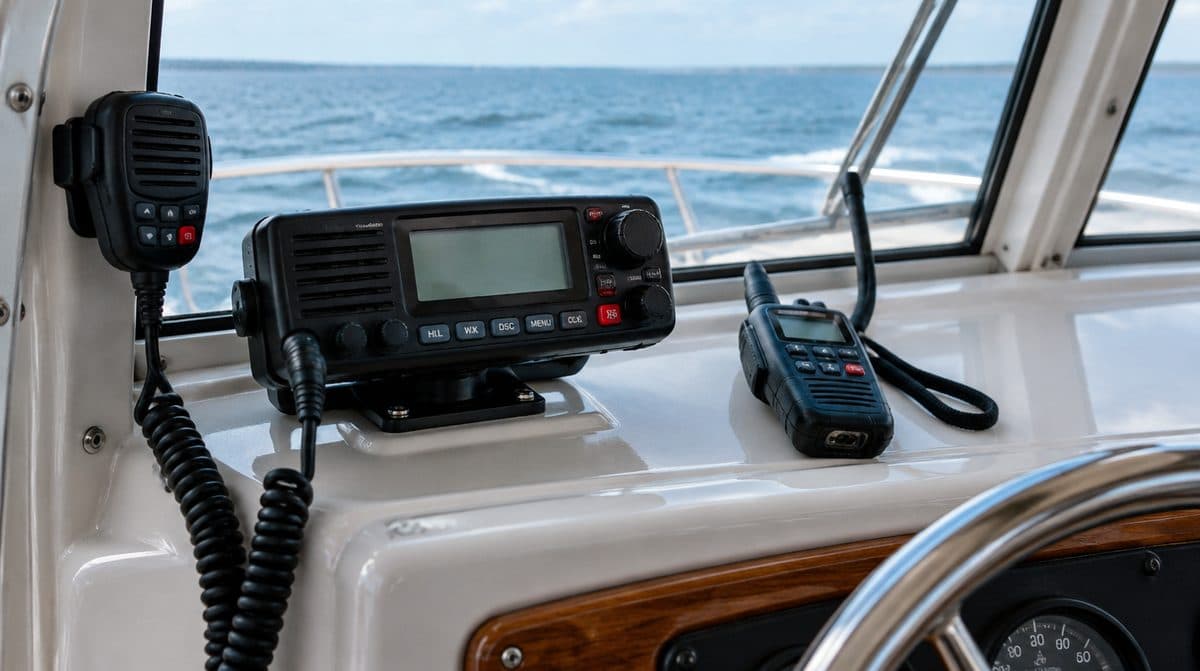
- Fixed-mount radios run off your boat's battery, put out the full 25 watts, and reach much farther because of a taller antenna. This is your primary radio.
- Handheld radios are portable, battery-powered, and limited to about 6 watts. They make an excellent backup and are ideal for small boats, dinghies, and taking in a ditch bag.
The best setup is a fixed-mount primary plus a handheld backup. The fixed-mount does the daily work: monitoring channels, hailing marinas, calling bridges. The handheld is the radio you grab when the electrical system is underwater or you're climbing into the dinghy. A handheld that floats and flashes when it hits the water is worth seeking out, because the moment you need it most is exactly the moment it's likely to go for a swim.
Power and Range
Range is mostly about antenna height, not just watts. A fixed-mount radio with a tall antenna can reach 20 or more nautical miles, while a handheld typically reaches only a few miles. VHF is line of sight: the signal travels straight and the curve of the earth is what stops it. Watts help the signal punch through weather and noise, but no amount of transmit power bends a signal over the horizon. That's why the antenna deserves as much thought as the radio; we cover that choice in our VHF antenna guide. If you boat offshore, a fixed-mount with a good antenna is not optional.
DSC and Your MMSI Number
Modern VHF radios include Digital Selective Calling (DSC). Connected to your GPS and registered with an MMSI number, DSC lets you send a distress call with your exact position at the push of a button. One press of the red button broadcasts who you are and precisely where you are, over and over, even if you never get to speak. It removes the two hardest parts of a mayday: staying calm enough to give a position, and knowing your position at all.
The catch is that DSC only works if you finish the setup. Always connect GPS and register your MMSI. Registration takes a few minutes online, and many radios now have GPS built in, which turns the install into power, ground, and antenna. An unregistered DSC radio cannot do its most important job: the distress call goes out without an identity attached, and responders have far less to work with.
Features Worth Having
- GPS built in or connected, for position in distress calls
- NOAA weather channels with alerts
- Scan and dual or tri-watch to monitor multiple channels
- Floating and waterproof rating (look for IPX7 or better on handhelds)
Beyond those, look at the basics you'll live with: a display you can read in sunlight, a speaker you can hear over the engine, and controls you can work with wet hands. Dual-watch matters more than it sounds like it would. It lets you monitor channel 16 while you keep an ear on your marina's working channel, which is how a radio becomes something you actually use instead of a box you turn on in emergencies.
Installing It Right
A fixed-mount VHF is one of the friendlier electronics installs. Mount the radio somewhere the display is visible from the helm and the mic can reach you at the wheel. Wire it to your distribution panel with the fuse the manufacturer specifies, keep the power run short and clean, and connect the antenna cable without pinching it through a locker lid. If the radio doesn't have internal GPS, wiring the position feed from your chartplotter is a one-time job that makes the whole DSC system real. Then do a radio check, not from the dock to the shop next door, but from out on the water to a station a real distance away.
Learning to Use It Before You Need It
Monitor channel 16 whenever you're underway. Know your boat's name, your position, and the shape of a mayday call: who you are, where you are, what's wrong, how many aboard. Practice the hail-and-switch rhythm with a friend on a working channel so the mechanics are boring by the time they matter. A radio you've never keyed is only slightly more useful than no radio at all.
From the Water
Do your radio check on your local working channel, not 16. Channel 16 needs to stay clear for real emergencies. Ask your marina which channel the local fleet uses for checks and chatter; every harbor has one, and the regulars will be happy you asked instead of keying up on the hailing channel.
Where to Get It Everything in this guide is stocked at Boat Supplies Direct, the Nautical Network marine parts store.
In stock as this guide goes up: - Standard Horizon GX1410GB Eclipse Series 25W fixed-mount VHF with GPS, black - Raymarine Ray53 compact VHF radio with GPS - Uniden Atlantis 275 floating handheld VHF marine radio
Browse the full range: - Fixed-mount - Handheld - Read the full buying guide, including FAQs
More from the Wire
 Buying Guides
October 18, 2026
Starting vs. Deep Cycle: The Battery Mistake That Strands Boaters
Starting, deep cycle, or dual purpose, and flooded, AGM, or lithium. How to pick the battery type that will not leave you stranded.
Read more Buying Guides
October 18, 2026
The Onboard Charger: Cheap Insurance for Expensive Batteries
Batteries die young when they sit half-charged. How to size an onboard charger by amps, banks, and chemistry.
Read more Buying Guides
October 18, 2026
Battery Switches and Isolators: Never Get Stranded by a Dead Battery
The switch and isolator setup that keeps your starting battery ready while the house bank runs your gear.
Read more