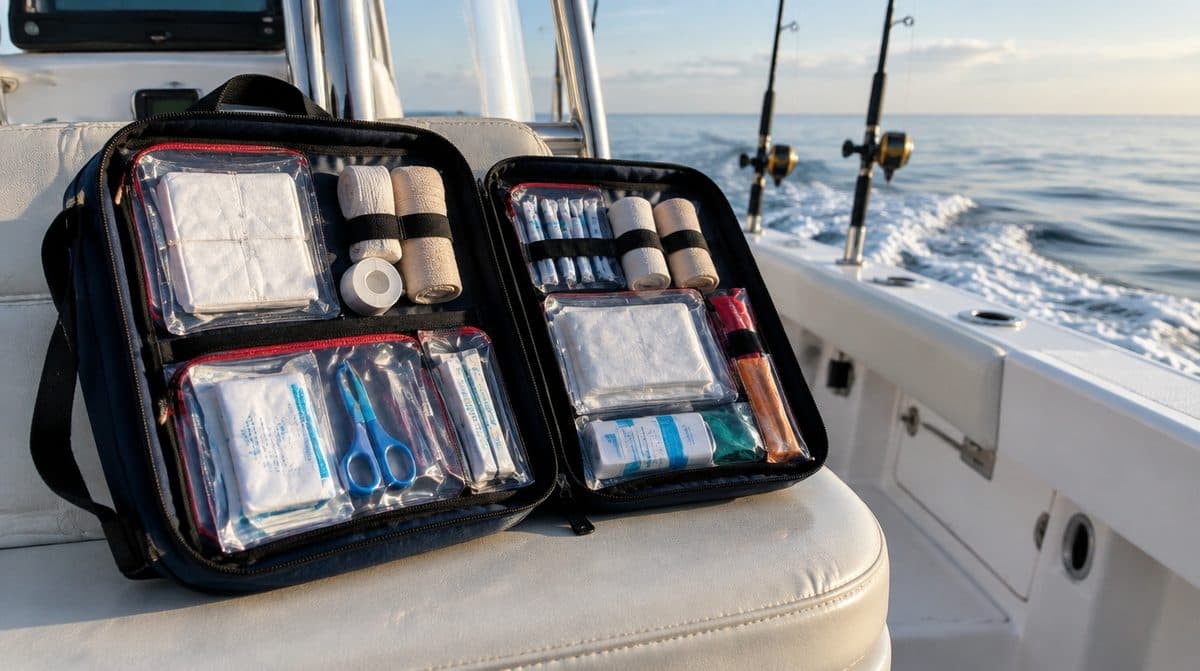
Marine First Aid Kits: Ready When Help Is Hours Away
Offshore, the nearest clinic is measured in hours. How to size a first aid kit to your crew and range, and the one tool fishing boats always forget.
Hooks, knives, sun, and slippery decks mean injuries happen on boats. Most of them are small: a sliced thumb while cutting bait, a barked shin on a cleat, a sunburn that turns the ride home miserable. But when you're far from shore, even the small stuff needs handling, and the big stuff needs handling now, because your kit is your first responder until a real one arrives. A first aid kit is one of the cheapest pieces of safety gear aboard, and one of the most used. Here is how to pick one that actually fits your boating.
Size to Crew and Range
- Day boat near shore: a compact kit.
- Offshore or extended trips: a larger kit with trauma supplies and more quantity.
Match the kit to how many people you carry and how far you go from help. The reasoning is straightforward: distance from shore is really distance from a clinic, measured in time. Ten minutes from the ramp, your kit just needs to stabilize and keep everyone comfortable for the short ride in. Hours offshore, the kit has to carry you through the whole event, possibly for more than one injured person, and that means larger dressings, more of everything, and supplies for bleeding control. Crew count matters the same way. Say you run a six-person boat: a kit sized for two will run out of the basics exactly when you need them most.
The Waterproof Case
The case must keep contents dry. A soaked first aid kit is useless. Bandages that have been wet and dried are no longer sterile, adhesive strips lose their stick, and medication labels turn to mush. Look for a waterproof or water-resistant case with organized compartments, because organization matters more than it sounds: when someone is bleeding, you want to open the kit and see where everything is, not paw through a loose jumble. Soft cases with clear pockets stow easily in tight spots; hard cases take more abuse. Either works, as long as the seal is real. Open your kit after a rough, wet season and check. If anything inside is damp, the case failed and so did the kit.
Marine-Specific Contents
Good kits add seasickness remedies, marine wound care, and items for cuts, burns, hooks, and sun. That list is not marketing; it maps exactly to how people get hurt on boats. Expect, at minimum: a range of bandages and sterile dressings, antiseptic wipes, adhesive tape, scissors, tweezers, burn gel for the grab-the-hot-engine-part moment, sting relief, sunscreen or sunburn care, motion sickness tablets, and gloves. Offshore kits should step up to trauma dressings, a pressure bandage or tourniquet, a splint, and a more serious quantity of everything. A household kit from the pharmacy covers some of this, but marine kits are built around the injuries boats actually produce and packed to survive the environment.
The Hook Problem
Fishhooks deserve their own paragraph because they cause so many of the injuries aboard a fishing boat. A barbed hook buried past the barb is not coming out the way it went in, and yanking it makes things worse. The two field methods boaters actually use are the push-through (advance the point out through the skin, clip the barb, back the shank out) and the string-yank technique, and both go much better with strong pliers, side cutters, and antiseptic on hand. Anything in or near an eye, or deep in a joint or tendon, gets taped in place and taken to a professional. Your job on the water is to control bleeding, prevent worse, and get moving.
Restock and Check Dates
A first aid kit is not a buy-once item. Every time you use something, restock it before the next trip, because the kit quietly becomes theater otherwise: a nice case with nothing useful left inside. Medications, ointments, and even sterile dressings carry expiration dates, and heat accelerates the aging of all of them, so a kit living in a hot console ages faster than the one in your bathroom. Twice a season, dump the kit out, toss the expired and the damp, and rebuild it. It takes ten minutes. While you're at it, check that the scissors haven't rusted shut, because cheap steel in salt air does exactly what you'd expect.
Where to Stow It, and Who Knows
Stow the kit somewhere dry, reachable in seconds, and known to everyone aboard. Not under three bags of gear, not locked in a cabin only you can open. The person giving first aid is often not the captain; the captain is usually driving the boat toward help. Point the kit out during the same thirty-second briefing where you show guests the life jackets and the radio. And consider pairing the gear with a little knowledge: a basic first aid and CPR class is a few hours of your life, and it turns the contents of that case from mysterious to useful.
From the Water
Add strong pliers or a hook remover to the kit. Embedded hooks are one of the most common injuries aboard. Keep them in the kit itself, not just in the tackle box, because the tackle box pliers are always covered in bait exactly when you need a clean tool.
Where to Get It
Everything in this guide is stocked at Boat Supplies Direct, the Nautical Network marine parts store. Orders ship free all year with Dock Pass, the $49 a year shipping pass.
In stock as this guide goes up: - Orion Daytripper First Aid Kit, Soft Case - Orion Blue Water First Aid Kit, Soft Nylon Case - Orion Offshore Sportfisherman First Aid Kit
Browse the full range: - Shop medical kits - Read the full buying guide, including FAQs
More from the Wire
 Buying Guides
October 19, 2026
Your Phone Is Not a Safety Plan: The Case for a Marine VHF Radio
Your phone can't call the boat a mile away, and offshore it can't call anyone. What a VHF does that a cell signal never will, and how to pick one.
Read more Buying Guides
October 19, 2026
Radar for Recreational Boaters: Seeing Through Fog and Dark
Fog doesn't ask if you're ready. How a modern radome sees boats, buoys, and squalls your eyes can't, and what actually matters when you buy one.
Read more Buying Guides
November 5, 2026
Flares and Distress Signals: Making Sure Rescuers Can Find You
Rescuers can be a mile away and still miss you. The day and night signals that close the gap, and the expiration date most boaters forget to check.
Read more