Galvanic Isolators: Stop the Dock From Eating Your Boat
If your anodes vanish at the marina but last on the mooring, the dock is the suspect. What a galvanic isolator actually does, and how to size one without giving up your safety ground.
If your anodes vanish fast at the marina but last at home, the dock is likely the problem. The boat did not change, the water did not change, but the moment you started plugging into shore power at a busy dock, your zincs started disappearing like dockside beer. A galvanic isolator solves it, and understanding why takes about two minutes.
What galvanic corrosion actually is
Put two different metals in seawater and connect them with a wire, and you have built a battery. Current flows, and the less noble metal slowly dissolves to feed it. That is the entire reason your boat wears sacrificial anodes: the zinc (or aluminum, or magnesium) is deliberately the least noble metal in the circuit, so it corrodes first and spares your prop, shaft, outdrive, and thru-hulls. On a boat sitting alone on a mooring, your anodes only have to protect your own metal, and they wear at a slow, predictable rate.
Why the dock changes everything
When you plug into shore power, the safety ground connects your boat to every other boat on the dock. That green grounding wire runs from your boat, up the cord, through the pedestal, and ties into the same grounding system as every other boat plugged in along the dock. Electrically, all the underwater metal on all those boats becomes one big connected contraption sitting in the same body of water.
Now the battery effect goes marina-wide. Galvanic current flows and eats your anodes and metals, and the boats with fresh zincs end up protecting the boats with neglected ones. If your neighbor's anodes are gone, your anodes are now defending his shaft and prop too. Charming for him, expensive for you.
Cutting the ground wire would stop it, and it would also remove the thing that keeps an electrical fault on board from becoming a lethal voltage on your hull. Never do that. The ground stays; you just need to make it smarter.
What an isolator does
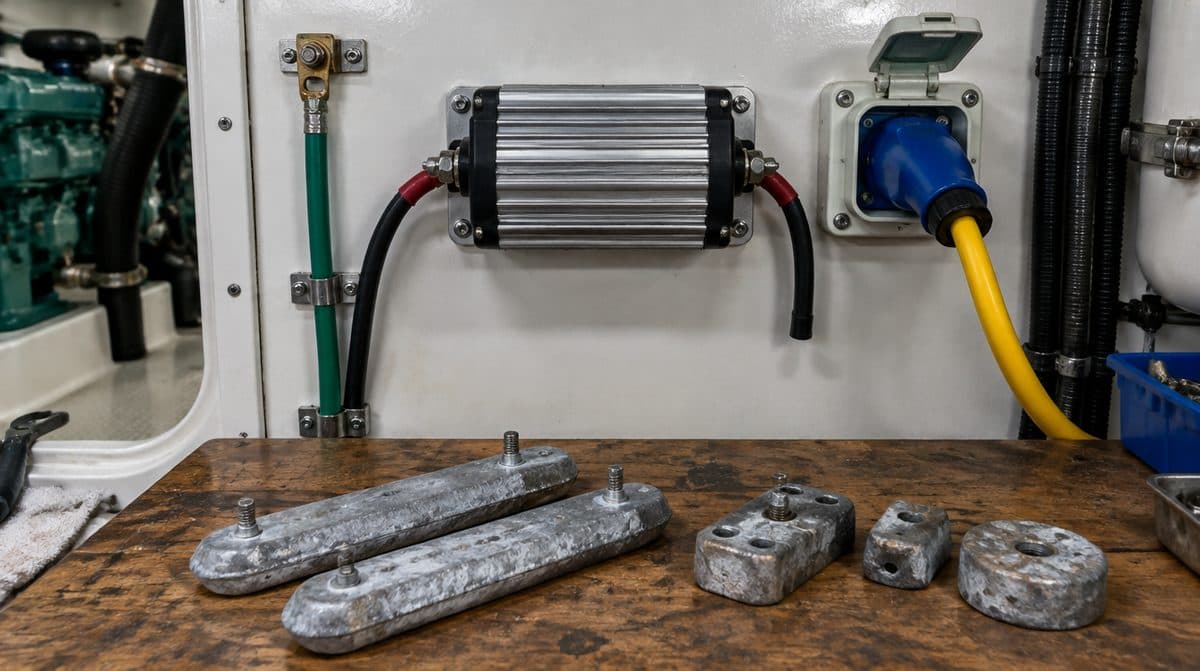
A galvanic isolator goes in series with that green safety ground right where shore power comes aboard. Inside is a set of diodes that block low-voltage DC, which is the kind of current galvanic corrosion runs on, while keeping the safety ground intact for genuine AC faults. The small galvanic voltages pushing current between your underwater metal and the dock's cannot climb over the diodes, so the marina-wide battery is broken. A real electrical fault produces far more voltage, passes straight through, and trips breakers exactly the way the ground wire is supposed to let it.
In other words: the isolator removes the corrosion path without touching the safety path. That is the whole trick, and it is a good one.
Size to your shore power
Match the isolator rating to your shore power amperage (30A or 50A). The isolator sits in the fault path, so it has to be able to carry everything your shore power service can deliver during a fault, for as long as it takes the breaker to open. An undersized isolator is a safety problem, not a bargain. If your boat has more than one shore power inlet, each grounding conductor needs its own properly rated isolator.
Choose a fail-safe model that keeps the ground connected if the isolator fails. This matters more than any other spec on the box. Older or cheaper designs could fail open, which quietly disconnects your safety ground while everything appears normal. A fail-safe unit fails shorted instead, so the worst case is that you go back to losing zincs, not that you lose the ground.
Isolator vs. isolation transformer
An isolation transformer gives the best protection by fully separating your boat from shore ground, at higher cost and weight. Shore power feeds the primary winding, your boat runs off the secondary, and there is no continuous metallic connection between the two at all. No connection, no galvanic path, and a bonus layer of protection against miswired docks. For big boats, steel or aluminum hulls, and boats that live plugged in at rough marinas, it is the gold standard.
For everyone else, a galvanic isolator is the affordable, effective choice for most boats: a fraction of the cost and weight, simple to install, and it addresses the specific problem a dock creates.
Installation realities
The isolator splices into the grounding conductor between the shore power inlet and the rest of the boat's AC system, mounted somewhere dry and accessible. It is conceptually simple, but it is still AC shore power wiring, and a mistake here involves the one wire whose entire job is keeping people alive. If you are not completely confident, this is a short, inexpensive job for a verified marine electrician on Waypoint, and you get your ground system inspected in the bargain.
While you are in there, have the inlet, cord ends, and connections looked over. Corroded shore power connections and galvanic corrosion are different problems that love to show up together.
From the Water
Track how fast your anodes wear after moving to a new slip. Sudden fast wear is a classic sign of stray current. Take a phone photo of each fresh anode on install day and compare monthly; memory always insists they looked fine. A dated photo turns a vague feeling into evidence, and it tells you within weeks whether the new slip, a new neighbor, or a new piece of gear changed your boat's electrical life.
Where to Get It Everything in this guide is stocked at Boat Supplies Direct, the Nautical Network marine parts store.
In stock as this guide goes up: - Shore power inlets, cords, and connection gear in the shore power collection
Browse the full range: - Shop shore power - Read the full buying guide, including FAQs
More from the Wire
 Buying Guides
October 18, 2026
Starting vs. Deep Cycle: The Battery Mistake That Strands Boaters
Starting, deep cycle, or dual purpose, and flooded, AGM, or lithium. How to pick the battery type that will not leave you stranded.
Read more Buying Guides
October 18, 2026
The Onboard Charger: Cheap Insurance for Expensive Batteries
Batteries die young when they sit half-charged. How to size an onboard charger by amps, banks, and chemistry.
Read more Buying Guides
October 18, 2026
Battery Switches and Isolators: Never Get Stranded by a Dead Battery
The switch and isolator setup that keeps your starting battery ready while the house bank runs your gear.
Read more