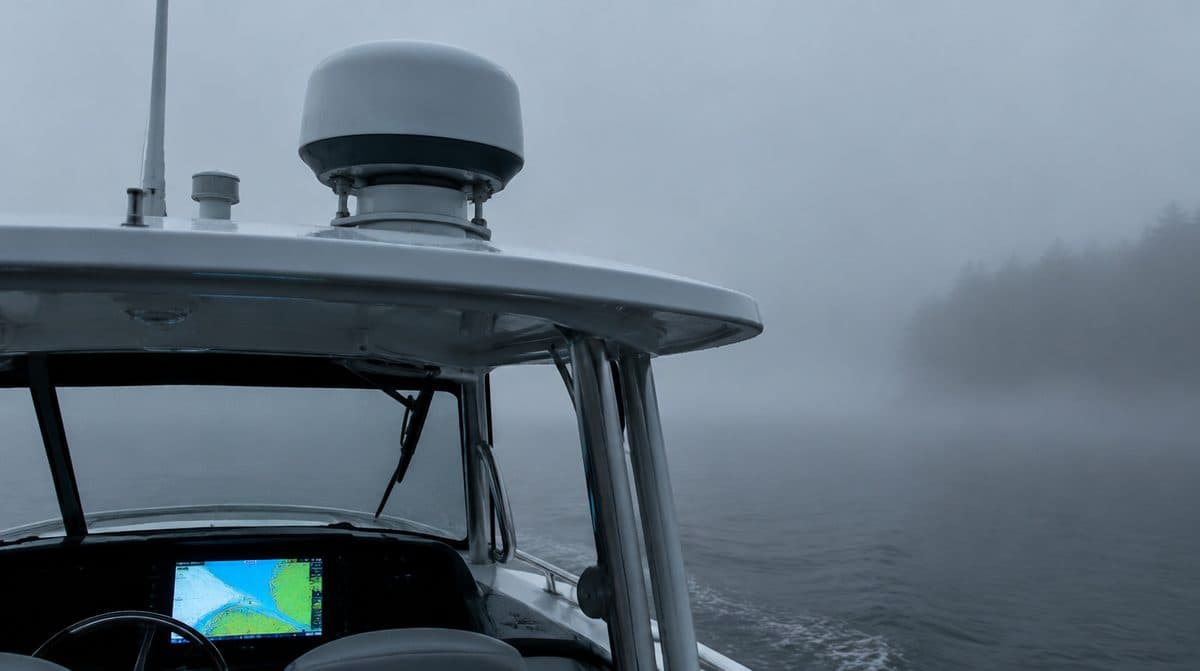
Radar for Recreational Boaters: Seeing Through Fog and Dark
Fog doesn't ask if you're ready. How a modern radome sees boats, buoys, and squalls your eyes can't, and what actually matters when you buy one.
Fog rolls in faster than you'd think, and coming home after dark is part of boating. Radar turns both from stressful to manageable. It's the one electronics purchase that works precisely when your eyes don't, and modern recreational units have gotten small enough, cheap enough, and smart enough that radar is no longer just a big-boat luxury.
How Radar Sees
Radar works like sonar's above-water cousin. A rotating antenna sends out pulses of radio energy, those pulses bounce off boats, buoys, rain, and shoreline, and the unit times the echoes to place each target on screen with you at the center. Unlike your chartplotter, which draws the world as the chart says it should be, radar draws the world as it actually is right now: the ferry that isn't on your chart, the squall line, the unlit mooring buoy at 2 a.m. That's the whole appeal. Charts tell you where the rocks are; radar tells you where the moving things are.
Dome vs. Open Array
- Radome (dome): enclosed, compact, great for most powerboats and sailboats.
- Open array: better range and target separation, for larger vessels.
The radome's closed shell protects the rotating antenna, fits on a mast or hardtop without drama, and won't snag a flag halyard. Open arrays spin a long, exposed antenna, and that length is what buys the sharper beam: better separation between two targets close together and more reach. On a trawler or sportfisher with a big arch, an open array earns its keep. On everything else, the dome is the right call, which is why it dominates the recreational market.
Power and Range
Higher power and modern solid-state radar give better short-range detail and long-range reach. For most recreational boats, a modern solid-state radome is the sweet spot. Older magnetron radars blast a strong pulse and need a warm-up period; solid-state units transmit smarter, wake instantly, draw less from your battery, and pull cleaner detail out of close targets, which is where recreational boaters actually live. Published maximum ranges assume a tall mount and a big target. Your practical working range is set by antenna height, because radar is line of sight just like VHF. A radar can't see a dinghy hiding behind the curve of the earth no matter what the box says.
Features That Matter
- Doppler target tracking that highlights moving targets
- Overlay on your chartplotter
- Good close-in detection for crowded harbors
Doppler is the standout. The radar reads whether each target is closing on you or moving away and colors it accordingly, so a glance separates the anchored fleet from the one boat actually converging with your course. Chart overlay paints radar returns on top of the chart so you stop mentally rotating two pictures into one. And close-in performance, how cleanly the unit resolves targets within the first few hundred yards, matters more on a foggy Saturday in a busy channel than any number on the range spec.
Mounting Realities
Mount the radar as high as practical, with a clear view all around, and above head height: you don't want to stand with your eyes at the level of a transmitting antenna. Higher mounting extends your horizon, but there's a tradeoff, since a very high radar can look over the top of close targets. On most boats the mast, hardtop, or arch settles the question for you. Keep the dome clear of other antennas, level it to your running attitude, and leave room to run the cable without sharp bends.
Networking
Radar needs to talk to your display, so match it to a compatible chartplotter and network. Radar is almost always brand-matched: a given scanner talks to its own maker's displays, so pick the radar and plotter as a system, not as separate purchases. Check that your display has an available network port and that your software is current before the install, not after. If your boat's instruments are getting tangled, our NMEA 2000 networking guide walks through how the backbone fits together.
Learning It Is Part of the Purchase
A radar screen full of blobs is only useful to someone who knows which blob is which. Gain, sea clutter, and rain clutter settings change the picture dramatically, and auto modes are good but not psychic. Run the radar on clear days alongside what your eyes can verify. Watch a buoy come in from a distance, see what a ferry wake looks like, notice how rain paints the screen. Set a guard zone when you anchor and let the radar stand watch.
From the Water
Practice with your radar on clear days so you learn what boats, markers, and shoreline look like on screen. You don't want to learn it in the fog. Make it part of every run for a season, glancing from screen to horizon and back, until the translation is automatic. The first time you bring the boat home through real fog, you'll be running on that practice, not on the manual.
Where to Get It Everything in this guide is stocked at Boat Supplies Direct, the Nautical Network marine parts store.
In stock as this guide goes up: - SI-TEX T-760 compact color radar with 4kW 18 inch dome and 7 inch touchscreen - Furuno 1st Watch wireless radar - Furuno DRS6AX 6kW UHD digital radar
Browse the full range: - Shop radar - Read the full buying guide, including FAQs
More from the Wire
 Buying Guides
October 18, 2026
Starting vs. Deep Cycle: The Battery Mistake That Strands Boaters
Starting, deep cycle, or dual purpose, and flooded, AGM, or lithium. How to pick the battery type that will not leave you stranded.
Read more Buying Guides
October 18, 2026
The Onboard Charger: Cheap Insurance for Expensive Batteries
Batteries die young when they sit half-charged. How to size an onboard charger by amps, banks, and chemistry.
Read more Buying Guides
October 18, 2026
Battery Switches and Isolators: Never Get Stranded by a Dead Battery
The switch and isolator setup that keeps your starting battery ready while the house bank runs your gear.
Read more