Navigation Lights: Be Seen and Stay Legal After Dark
Your nav lights are a sentence other boaters read in the dark. What the rules require for your boat length, and why LED is the easy upgrade.
That sunset cruise can turn into a ticket, or something worse, if your nav lights aren't right. Navigation lights are not decoration: they are how every other boat on the water figures out what you are, which way you are pointed, and who has to give way. They are also easy to neglect, since they only matter after dark and nobody checks them in July sunshine, which is why this topic is worth ten minutes of your attention before the next evening run.
Required lights depend on boat size
Smaller powerboats generally need red/green sidelights and a white all-round (or stern plus masthead) light. Larger boats have more specific requirements. Match your setup to the navigation rules for your boat length.
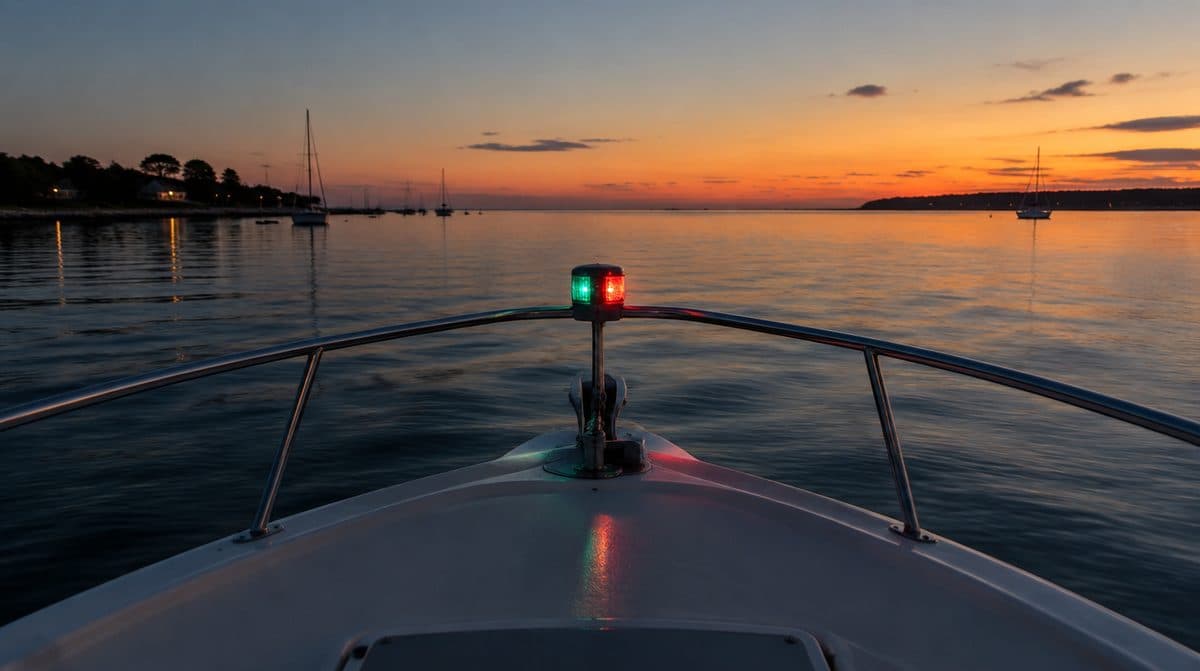
The logic behind the colors is worth knowing, because it makes the rules stick. Red is your port side, green is starboard, and the white stern light fills in behind. Another skipper reading your lights at night can tell your heading from the colors alone: see red and you are looking at someone's port side crossing you; see both red and green and a boat is pointed straight at you. Your lights are a sentence other boaters read, which is why running with half of it burned out is genuinely dangerous. And do not forget the anchor light: a white all-round light is what tells traffic you are stopped, not underway.
Visibility range
Lights are rated by how far they must be seen (in nautical miles), which increases with boat size. Buy lights rated for at least the minimum range for your boat. Range ratings are a legal floor, not a ceiling, and there is no penalty for being easier to see. If you boat where fast traffic runs at night, a brighter certified light buys the other guy more time to notice you.
Look for fixtures that are certified to the navigation rules for their stated range and arc. That certification is the difference between a navigation light and a white light that happens to be on your boat. It is printed on the fixture or the packaging, and it is the first thing to check before anything else on the spec sheet. Remember too that range ratings assume a clean, clear lens; a housing full of spray film or a lens gone chalky is quietly shrinking your legal range every season it stays aboard.
LED vs. incandescent
LED nav lights draw far less power, last longer, and are brighter. For battery-conscious boats, LED is the clear upgrade. An anchor light that burns all night is the classic case: with incandescent it is a meaningful overnight drain on a small battery, with LED it is a rounding error.
One caution: the clean way to upgrade is a certified LED fixture, not a bare LED bulb dropped into an old incandescent housing. The fixture's certification covers the lamp and lens together, and a mismatched bulb can change the arc and intensity that certification promised.
Mounting height and angle
Sidelights and all-round lights have required arcs of visibility. Mount them where nothing blocks the beam and the angles are correct. In practice that means sidelights mounted level, not following the sheer of the hull, and an all-round or anchor light tall enough to clear biminis, antennas, rod holders, and the cooler that always ends up on the transom. Walk the full circle around your boat and look: if you can stand anywhere and lose a light, so can an approaching boat.
Wiring and protection
Nav light problems are usually wiring problems. These circuits live at the wettest ends of the boat, so corrosion finds the bulb sockets, plug-in pole bases, and butt splices first. Use tinned marine wire, seal connections with adhesive-lined heat shrink, and put dielectric grease on sockets and pole-light contacts. Every lighting circuit should be fused to protect the wire; our marine fuse and breaker guide covers sizing that correctly.
Signs it is time to replace
Flickering when you tap the lens, green crust on the contacts, a lens gone cloudy or yellow from UV, or water sloshing inside the housing all mean the light is on its way out. A faded lens is sneaky: the bulb still works, but the light reaching other boats is a fraction of what the rating promised.
Mistakes to avoid
- Running at anchor with no anchor light because "nobody comes through here at night."
- Mounting a stern light where it blinds the helm and ruins your own night vision.
- Letting gear pile up around the all-round light until it only shows in one direction.
- Grabbing a generic trailer or RV bulb as a replacement and calling it done.
- Testing lights only at midday, when a weak or misaimed light looks fine against bright sun.
From the Water
Turn your nav lights on and walk around the boat at dusk before you leave. A dead stern light is easy to miss from the helm. Make it part of the same habit as checking the drain plug, and keep a spare bulb or a small battery-powered backup light in the ditch bag so a dead light is a two-minute fix instead of a ruined night.
Where to Get It
Everything in this guide is stocked at Boat Supplies Direct, the Nautical Network marine parts store.
In stock as this guide goes up: - Navigation lighting and wiring supplies in the electrical collection
Browse the full range: - Shop electrical - Read the full buying guide, including FAQs
More from the Wire
 Buying Guides
October 18, 2026
Starting vs. Deep Cycle: The Battery Mistake That Strands Boaters
Starting, deep cycle, or dual purpose, and flooded, AGM, or lithium. How to pick the battery type that will not leave you stranded.
Read more Buying Guides
October 18, 2026
The Onboard Charger: Cheap Insurance for Expensive Batteries
Batteries die young when they sit half-charged. How to size an onboard charger by amps, banks, and chemistry.
Read more Buying Guides
October 18, 2026
Battery Switches and Isolators: Never Get Stranded by a Dead Battery
The switch and isolator setup that keeps your starting battery ready while the house bank runs your gear.
Read more