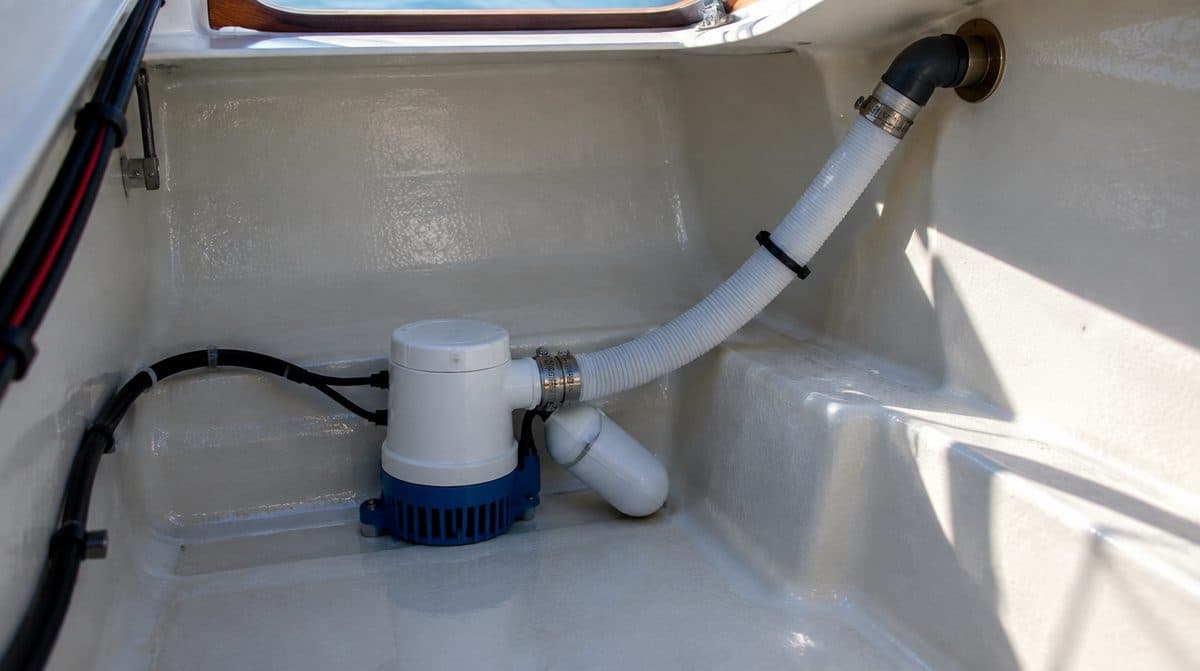
The Bilge Pump Most Boaters Never Think About (Until They Need It)
Your bilge pump's rated GPH is not what it delivers. Capacity by boat length, automatic versus manual, and the wiring that keeps it alive.
Ask any captain who has watched water creep over the floorboards and they'll tell you the same thing: the bilge pump is the quietest piece of gear on your boat until it's the only one that matters. It sits in the darkest, wettest corner of the hull, usually under a hatch nobody opens, and the day it earns its keep is the day everything else has already gone wrong. Here's how to make sure yours is up to the job.
How a Bilge Pump Actually Works
Most bilge pumps on recreational boats are centrifugal: a small 12V motor spins an impeller that slings water outward and up the discharge hose. They are cheap, compact, and move impressive volumes, but they have two honest limitations. They cannot run dry for long without wearing, and they lose output quickly as the water has to climb. That vertical climb, called head or lift, is why the number on the box never matches what comes out of the thru-hull. Diaphragm pumps and manual pumps handle lift better and can run dry, which is why they show up as backups, but the automatic centrifugal pump remains the workhorse.
Start with Pump Capacity (GPH)
Bilge pumps are rated in gallons per hour (GPH). More is not always better, but undersizing is dangerous. A rough guideline by boat length:
- Up to 18 ft: 500 to 1,100 GPH
- 18 to 24 ft: 1,100 to 2,000 GPH
- 24 to 32 ft: 2,000 to 3,500 GPH
- 32 ft and up: 3,500 GPH or more, often with multiple pumps
Remember that real-world output is always lower than the rated number once you account for hose length, fittings, and vertical lift. Plan for the rated GPH to deliver roughly 60 to 70 percent in practice, and size up accordingly. Run the arithmetic on your own boat: say you have a 24 footer and you install a pump rated 2,000 GPH. At 60 to 70 percent delivered, that is roughly 1,200 to 1,400 gallons per hour actually leaving the boat. That sounds like a lot until you picture a failed 3/4 inch hose below the waterline feeding water in the other direction. The rating on the box is a starting point, not a safety margin.
Automatic vs. Manual
- Automatic pumps have a built-in or separate float switch that turns the pump on when water rises. This is what you want for unattended protection at the dock.
- Manual pumps only run when you flip a switch. Many boats use a manual backup in addition to an automatic primary.
The best setup for most boats is an automatic primary pump plus a second, higher-capacity pump mounted slightly higher as an emergency backup. The logic is simple: the low pump handles everyday nuisance water, rain, stuffing box drips, melted cooler ice. The high pump only ever sees water if things are genuinely going sideways, so it stays clean, unworn, and ready. Wire the high pump to its own circuit, and if you can, to an alarm, because a backup pump running is information you want immediately, not after the batteries die.
On the switch side, you have choices. Mechanical float switches are simple and proven, but they can jam on debris. Electronic sensing pumps check for water on a cycle with no moving parts to foul, which is a real advantage in a grimy bilge. Either way, mount the switch where it sits in the lowest pocket of the bilge but out of the slosh zone.
Match the Hose and Fitting Size
Your pump outlet determines your hose diameter (commonly 3/4", 1", or 1-1/8"). Do not neck down to a smaller hose, since it chokes flow and kills your real GPH. Buy the matching hose, a thru-hull fitting, and stainless clamps at the same time.
Routing matters too. Keep the run as short and straight as you can, avoid droops where water sits and freezes, and put a gentle high loop near the discharge so following seas cannot siphon back into the hull. Smooth-bore hose flows noticeably better than cheap corrugated hose; this is not the place to save five dollars.
Voltage and Wiring
Most recreational boats run 12V pumps. Confirm your system voltage, use marine-grade tinned wire, and protect the circuit with the correct inline fuse. A pump that fails because of corroded wiring is as useless as no pump at all.
Every connection in the bilge will eventually sit in water, so treat the wiring as part of the pump. Use heat-shrink crimp connectors, keep splices as high above the bilge water as the wire run allows, and wire the automatic side directly to the battery through its own fuse so the pump works with the battery switch off. If your crimps tend to come out looking like modern art, our marine wire and terminal guide walks through doing it properly.
Maintenance and When to Replace
A bilge pump asks for very little: keep the bilge clean so debris cannot reach the intake, lift the strainer base and clear it a few times a season, and test both the float switch and the manual switch regularly. Pumps do wear out, usually quietly. Replace a pump that hums without moving water, trips its fuse, cycles without shutting off, or shows a cracked housing. A pump is cheap enough that suspicion alone is a fine reason to swap it, and the old one can live in the spares box.
Common Mistakes to Avoid
- Buying on GPH alone and ignoring hose/lift losses
- Running a single pump with no backup
- Using automotive wire instead of marine tinned wire
- Mounting the float switch where normal sloshing triggers it
- Wiring the automatic circuit through the battery switch so dockside protection dies when you flip it off
From the Water
Every time you leave the dock, flip the bilge switch to manual for a second and listen. A pump that hums at the slip is a pump you can count on offshore. It takes two seconds, and it has caught more dead pumps than any inspection schedule ever written.
Where to Get It
Everything in this guide is stocked at Boat Supplies Direct, the Nautical Network marine parts store.
In stock as this guide goes up: - Rule 2000 GPH bilge pump - Rule 500 GPH electronic sensing bilge pump, 12V - Rule-A-Matic Plus float switch
Browse the full range: - Shop bilge pumps - Read the full buying guide, including FAQs
More from the Wire
 Buying Guides
October 18, 2026
Starting vs. Deep Cycle: The Battery Mistake That Strands Boaters
Starting, deep cycle, or dual purpose, and flooded, AGM, or lithium. How to pick the battery type that will not leave you stranded.
Read more Buying Guides
October 18, 2026
The Onboard Charger: Cheap Insurance for Expensive Batteries
Batteries die young when they sit half-charged. How to size an onboard charger by amps, banks, and chemistry.
Read more Buying Guides
October 18, 2026
Battery Switches and Isolators: Never Get Stranded by a Dead Battery
The switch and isolator setup that keeps your starting battery ready while the house bank runs your gear.
Read more