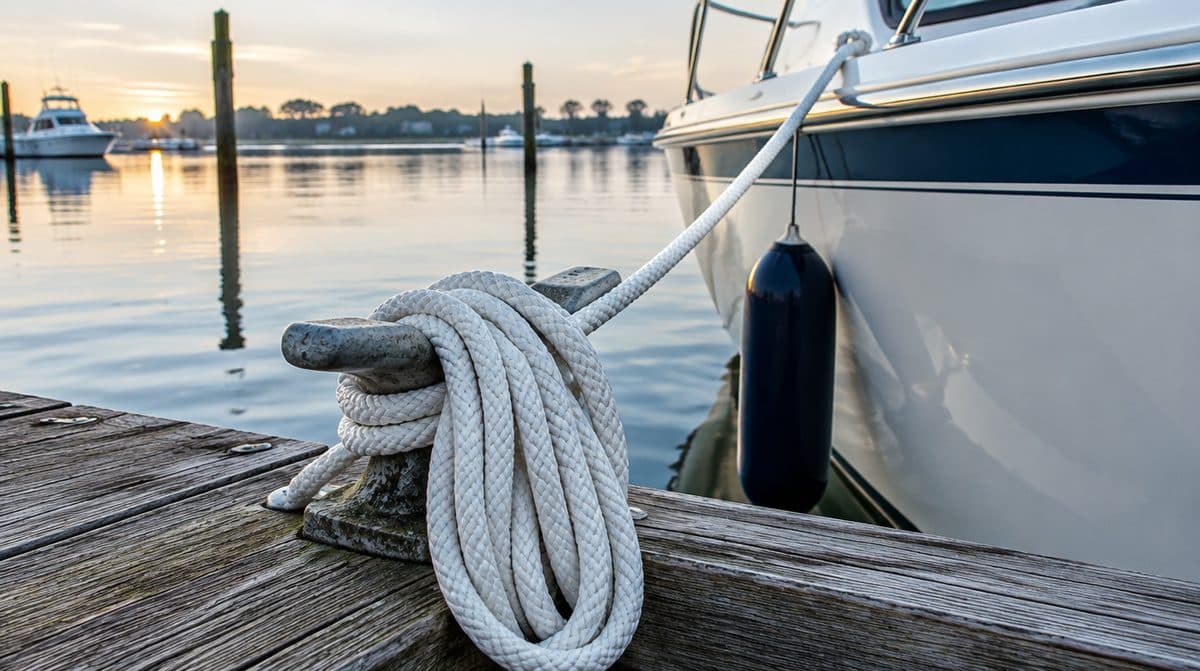
Dock Lines 101: Size, Length, and the Lines Most Boaters Forget
Bow and stern lines are the easy part. Line diameter, length, and the spring lines most boaters never rig, explained by boat size.
Plenty of boaters tie up with a couple of random lines and hope for the best. Then a storm or a big wake shows what good dock lines are really for. The boat that rides quietly through a blow isn't lucky; it's tied with the right diameter line, at the right lengths, in the right places. All three are easy to get right, and most of the fleet gets at least one of them wrong.
Diameter by Boat Length
As a guideline, use 3/8" line up to about 25 ft, 1/2" for 25 to 35 ft, 5/8" for 35 to 45 ft, and larger above that. When in doubt, go up a size.
Diameter is about strength, but it's also about stretch and chafe. A thicker line has more material to sacrifice before chafe becomes failure, and it absorbs shock loads with less strain on cleats and chocks. The one caution on upsizing: the line still has to fit your cleats and chocks with room to work. A line too fat for the hardware chafes faster and is miserable to cleat properly.
Say your boat is 28 feet: 1/2" is the answer, and if it's a heavy 28-footer that lives on an exposed dock, stepping up to 5/8" is a reasonable call, not overkill.
Length
A common setup: dock lines about 2/3 of your boat length for bow and stern, and lines equal to your boat length for spring lines.
Work the example: on a 24-foot boat that's bow and stern lines of about 16 feet and spring lines of about 24 feet. A little extra length never hurts, because a line that's slightly long can be shortened at the cleat in seconds, while a line that's slightly short is useless and always will be. Long lines also give you options at an unfamiliar dock, where the cleats are never where you want them.
Material
Nylon is the standard because it stretches and absorbs shock loads. Avoid stiff, low-stretch lines for docking.
That stretch is the entire point. When a wake rolls through, a nylon line elongates and soaks up the surge gradually instead of snapping the load into your cleats. Low-stretch line transfers that same jolt straight into the hardware, and deck cleats pulled out of fiberglass are a repair you only need to see once.
Within nylon you'll choose between three-strand and double braid. Three-strand stretches more and costs less, and it's the workhorse choice. Double braid is stronger for its size, handles more softly, and looks better on the dock, which matters to some of us more than we admit. Either is right; a stiff bargain-bin polypropylene line is not.
How Many
Carry at least 4 lines (bow, stern, and two springs), plus spares. The spares aren't optional extras. Lines chafe through, get left on docks, go missing at raft-ups, and get donated to neighbors in storms. Six aboard is a comfortable number, and the two in the locker should be as good as the four in use.
Spring Lines, the Ones That Get Skipped
A spring line runs roughly parallel to the dock: one from the bow cleat leading aft, one from the stern cleat leading forward. Bow and stern lines hold the boat near the dock; springs stop it from surging forward and backward along it. That fore-and-aft surge is what grinds hulls against pilings, saws rub rails against dock edges, and snaps undersized lines in a blow. Rig both springs every time you tie up for more than a few minutes, and docking in wind gets calmer too: a single aft spring lets the engine pin the boat gently against the dock while you sort out the rest. Good lines deserve good fenders between hull and dock, and our boat fender guide covers sizing those.
Chafe Is What Actually Kills Lines
Dock lines rarely break in the middle. They fail where they rub: at chocks, cleat edges, dock hardware, and piling rims. Inspect the wear points every time you leave the boat for more than a day, and protect them with chafe guards, or a wrap of old hose or heavy canvas where the line passes through a chock. A few dollars of chafe gear routinely saves an entire line, and sometimes a hull.
When to Retire a Line
Nylon tells you when it's done. Look for fuzzed and flattened sections, stiff or glazed spots where heat from friction has fused fibers, broken strands, and a line that no longer springs back when you flex it. Sun-bleached, board-stiff line has lost much of its strength and all of its stretch. Retire it to lighter duty, like holding the trailer spare or lashing gear, and put fresh nylon between your boat and the weather.
From the Water
Spring lines are what stop your boat from surging forward and back. If you only tie bow and stern, you're missing the lines that do the real work. Watch a marina during a storm and the boats lying quietly are the ones with four lines rigged, while the two-line boats are the ones pacing back and forth, grinding on their fenders.
Where to Get It
Everything in this guide is stocked at Boat Supplies Direct, the Nautical Network marine parts store.
In stock as this guide goes up: - Sea-Dog Double Braided Nylon Dock Line, 1/2" x 25', White for bow and stern duty on boats in the 25 to 35 foot range - Sea-Dog Double Braided Nylon Dock Line, 5/8" x 35', White for spring lines and bigger boats - Attwood Mooring Snubber Kit with 3/8" x 20' Dock Line to take the jolt out of a smaller boat's lines at a busy dock
Browse the full range: - Shop dock lines - Read the full buying guide, including FAQs
More from the Wire
 Buying Guides
October 18, 2026
Starting vs. Deep Cycle: The Battery Mistake That Strands Boaters
Starting, deep cycle, or dual purpose, and flooded, AGM, or lithium. How to pick the battery type that will not leave you stranded.
Read more Buying Guides
October 18, 2026
The Onboard Charger: Cheap Insurance for Expensive Batteries
Batteries die young when they sit half-charged. How to size an onboard charger by amps, banks, and chemistry.
Read more Buying Guides
October 18, 2026
Battery Switches and Isolators: Never Get Stranded by a Dead Battery
The switch and isolator setup that keeps your starting battery ready while the house bank runs your gear.
Read more