Fuses and Breakers: The Boring Parts That Prevent Fires
Fuses and breakers are the boring parts that prevent fires. How circuit protection works, how to size it to the wire, and where to put it.
Most boat fires are electrical, and most of those trace back to circuits that weren't properly protected. That makes fuses and breakers the least glamorous and most important parts on your boat. Nobody shows off a fuse block at the dock. But a correctly protected circuit fails safe: something trips, you lose a pump or a light, and you fix it at your leisure instead of reaching for an extinguisher. This guide covers how circuit protection works, how to size it, and where to put it.
What a fuse or breaker actually does A fuse is a sacrificial weak link: a metal element that melts and opens the circuit when current exceeds its rating. A breaker does the same job with a mechanism that trips instead of melting, so you can reset it. Either way, the job is identical. When a wire chafes through and shorts to ground, or a pump seizes and draws far more current than it should, the protection opens the circuit before the wire overheats, melts its insulation, and ignites whatever it is resting against. No protection, or oversized protection, means the wire itself becomes the fuse. That is how fires start.
Size to the wire, not the device Circuit protection exists to protect the wire from overheating. Size the fuse or breaker to the wire gauge's safe capacity, close to the power source.
This is the rule people get backwards most often. The fuse is not there to babysit your radio; the radio has its own internal protection and its own inline fuse if the manufacturer wanted one. Your fuse is there so the wire feeding the radio can never carry more current than it can safely handle. Work the sizing in this order. First, size the wire to the load and the round-trip length of the run. Then size the fuse at or below that wire's safe capacity, and at or above the normal draw of the device so it does not blow in regular use. If the device's manual specifies a fuse rating, use it, as long as it does not exceed what the wire can handle. When those two numbers disagree, the wire wins, and the real fix is thicker wire. Sizing wire correctly is its own topic, covered in the marine wiring guide.
Fuse vs. breaker - Fuses: cheap, reliable, one-time use, carry spares. - Breakers: resettable, convenient, double as switches, cost more.
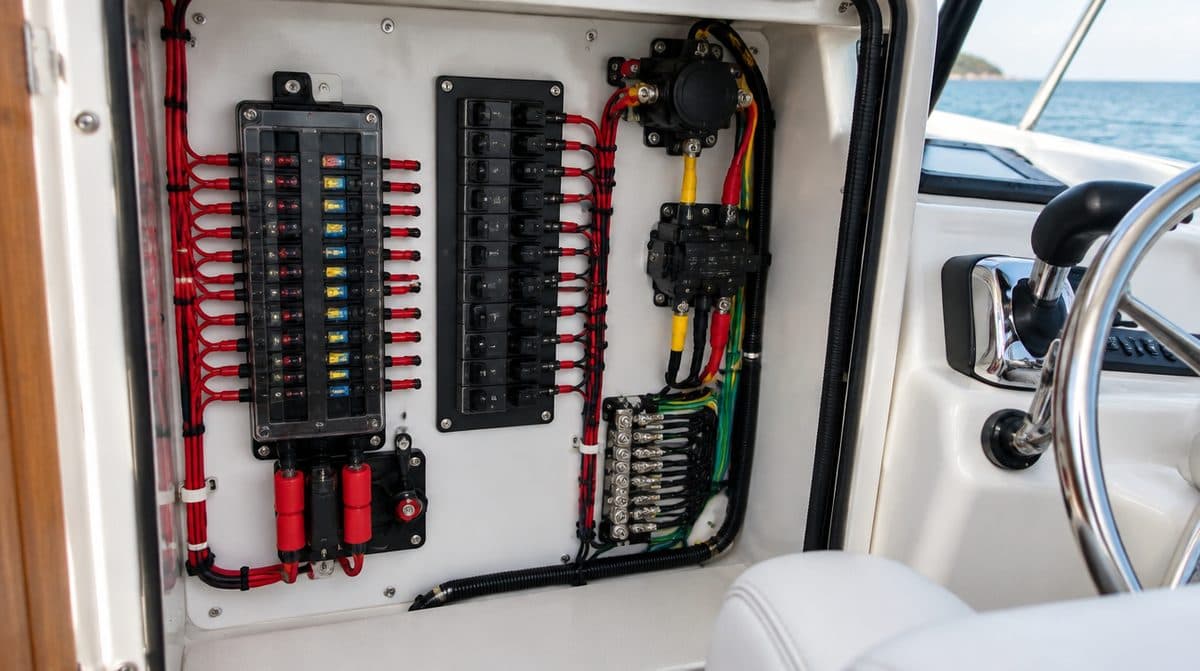
Many boats use a main breaker panel with branch breakers plus inline fuses for individual add-ons.
There is no wrong answer here, only trade-offs. A fuse has no moving parts, nothing to corrode shut, and nothing to wear out, which is why they remain the standard for simple branch circuits. The cost is that a blown fuse is dead forever, so the system only works if spares live aboard. Breakers earn their price on circuits you expect to trip occasionally, on circuits you want to switch on and off, and on high-current feeds where a fuse would be buried somewhere inconvenient. The hybrid approach on most boats is sensible: a breaker panel for the main house circuits, and a fuse block behind the helm or console for electronics and accessories.
Know the common formats Marine fuses come in a handful of standard formats, and it pays to recognize them. Blade fuses are the familiar plastic automotive style used in fuse blocks for accessories and electronics. Larger window and terminal-mount fuses handle high-current feeds like windlasses, inverters, and the main feed from the battery. Glass tube fuses still show up inline on older gear. Whatever the format, two numbers matter: the amp rating, and the fact that the fuse is marine rated. One more rule that is easy to forget: electrical gear installed in a gasoline engine or tank space must be ignition protected, meaning it is designed not to spark fuel vapors. Buy accordingly.
Protect close to the source Place the fuse or breaker as close to the battery or power source as practical, so the whole run is protected.
Think about what an unprotected stretch of wire means. Everything between the battery and the fuse is live and unguarded; a chafe-through in that section shorts directly across the battery with nothing to stop it. Put the protection at the start of the run and the entire length downstream is covered. This is also why every wire that connects directly to a battery deserves its own protection near the battery, not just a fuse buried at the far end next to the device.
Fuse blocks beat the octopus If your console hides a tangle of inline fuses spliced into individual wires, consolidate. A fuse block gives every accessory its own labeled, protected circuit fed from one properly sized supply, and a version with a negative bus tidies the ground side too. Troubleshooting goes from surgery to a glance: open the cover, spot the blown fuse, replace it. Mount the block somewhere dry and reachable, label every position, and keep a circuit list taped inside the console.
Maintenance and signs of trouble Circuit protection is not quite install-and-forget. Once a season, open the fuse block and look for corrosion on the contacts, discolored or melted plastic, and loose connections, and exercise your breakers by flipping them off and on. A fuse that blows repeatedly is not a bad fuse. It is a message: either the circuit has a fault, the device is drawing more than it should, or the original sizing was wrong. Putting in a bigger fuse to stop the nuisance is how wires end up cooking. Find the cause instead.
Mistakes to avoid - Upsizing a fuse because the correct one keeps blowing. - Wrapping a blown fuse in foil or jamming in a bolt to get home. You have just removed the only thing protecting the wire. - Leaving any battery-direct wire unprotected because the run is short. - Automotive fuse holders that corrode in a season. Buy marine-grade, sealed where exposed. - No labels. Future you is the one standing in a rocking boat at dusk trying to guess which fuse feeds the nav lights.
From the Water Keep a labeled bag of spare fuses for every size on your boat. A blown fuse offshore is a two-minute fix if the spare is aboard. Walk the boat once, write down every fuse size and location while you are at it, and tape that list inside the console so anyone aboard can play electrician.
Where to Get It Everything in this guide is stocked at Boat Supplies Direct, the Nautical Network marine parts store.
In stock as this guide goes up: - Blue Sea ST Blade 6-circuit fuse block with negative bus - Blue Sea ST Blade 12-circuit fuse block with negative bus - Blue Sea water-resistant ST-Blade fuse block
Browse the full range: - Shop electrical - Read the full buying guide, including FAQs
More from the Wire
 Buying Guides
October 18, 2026
Starting vs. Deep Cycle: The Battery Mistake That Strands Boaters
Starting, deep cycle, or dual purpose, and flooded, AGM, or lithium. How to pick the battery type that will not leave you stranded.
Read more Buying Guides
October 18, 2026
The Onboard Charger: Cheap Insurance for Expensive Batteries
Batteries die young when they sit half-charged. How to size an onboard charger by amps, banks, and chemistry.
Read more Buying Guides
October 18, 2026
Battery Switches and Isolators: Never Get Stranded by a Dead Battery
The switch and isolator setup that keeps your starting battery ready while the house bank runs your gear.
Read more