Marine Inverters: Home Power on Battery
Home power on battery: sizing an inverter by watts, choosing pure sine, and wiring it safely.
Coffee at anchor, a laptop charging, a blender for the sandbar. An inverter makes all of it possible away from the dock, turning your battery bank's DC into the household AC your gear expects. It is one of the most satisfying upgrades you can make to a boat, right up until it is sized wrong or wired wrong, at which point it becomes a very effective battery-flattening machine. Here is how to get it right.
How an Inverter Actually Works
An inverter takes low-voltage DC from your batteries and converts it to household AC. The catch is in the math, and the math is not optional. Power is volts times amps, so delivering household wattage from a 12 volt bank means pulling enormous current on the battery side. Run a 1,000 watt load on a 12 volt system and the inverter is drawing on the order of 83 amps from your batteries before conversion losses, and more than that in practice since no inverter is perfectly efficient. That one fact explains almost everything else in this guide: why cables are thick, why fusing matters, and why your battery bank is the real limit on what you can run.
Size to Your Loads
Add up the watts of what you want to run at once, then add headroom. Small inverters (300 to 600W) run laptops and chargers. Larger (1,000 to 2,000W+) run coffee makers, microwaves, and tools.
The phrase "at once" is doing the heavy lifting there. You do not size an inverter to everything aboard, just to the biggest combination you will realistically run simultaneously. A laptop plus a phone charger is a tiny load. A coffee maker is a big one all by itself, because anything that makes heat is hungry.
Watch both numbers on the spec sheet: continuous watts and surge watts. Motors and compressors demand a brief spike well above their running draw at startup, and the surge rating is what covers it. An inverter that can run your gear but cannot start it will shut down on overload at the exact moment you wanted that blender. Headroom on both ratings is what separates an inverter you love from one you curse.
Pure Sine vs. Modified Sine
- Pure sine wave: clean power, safe for sensitive electronics and motors. Recommended.
- Modified sine wave: cheaper, but can buzz or damage sensitive gear.
Pure sine power is the same smooth waveform your house delivers, so everything that runs at home runs on it. Modified sine approximates that curve with a stair-step pattern, and plenty of devices quietly hate it. Motors run hotter and buzz, some chargers and anything with a sensitive power supply can misbehave or suffer over time, and audio gear can pick up a hum you will never locate. The price gap between the two has become small enough that for a boat, pure sine is the sensible default. Buy it once and never think about compatibility again.
Battery Bank and Wiring
A big inverter drains batteries fast. Make sure your bank and wiring can supply the current without voltage drop.
Start with the bank. Using the worked example above, a 1,000 watt coffee maker pulling around 83 amps and up will walk through a small battery bank in short order, so match your inverter ambitions to the deep cycle capacity you actually carry. A big inverter on a single undersized battery is a promise the bank cannot keep.
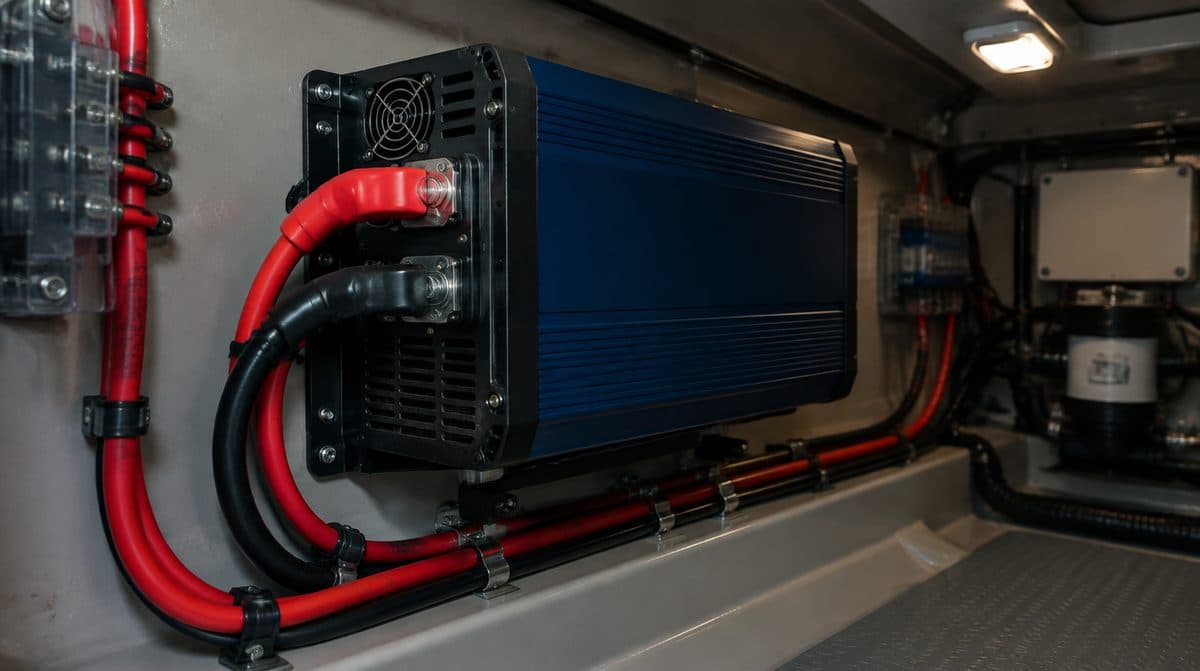
Then the wiring, which is where inverter installs most often go wrong. At these currents, the DC cables between battery and inverter need to be short, fat, and terminated perfectly, because every bit of resistance steals voltage and makes heat. Mount the inverter close to the batteries to keep those runs short. And every inverter needs proper overcurrent protection on the positive cable, close to the battery, sized to the inverter manufacturer's spec. A fuse is what stands between a chafed cable and a fire, and we cover how to choose one in our marine fuse and breaker guide.
Inverter vs. Inverter/Charger
If your boat has shore power, consider an inverter/charger combo. It inverts away from the dock, then becomes your battery charger the moment you plug in, switching between the two automatically. One box, one install, and your batteries get topped off every time you are in the slip. A remote panel is a worthwhile companion for any permanently installed unit: it puts the on/off switch and battery status at the helm or galley, so you are not crawling into a compartment to manage it, and you can actually see what the inverter is doing to your bank.
Installation Realities
Give the inverter a dry, ventilated mounting spot, close to the batteries but never in a compartment where battery gases collect, since standard inverters are not ignition protected. Leave air space around the cooling fins and fan. Follow the manufacturer's grounding instructions to the letter, because AC on a boat deserves respect. The DC side of an inverter install is honest work for a careful DIYer, but if permanently wiring AC outlets runs past your comfort level, that is precisely the job marine electricians exist for.
Mistakes to Avoid
- Sizing to continuous watts and ignoring the startup surge of motors and compressors.
- Running a big inverter through a cigarette lighter plug. Those sockets are for small loads only; anything serious gets cabled to the battery.
- Pairing a large inverter with a small bank and wondering why ten minutes of use kills the batteries.
- Skipping the fuse because the cables are short. The fuse protects the cable, and chafe does not care about length.
- Buying modified sine to save a little, then replacing it after the first device it damages.
From the Water
Turn the inverter off when you aren't using it. Even idling, it quietly pulls from your batteries. That idle draw runs all night while you sleep, so make switching it off part of your shutdown routine, the same as lights and electronics, and your bank will thank you in the morning.
Where to Get It Everything in this guide is stocked at Boat Supplies Direct, the Nautical Network marine parts store.
In stock as this guide goes up: - Xantrex XM1800 Pro Series inverter - Xantrex Freedom remote panel with battery status
Browse the full range: - Shop electrical - Read the full buying guide, including FAQs
More from the Wire
 Buying Guides
October 18, 2026
Starting vs. Deep Cycle: The Battery Mistake That Strands Boaters
Starting, deep cycle, or dual purpose, and flooded, AGM, or lithium. How to pick the battery type that will not leave you stranded.
Read more Buying Guides
October 18, 2026
The Onboard Charger: Cheap Insurance for Expensive Batteries
Batteries die young when they sit half-charged. How to size an onboard charger by amps, banks, and chemistry.
Read more Buying Guides
October 18, 2026
Battery Switches and Isolators: Never Get Stranded by a Dead Battery
The switch and isolator setup that keeps your starting battery ready while the house bank runs your gear.
Read more