Macerator Pumps: What They Do and Why They Burn Out
A macerator has one unglamorous job and one very common way to die. Flow ratings, run-dry protection, and the plumbing details that keep it grinding for years.
Nobody likes thinking about the holding tank, but a failed macerator makes it impossible to ignore. It is one of those systems you never notice until the moment it quits, usually with the tank full and guests aboard. A little understanding up front buys you years of not thinking about it, which is the whole point.
What a macerator actually does
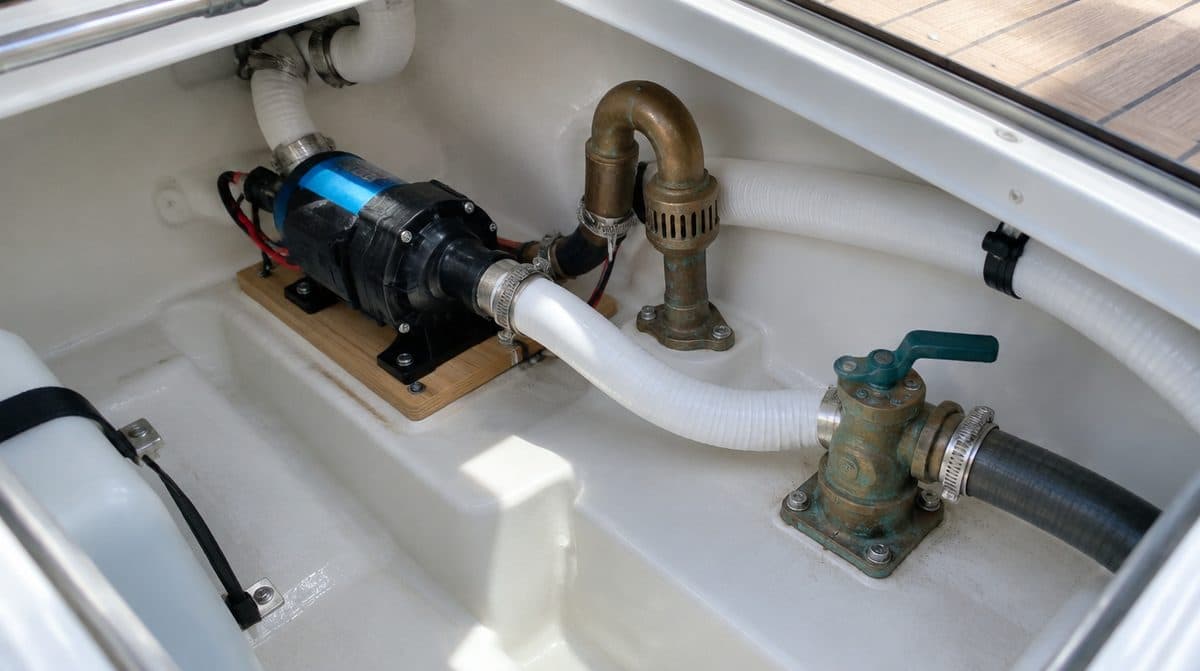
A macerator pump is two machines in one housing. At the inlet, a cutter chops waste and paper into a slurry. Behind it, an impeller moves that slurry out of the holding tank, down the discharge hose, and overboard through the seacock. The grinding step matters because holding tank contents are not uniform; without the cutter, solids would jam the impeller or hang up at the first hose fitting.
That dual job is also why macerators fail in one very specific way. The rubber impeller depends on liquid for lubrication and cooling. Run the pump dry, with nothing left in the tank, and the impeller heats up and shreds itself in short order. Keep that single fact in mind and most of the rest of this guide follows naturally.
Flow and run-dry protection
Pick a pump rated to empty your tank in a few minutes. Look for run-dry protection, because macerators are often run until the tank is empty and a basic motor burns out doing it.
Think about how emptying actually goes: you flip the switch, the pump chews through the tank, and nothing tells you the exact second it runs dry. Everyone overruns a macerator eventually. A sealed pump designed to tolerate dry running forgives the habit; a bare-bones pump punishes it, and it only has to punish you once to cost more than the better pump would have. Self-priming is the other spec worth paying for, because a pump that can pull its own prime keeps working even when the installation is not perfectly below the tank.
Mounting and plumbing
Mount below the tank where possible for gravity-assisted priming, and use the correct discharge hose and seacock. Smooth-bore sanitation hose resists clogs and odor.
Cheap hose is the false economy of the sanitation world. Ordinary hose lets odor permeate through its walls over time, and a rough interior gives waste something to cling to. Keep the run from tank to pump short and straight, with as few elbows as you can manage. And if your discharge fitting sits near or below the waterline, put a vented loop in the line so the sea cannot siphon back toward your tank. It is a small bronze fitting that prevents a very large problem. Finally, mount the pump itself where you can reach it with tools, not just see it with a flashlight.
Wiring it so it lasts
A macerator lives in the dampest corner of the boat and pulls real current while it grinds. Give it marine-grade tinned wire sized for the run, a fuse or breaker matched to the manufacturer's rating, and crimped heat-shrink terminals rather than twisted wires and tape. Corroded connections drop voltage, and a macerator running on low voltage runs slow, hot, and short-lived. We cover the right connectors and crimping technique in our marine wire terminal guide.
Maintenance that actually works
The kindest thing you can do for a macerator is not letting waste sit in it. After a pump-out or a legal discharge, run fresh water through the system: a few bowl flushes of clean water into the tank, then a short burst on the pump to push it through. That rinses salt and waste out of the cutter and impeller before they can dry in place.
Impellers and seals are wear items. If your pump has a serviceable impeller, carry a spare and the gasket that goes with it. Boats that sit for months between uses are harder on macerators than boats used every weekend, because everything inside dries out and sticks.
Signs yours is on the way out
Macerators rarely die without warning. A motor that hums but does not pump usually means a seized or stripped impeller. A discharge that slows from minutes to ages points to a worn cutter or a scaling hose. A pump that keeps blowing its fuse is binding or shorting. Any weeping around the motor end means the shaft seal is failing, and the motor goes next. Catch it at the humming stage and you replace an impeller; catch it later and you replace the pump.
Waste vs. washdown
A macerator is for waste discharge, not general pumping. Match the pump to sanitation duty, not a bilge or washdown job. The reverse holds too: a bilge or washdown pump pressed into sanitation duty will clog, stink, and fail. Pumps are cheap compared to replacing hose runs that have soaked up a mistake. Buy the one designed for the job it will actually do.
From the Water Know where overboard discharge is legal before you ever flip the switch. In no-discharge zones, keep the seacock closed and use a pump-out. Plenty of skippers go a step further and padlock the seacock handle or remove it in protected waters, so there is never an accidental discharge, and never an awkward conversation with an inspector at the dock.
Where to Get It Everything in this guide is stocked at Boat Supplies Direct, the Nautical Network marine parts store. Orders ship free all year with Dock Pass, the $49 a year shipping pass.
In stock as this guide goes up: - Jabsco Sealed Macerator Self-Priming Pump (12V) - Jabsco Y-Valve - GROCO Bronze Vented Loop (1 inch hose)
Browse the full range: - Shop sanitation - Read the full buying guide, including FAQs
More from the Wire
 Buying Guides
October 19, 2026
Fuel Filters and Water Separators: Stop Bad Fuel Before It Stops You
Water in the fuel stops more boats than any storm. Micron ratings, flow capacity, and why a clear bowl with a drain is the best early warning system aboard.
Read more Buying Guides
October 19, 2026
Marine Metal Polish: Keeping Stainless Bright in Salt Air
Stainless really means stains less, especially in salt air. How to match polish to metal, erase tea staining, and keep the rust bloom from coming back.
Read more Buying Guides
October 19, 2026
Trailer Maintenance: Keep Your Boat Off the Side of the Highway
Your boat logs more miles on asphalt than on water, and the trailer only gets noticed when it quits. Bearings, straps, bunks, and lights: how to keep all four from ending your day on the shoulder.
Read more