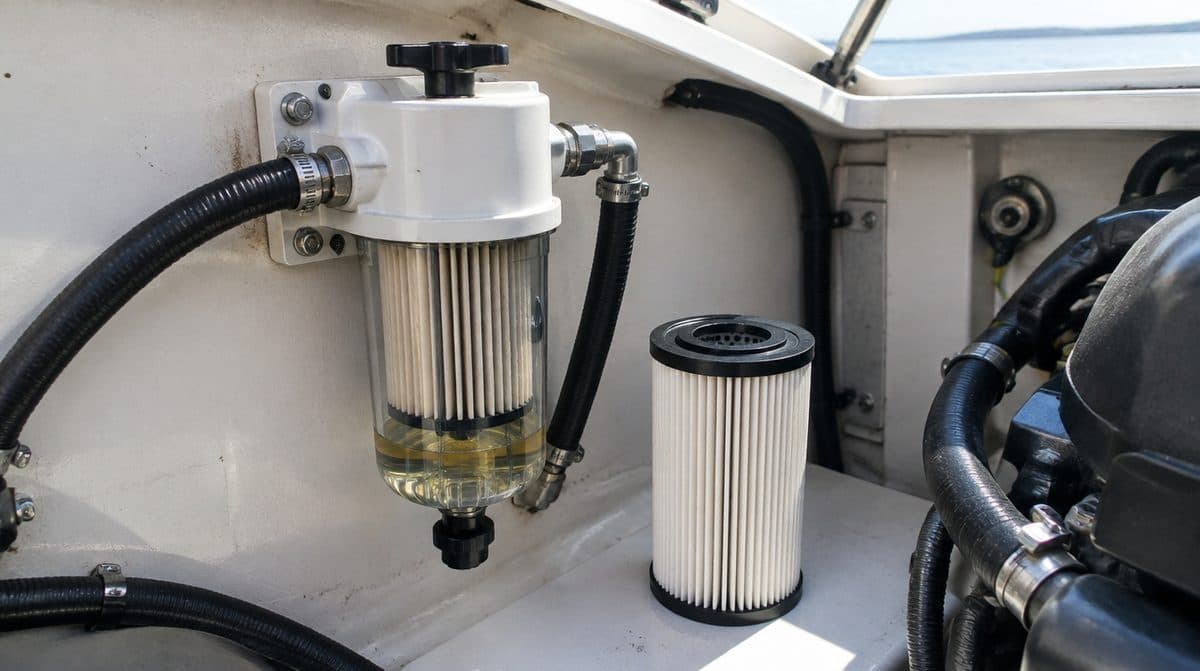
Fuel Filters and Water Separators: Stop Bad Fuel Before It Stops You
Water in the fuel stops more boats than any storm. Micron ratings, flow capacity, and why a clear bowl with a drain is the best early warning system aboard.
Water in the fuel is the most common cause of engine trouble on the water. It sneaks in as condensation inside a half-empty tank, comes aboard with a bad load of dock fuel, and in ethanol gasoline it can pull the fuel itself apart. Your engine will tolerate a surprising range of imperfect fuel, but it cannot burn water. A good filter catches it before your engine does.
How water gets into your tank
A tank breathes. As temperatures swing, moist air moves in and out through the vent, and the moisture condenses on the cool walls above the fuel, then runs down into it. The less fuel in the tank, the more wall area collecting condensation, which is one argument for keeping tanks reasonably full in storage. Ethanol-blended gasoline adds its own failure mode: ethanol absorbs water until it cannot, and then the mix phase separates, dropping a layer of water and ethanol to the bottom of the tank, exactly where the fuel pickup lives. Diesel has a different version of the problem, since water in diesel feeds the microbial growth boaters call the diesel bug, and that slime clogs filters fast. Prevention chemistry helps (we cover stabilizers and treatments in our marine fuel additive guide), but the hardware answer is the same for every fuel: a filter built to separate water before it reaches the engine.
Micron rating
- Primary (water separator): coarser, around 10 to 30 micron, catches water and bigger debris.
- Secondary (on-engine): finer, often 2 to 10 micron, final polish before the injectors.
Match the micron rating to your engine manufacturer's spec. Resist the instinct that finer must be better everywhere. The two stages are a team with different jobs: the primary knocks out water and the big stuff without clogging, and the secondary catches what is left. Put a too-fine element in the primary slot and it plugs early and starves the engine, doing the secondary's job at the worst location.
Flow (GPH) capacity
The filter must flow more than your engine's fuel demand at wide open throttle. Undersizing starves the engine at speed. This one hides well, because an undersized or half-clogged filter feels fine at idle and at cruise, then the engine flattens out or surges when you ask for everything it has. Size the assembly with headroom over your engine's maximum fuel demand, since every hour of service shrinks the element's real capacity. If your boat runs twin engines, each one wants its own properly sized filter.
Clear bowl and drain
A clear bowl lets you spot water and debris, and a drain lets you clear it without removing the filter. Carry spare elements. Water and fuel do not mix, so the bowl works as a window: water sits at the bottom as a distinct layer, and a quick glance tells you more than any gauge. One note for gasoline installations: the engine space of a gasoline-powered boat has fire safety requirements, and some clear bowls need a metal heat shield or a metal bowl to be used there, so check what your installation calls for before you buy.
Installation realities
Mount the primary filter between the tank and the engine, somewhere you can actually reach with a drain cup in one hand and a wrench in the other, because a filter you cannot reach is a filter that never gets checked. Keep it upright with room below the housing to drop the element, use marine fuel-rated hose and proper clamps, and route lines so they cannot chafe. After every element change, be ready to prime the system; diesels especially hate air in the fuel and will make you bleed it out. Write the install date on each new element with a paint marker, and future you will know exactly how old it is.
When to change elements
Follow your engine manufacturer's schedule as the baseline, change elements at least seasonally, and change them immediately after any suspect load of fuel. Between changes, let symptoms talk: hesitation or fading at high throttle that improves when you back off is the classic clogged-element complaint. And if water keeps reappearing in the bowl trip after trip, stop blaming the filter. The filter is the messenger; the source is the tank, the fill cap O-ring, or the vent, and that is where to look.
Mistakes to avoid
- Carrying no spare elements, or carrying them without the wrench that fits the housing.
- Draining the bowl into the bilge. Drain into a container and dispose of it ashore.
- Treating repeat water as a filter problem instead of finding the leak or condensation source feeding it.
- Ignoring the secondary filter because the primary looks clean. The engine maker specified both stages for a reason.
- Buying by thread size alone and ignoring flow rating, then wondering why the boat will not reach full throttle.
From the Water
Drain a little from the separator bowl into a clear cup every few trips. Water or debris settled at the bottom is your early warning. Fuel floats on water, so a distinct layer at the bottom of the cup is impossible to miss, even in a rocking cockpit. Finding it at the dock costs you a minute; finding it a mile off the inlet costs you the whole afternoon.
Where to Get It
Everything in this guide is stocked at Boat Supplies Direct, the Nautical Network marine parts store.
In stock as this guide goes up: - Browse filters, elements, and fuel system spares in the Engine Parts and Service collection
Browse the full range: - Shop engine parts - Read the full buying guide, including FAQs
More from the Wire
 Buying Guides
October 18, 2026
Starting vs. Deep Cycle: The Battery Mistake That Strands Boaters
Starting, deep cycle, or dual purpose, and flooded, AGM, or lithium. How to pick the battery type that will not leave you stranded.
Read more Buying Guides
October 18, 2026
The Onboard Charger: Cheap Insurance for Expensive Batteries
Batteries die young when they sit half-charged. How to size an onboard charger by amps, banks, and chemistry.
Read more Buying Guides
October 18, 2026
Battery Switches and Isolators: Never Get Stranded by a Dead Battery
The switch and isolator setup that keeps your starting battery ready while the house bank runs your gear.
Read more