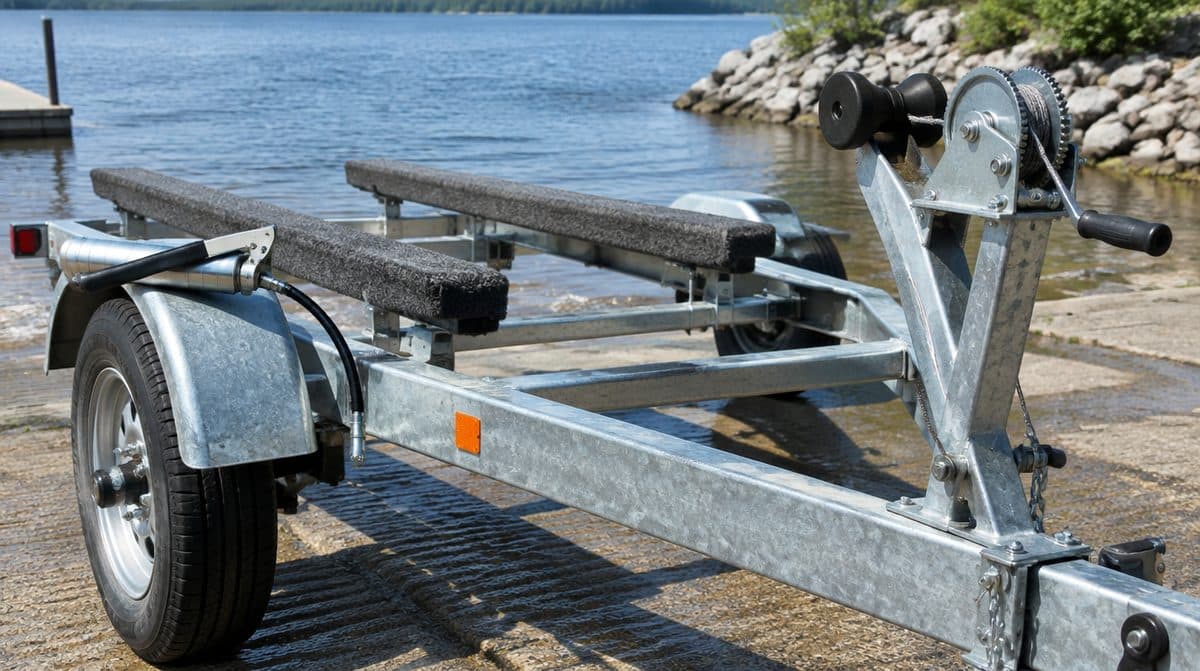
Trailer Maintenance: Keep Your Boat Off the Side of the Highway
Your boat logs more miles on asphalt than on water, and the trailer only gets noticed when it quits. Bearings, straps, bunks, and lights: how to keep all four from ending your day on the shoulder.
Most boats spend more miles on the trailer than on the water. Every trip starts and ends with a tow, and the trailer is usually the one piece of the whole operation that gets zero attention until something lets go at highway speed. When the trailer fails, the day is over before it starts, and you get to watch other people's fish pictures roll in while you wait on the shoulder for a flatbed.
The good news is that trailers are simple machines: bearings, a winch, some straps, bunks, and lights. Every one of those parts telegraphs trouble before it fails, if you know what to look for and actually look.
Bearings and hubs
Wheel bearings are the number one trailer failure, and the reason is baked into how we use them. You run the hubs down the highway until they are hot, then back them into cold water at the ramp. The air inside the hub contracts as it cools, and that vacuum pulls water straight past the seals. Water plus grease plus steel rollers equals rust, and rust inside a bearing is a countdown timer.
Match bearing size to your hub, keep them greased, and consider bearing protectors, which hold light spring pressure on the grease so water has a harder time sneaking in. Repack bearings on a schedule rather than waiting for noise, because by the time a bearing howls it has already chewed itself up inside. And carry a spare bearing kit on long tows. A bearing kit rides happily in a coffee can with a tub of grease. A seized hub a long way from home does not ride happily anywhere.
If you want the deep dive on hubs, seals, and repacking, we cover all of it in our trailer bearing and hub guide.
Winches and straps
Size your winch to your boat weight, with the strap and gear rated above your loaded boat. Loaded is the key word. The bare hull number on the spec sheet ignores the engine, fuel, water, batteries, and every piece of gear you have crammed into the lockers over the years. Say the brochure calls your boat 3,000 pounds: by the time you add an outboard, a full tank, and a season's worth of stuff, the real weight climbing the bunks is meaningfully higher, and your winch needs to be rated for that number, not the optimistic one.
Replace frayed winch straps before they snap. A strap under load stores a frightening amount of energy, and the fuzzy edge you keep meaning to deal with is exactly where it will let go, usually while your hand is near the winch handle. Straps are cheap insurance. Cranking a boat up the bunks on a strap that looks like a cat toy is not thrift, it is a dare.
While you are at it, keep the winch itself out of the weather when the trailer sits for long stretches. Sun and spray kill straps and gears faster than use does, and a simple cover buys the whole assembly extra seasons.
Tie-downs
Transom tie-downs secure the stern, and the bow is held by the winch strap plus a safety chain. Never trail on the winch strap alone. The winch exists to pull the boat up to the bow stop during loading; it was never meant to be the only thing keeping the bow on the trailer through a panic stop. The safety chain backs it up, and the transom straps keep the stern from bouncing on the bunks and slowly walking sideways over rough pavement.
Check everything again at your first stop. Straps stretch, hulls settle onto the bunks, and a strap that was drum-tight at the ramp can be slapping in the wind an hour later.
Bunks and rollers
Bunks and rollers support the hull and must match your boat. Bunks spread the load across long carpeted boards, which makes them forgiving and quiet. Rollers make launching and loading easier, especially on shallow ramps, but they concentrate the load on small patches of hull, so they have to be adjusted correctly and kept in good condition.
Read your hull after the boat comes out. Shiny rub marks, a hooked spot in the gelcoat, or a boat that never seems to sit centered are all signs the supports are set up wrong. Replace torn bunk carpet before the exposed wood or bracket underneath starts grinding into gelcoat, and check that the bunk brackets themselves are solid. A bent or collapsed bracket turns a nice wide support into a point load in exactly the wrong place.
Guide-on posts are the cheapest quality-of-life upgrade on this whole list. They show you where the trailer actually is once it is underwater, and in wind or current they funnel the boat onto the bunks instead of onto the fender.
Lights and wiring
Trailer lights and wiring fail from corrosion and submersion, which is rough, because the job description of a boat trailer includes getting dunked on a regular basis. Old-style incandescent bulbs pop when cold water hits a hot filament. LED sealed lights last far longer: no filament to shock, no bulb socket to corrode, no housing that has to be opened up every season.
Beyond the lights themselves, put dielectric grease in every connector, support the harness so it cannot drag or chafe along the frame, and chase any flicker the day you notice it. Trailer wiring faults never heal on their own, and a dead brake light is the kind of problem that finds you at the worst time.
The five-minute walkaround
Before every tow, walk the trailer: tire pressure and sidewalls, lug nuts, coupler latched and pinned, safety chains crossed under the tongue, winch strap tight, safety chain clipped to the bow eye, transom straps snug, lights all working. It takes five minutes in the driveway. The same checklist takes all afternoon when the highway does it for you.
From the Water
At every fuel stop on a long tow, hold your hand near each hub. One that's much hotter than the others is a bearing about to fail. You do not even need to touch it: hover a palm an inch away and compare side to side. Catch it at the gas station and you are changing a bearing in a parking lot. Miss it and you are shopping for a hub, a spindle, and possibly an axle, delivered to wherever the trailer decided to stop.
Where to Get It Everything in this guide is stocked at Boat Supplies Direct, the Nautical Network marine parts store.
In stock as this guide goes up: - C.E. Smith 60 Inch Post Guide-On with Unlighted Posts - C.E. Smith Vertical Lanced Bunk Bracket, 9-1/2 Inch - Powerwinch Winch Cover Kit for RC23, RC30, 712, 912, and 915
Browse the full range: - Shop trailering - Read the full buying guide, including FAQs
More from the Wire
 Buying Guides
October 18, 2026
Starting vs. Deep Cycle: The Battery Mistake That Strands Boaters
Starting, deep cycle, or dual purpose, and flooded, AGM, or lithium. How to pick the battery type that will not leave you stranded.
Read more Buying Guides
October 18, 2026
The Onboard Charger: Cheap Insurance for Expensive Batteries
Batteries die young when they sit half-charged. How to size an onboard charger by amps, banks, and chemistry.
Read more Buying Guides
October 18, 2026
Battery Switches and Isolators: Never Get Stranded by a Dead Battery
The switch and isolator setup that keeps your starting battery ready while the house bank runs your gear.
Read more