Keep Your Bait Kicking: The Livewell Pump Guide
Lively bait catches fish, and the pump decides whether it stays lively. GPH sizing with the math shown, fill versus recirculate, and the wiring details that keep a well full of bait alive all day.
Lively bait catches fish. Dead bait catches seagulls. The difference is usually a pump that's moving enough fresh, oxygenated water, and the good news is that livewell plumbing is one of the simplest systems on the boat once you understand what each piece does.
Here's how to size a pump, choose between fill and recirculation, and keep a well full of bait frisky from the first cast to the last.
Sizing by Livewell Volume
Match flow (GPH) to your livewell size and how fast you want turnover: - Up to 20 gallon well: 500 GPH - 20 to 40 gallon well: 800 to 1,100 GPH - 40 gallon and up: 1,100 GPH or more, or dual pumps
Aim to turn over the full well volume every few minutes for healthy bait.
Here's the arithmetic behind that, because it makes the ratings click. Say your well holds 30 gallons and you're looking at an 800 GPH pump. Divide 800 gallons per hour by 60 and you get a bit over 13 gallons a minute, which means that pump cycles your entire 30 gallon well in a little over two minutes. That's healthy turnover. Run the same math on your own well before you buy, and remember that rated flow is measured in ideal conditions: every foot of lift and every elbow in the plumbing shaves some off. When in doubt, round up.
Fill vs. Recirculation and Aeration
Some pumps fill the well, others recirculate and aerate. Many boats run a fill pump plus a recirculation/aeration pump so you can keep bait alive at rest without pumping in warm surface water.
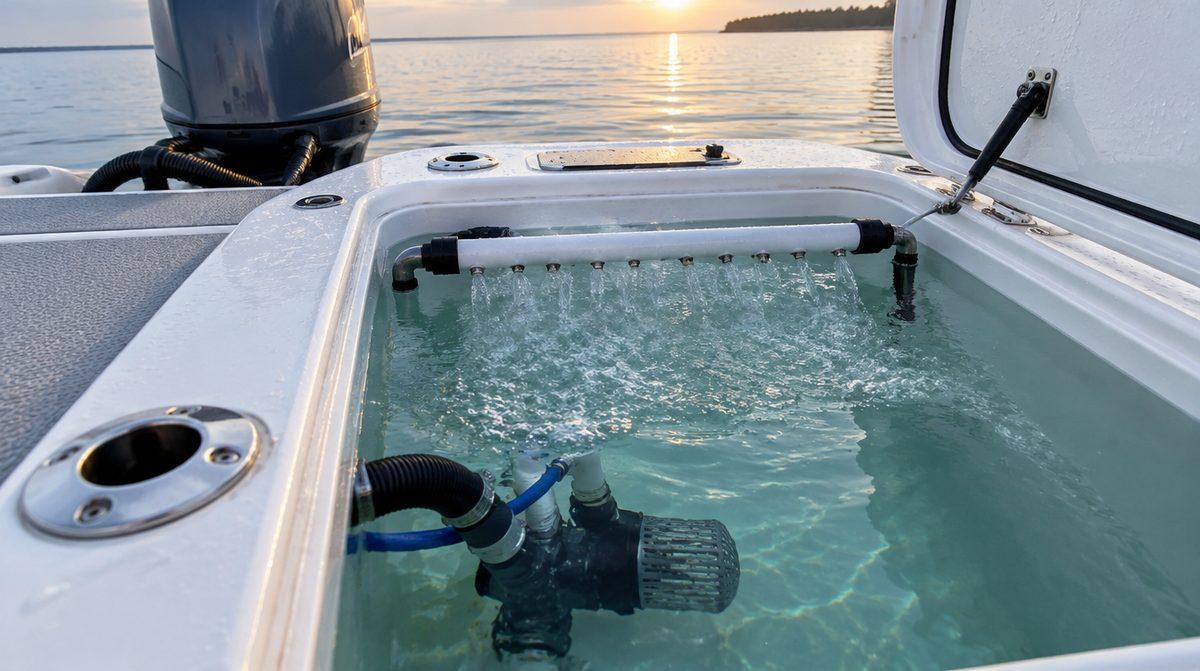
The fill pump pulls raw water from outside the hull, usually through a seacock or transom fitting, and tops off or exchanges the well. The recirculation pump takes water already in the well and sprays it back in through an aerator head, dragging oxygen into the water on the way. That two pump setup gives you options: exchange water when the outside water is good, and close the loop when it isn't, whether that's a hot afternoon, a red tide patch, or a long idle in a crowded channel.
Flow Matters More Than You Think
Too little flow and bait suffocates. Too much and you beat delicate baits to death. Spray-bar and adjustable-flow setups let you dial it in by bait type.
Hardy baits can handle a rolling boil of a well. Delicate baits want gentle, steady circulation that keeps oxygen up without tumbling them into the walls. Watch the well: bait swimming calmly in a slow circle is happy, bait gasping at the surface needs more flow or fresher water, and bait pinned against the standpipe is getting blasted. Adjust until the well looks calm but alive.
Installation and Wiring Realities
Most livewell pumps are centrifugal cartridge pumps, which has two practical consequences. First, they are not self-priming, so they have to mount below the waterline or they'll spin air and move nothing. Second, the motor cartridge pops out of the housing, so when a pump dies after a few seasons you can often swap the cartridge in minutes and leave the plumbing untouched.
On the wiring side, treat the pump like the always-wet, always-running appliance it is. Fuse it to the maker's spec, use marine grade tinned wire, and seal every connection with heat shrink terminals, because a corroded splice above a livewell has ruined more fishing days than any pump failure; our marine wire and terminal guide covers how to do it right. Mind your voltage too: most pumps are 12V, but tournament boats running 24V systems need a pump wound for 24 volts, not a 12V pump living a short, angry life.
Maintenance That Keeps the Flow Up
Livewell pumps mostly die of neglect, not work. Run fresh water through the system after every salt trip, because dried salt crystals chew up impellers and seize shafts over a winter. Pull the intake strainer now and then and clear the scales, weed, and the occasional very surprised shrimp. If the boat sits for months, spin the pump briefly on the hose before the first trip of the season rather than discovering a stuck rotor at the bait shop. Five minutes of rinsing after each trip is the whole program, and it roughly doubles how long a pump lasts.
Signs Your Pump Is Dying
Livewell pumps rarely quit without warning. Weaker spray at the aerator head, a pump that hums but doesn't move water, one that needs a tap to start, or a new grinding note all mean the impeller or cartridge is on its way out. Debris is the other killer: a stray minnow or weed in the intake will choke flow fast, so check the strainer before you condemn the pump. Carry a spare cartridge in the spares kit. It's cheap, it's tiny, and swapping one at the dock beats watching four dozen baits go belly up at first light.
From the Water
On hot days, switch from fill to recirculate once the well is full. Pumping in 88-degree surface water all afternoon cooks your bait. A frozen water bottle floated in the well knocks the temperature down gently, and the closed loop keeps the oxygen moving while the outside water stays where it belongs.
Where to Get It
Everything in this guide is stocked at Boat Supplies Direct, the Nautical Network marine parts store. Orders ship free all year with Dock Pass, the $49 a year shipping pass.
In stock as this guide goes up: - Rule 800 GPH Livewell Pump, Straight Seacock Inlet - Rule 1100 GPH Livewell Pump, Straight Seacock Inlet - Johnson Pump Twin Port 1000 GPH Livewell Aerating Pump, 12V
Browse the full range: - Shop livewell pumps - Read the full buying guide, including FAQs
More from the Wire
 Buying Guides
October 19, 2026
The Bilge Pump Most Boaters Never Think About (Until They Need It)
Your bilge pump's rated GPH is not what it delivers. Capacity by boat length, automatic versus manual, and the wiring that keeps it alive.
Read more Buying Guides
October 19, 2026
Underwater Lights: The Glow That Draws Fish and Turns Heads
The glow at the transom is not just for looks. How lumens, color, and mounting style decide whether your underwater lights draw a crowd of bait or just drain a battery.
Read more Buying Guides
October 19, 2026
Anchor Rode and Chain: The Half of Your Anchor System Nobody Talks About
The anchor gets the credit, but the rode does the work. Chain length, scope math, and nylon stretch: the unglamorous half of the system that decides whether you stay put.
Read more