Trailer Bunks and Rollers: Supporting Your Hull the Right Way
Your boat spends far more time on its trailer than in the water. How to choose between bunks and rollers, and how to support a hull without slowly wrecking it.
Your hull rests on the trailer far more than it rides on the water. Add up an honest year of boating and most trailered boats spend the overwhelming majority of their lives sitting on a few boards in a driveway, with the occasional slide up and down a launch ramp. How all that weight is supported matters twice: it decides how easily the boat loads and launches, and it decides how kindly the hull is treated for the thousands of hours in between. Bunks and rollers are about as unglamorous as marine gear gets, but get them wrong and you will feel it every single trip to the ramp.
Bunks vs. Rollers: What Each One Actually Does
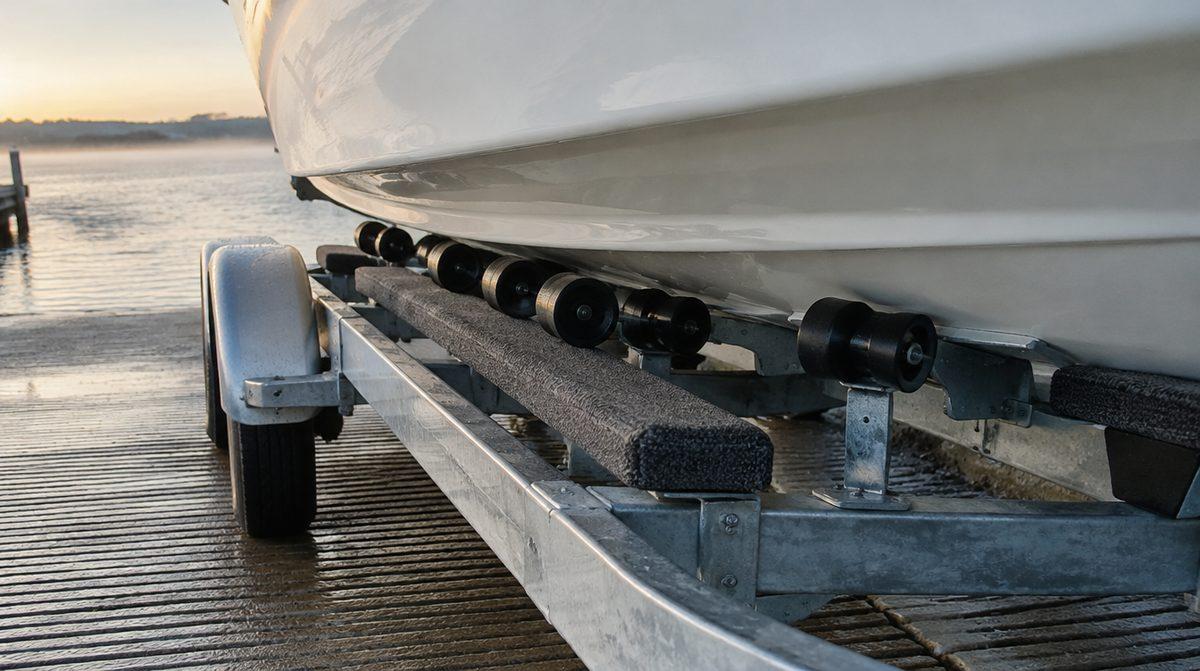
Bunks are long boards, usually dimensional lumber wrapped in marine carpet or fitted with slick plastic glides, mounted to brackets on the trailer frame. They cradle the hull along a wide strip of contact, which spreads the load beautifully. Because the hull sits down into them with real friction, bunks work best at deeper ramps where the boat floats mostly free before you winch it the last bit, and floats off again on launch day with barely a nudge.
Rollers are rubber or polyurethane wheels mounted on shafts and brackets, arranged so the hull can literally roll on and off the trailer. Each roller carries its load on a small patch of contact, but there are usually a lot of them, and the near-zero friction is the whole point. A roller trailer lets you load in shallower water, on steeper ramps, and with less horsing around, which is why heavier boats and solo boaters tend to love them.
How the Load Actually Travels
A fiberglass or aluminum hull is designed to be supported evenly, the way water supports it. On a trailer, that support gets concentrated into whatever is touching the hull, so placement matters. Bunks should run fore and aft under solid structure, ideally in line with the stringers, not under unsupported panels of the bottom. Keel rollers, where fitted, carry a share of the weight along the strongest line of the boat, with side bunks or rollers keeping it balanced and centered. Support a hull in the wrong places for long enough and you can get a hook or depression in the running surface, which shows up later as odd handling and gelcoat stress cracks nobody can explain.
Match the Setup to Your Ramp
This is the decision most people skip, and it is the one that matters most. If your home ramp is deep and gently sloped, bunks are simple, cheap, and secure, because the water does the lifting. If your ramp is shallow, steep, or tidal, rollers earn their keep, because the boat can roll on before it is anywhere near floating. A heavy boat loaded without much water under it is the classic roller use case. Plenty of trailers split the difference with keel rollers down the center and bunks outboard, giving you easy rolling at the keel and settled, stable support everywhere else.
A Word on Materials
Carpet is the traditional bunk covering, and good marine bunk carpet is tough, padded, and kind to gelcoat when it is clean. Slick plastic glides are the modern alternative: the boat slides on and off with far less effort, and the hard surface does not hold grit the way carpet fibers can. That grit point is bigger than it sounds, because sand embedded in carpet acts like sandpaper under the full weight of the boat. On the roller side, look for marine-grade rubber or polyurethane that resists cracking and will not leave black marks down your hull. Sun-baked bargain rollers go hard, flatten, and start printing their shape into the bottom paint.
Getting the Adjustment Right
Whether you are replacing worn parts or converting a setup, the hardware is straightforward: vertical and swivel brackets position bunks at the right height and angle, U-bolts clamp everything to the frame, and a rubber bow stop locates the boat in exactly the same spot every load. The goal is even contact. After any change, load the boat, pull forward on level ground, and sight along the hull. Every bunk and roller should be touching and sharing load, with the bow snug against the stop. One bunk carrying everything while its partner floats an inch away is how hulls get point-loaded. Getting the boat up the trailer smoothly is the other half of this story, and the trailer winch guide covers that end of things.
Maintenance and When to Replace
Bunk carpet tears, wears thin, and eventually exposes the staples or lag heads underneath, which will gouge gelcoat fast. Glides can crack or work loose. Rollers flatten, split, or seize on their shafts so the hull drags instead of rolls. Brackets and U-bolts rust, especially after saltwater dunks without a rinse. None of these parts are expensive, and all of them are cheap insurance compared to hull repair, so replace on the first real sign of wear rather than nursing them along another year.
Mistakes to Avoid
Do not power load hard onto dry bunks; the friction spike is brutal on carpet and gelcoat alike, and keeping the bunks wet makes everything slide easier. Do not ignore a proud staple or screw head, because it will scratch the same line into the hull on every load. Do not move the bow stop without rechecking how the boat sits over the axles, since tongue weight changes with it. And do not assume the setup that came with the trailer was ever adjusted for your specific boat.
From the Water
Check bunk carpet or glides every season. Torn carpet traps grit that scratches the hull every time you load. Run a bare hand along each bunk at the start of the year: if you feel embedded sand or a sharp edge anywhere, that spot is grinding against your hull under thousands of pounds of load, twice every outing.
Where to Get It
Everything in this guide is stocked at Boat Supplies Direct, the Nautical Network marine parts store. Orders ship free all year with Dock Pass, the $49 a year shipping pass.
In stock as this guide goes up: - C.E. Smith Vertical Bunk Bracket, Lanced, 9-1/2 Inch - C.E. Smith Swivel Bracket Assembly with 8 Inch Bracket - C.E. Smith Bow Y-Stop, 2 x 2 Inch Black Natural Rubber
Browse the full range: - Shop rollers and brackets - Read the full buying guide, including FAQs
More from the Wire
 Buying Guides
October 19, 2026
Trailer Maintenance: Keep Your Boat Off the Side of the Highway
Your boat logs more miles on asphalt than on water, and the trailer only gets noticed when it quits. Bearings, straps, bunks, and lights: how to keep all four from ending your day on the shoulder.
Read more Ownership
November 5, 2026
Boat Batteries in Winter: Store Them Right or Buy New Ones in Spring
More marine batteries die over the winter than on the water. The difference between four seasons and one is what happens between November and April.
Read more Buying Guides
October 19, 2026
Hull Cleaners: Getting Rid of the Waterline Stain
Boat soap won't touch the waterline mustache. Which hull cleaner actually dissolves it, and how to use the strong stuff without wrecking your wax.
Read more