Freshwater Pumps: Real Water Pressure on Your Boat
A sputtering shower or a pump that clicks all night is your freshwater system asking for help. GPM ratings, pressure switches, and accumulator tanks, explained in plain English.
A weak, sputtering shower or a pump that clicks on every few minutes at night is a sign your freshwater system needs attention. The pressure pump is the heart of that system, and swapping or upgrading one is among the friendlier jobs on a boat: a few hose connections, two wires, and suddenly the galley faucet behaves like the one at home.
How a pressure pump works
Most marine freshwater pumps are diaphragm pumps. A small motor drives a set of diaphragm chambers that pull water from the tank and push it toward the fixtures, while a built-in pressure switch watches the line. Close the last faucet and pressure climbs until the switch shuts the pump off. Open a tap, pressure falls, the switch trips, and the pump spins back up.
That cycle is the key to reading every symptom your system shows you. A pump that runs briefly every few minutes with everything closed is telling you pressure is bleeding away somewhere. A pump that hammers on and off while the shower runs is cycling around its switch point instead of matching your flow.
Match flow to fixtures
- 1 to 2 fixtures: around 3 GPM
- 3 or more fixtures: 4 GPM or higher
More fixtures running at once needs more flow to avoid pressure drops in the shower. Count honestly: galley sink, head sink, shower, transom shower, and any washdown outlet that shares the pump. You are not sizing for everything running at once, just for the realistic worst case, which on most boats is a shower running while somebody rinses dishes.
Pressure and cycling
Look for a pump with a built-in pressure switch and, ideally, variable speed so it does not rapid-cycle. An accumulator tank smooths pressure and reduces pump cycling.
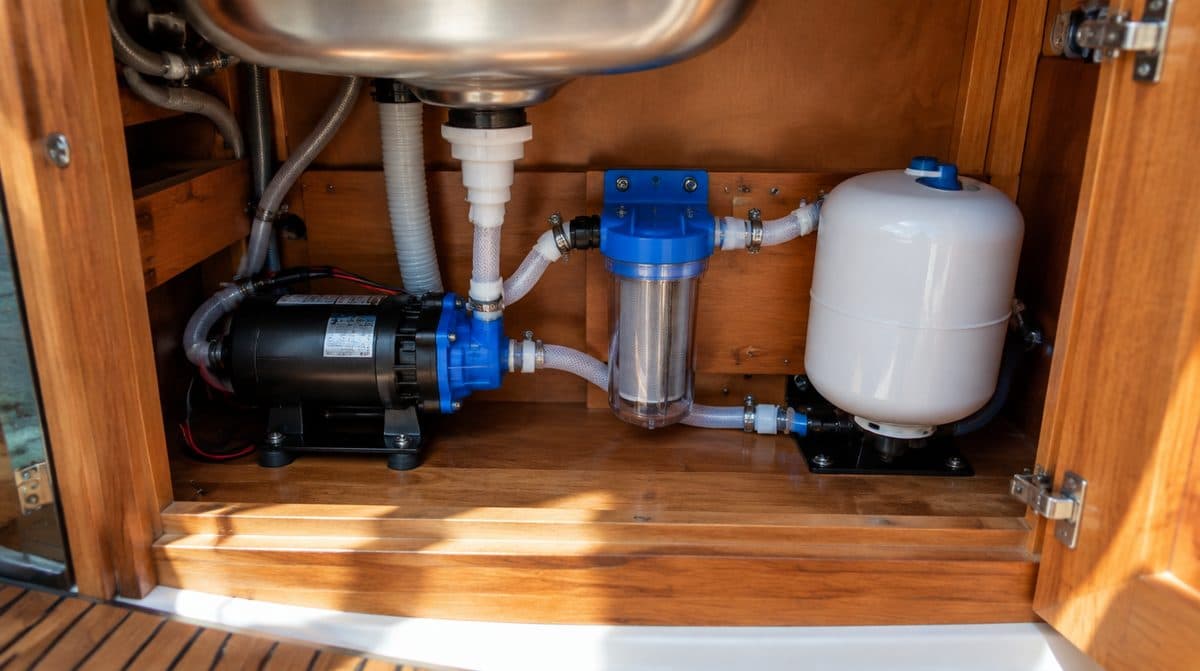
A variable-speed pump slows down to match a trickle instead of slamming on and off at full power, which means steadier showers, less noise, and less wear on the motor and switch. An accumulator is the budget route to similar comfort: a small tank with an air bladder plumbed in after the pump. The air cushion absorbs the pressure spikes and feeds small demands on its own, so filling a kettle or brushing your teeth does not wake the whole boat.
Self-priming and quiet running
Diaphragm pumps are self-priming and run dry safely for short periods. Rubber mounts cut noise so the pump is not thumping through the hull.
Mount the pump on a solid surface using its rubber feet, and connect it with short runs of flexible hose on the inlet and outlet rather than hard-piping straight into rigid plumbing. Most loud-pump complaints are really vibration telegraphing through a stiff pipe run and a thin bulkhead, not the pump itself. Ten minutes with a rubber-footed mount and two flex sections turns a thumper into a hum.
Installation realities
Put a strainer on the inlet side, between tank and pump. The diaphragms and the little internal check valves do not forgive tank debris, and a clear-bowl strainer takes seconds to inspect and rinse. Keep the pump close to the tank, low in the boat, and somewhere you can actually reach, because you will want to get at it someday.
Electrically, treat it like any motor: a dedicated feed from the panel, fused at the manufacturer's rated amperage, run in tinned marine wire. At anchor, a leaky system that cycles the pump all night is also quietly working on your house bank, one more reason to chase small leaks early (our marine battery guide covers how much bank you have to spend).
Maintenance and lifespan
Freshwater pumps are low-drama if the water stays clean. Rinse and inspect the strainer on a regular rhythm. If your boat lives where it freezes, drain and winterize the whole system, because ice is the number one killer of pump heads and fixtures alike. Diaphragms and check valves wear gradually with the years, and many popular pumps offer rebuild kits, so a tired pump can often be refreshed on the workbench instead of replaced outright.
Signs it needs attention
Rapid cycling with every fixture closed means a leak in the system or a failing internal check valve letting pressure bleed backward into the tank. Weak flow with the pump running points to a clogged strainer or tired diaphragms. A pump that refuses to shut off is either starving for water or has a failed pressure switch. None of these improve on their own, and every one of them is easier to fix at the dock than at anchor with a boat full of people who want showers.
From the Water If the pump cycles with every faucet closed, you have a leak somewhere. Find it before it drains your tank and your battery. Work from the pump outward: every fitting, every fixture, and the water heater relief valve if you have one. A dry paper towel wrapped around a suspect joint overnight turns an invisible seep into obvious evidence by morning.
Where to Get It Everything in this guide is stocked at Boat Supplies Direct, the Nautical Network marine parts store. Orders ship free all year with Dock Pass, the $49 a year shipping pass.
In stock as this guide goes up: - Jabsco Par-Max HD4 Heavy Duty Water Pressure Pump (12V, 4 GPM, 40 PSI) - Jabsco Par-Max HD6 Heavy Duty Water Pressure Pump (24V, 6 GPM, 60 PSI)
Browse the full range: - Shop pressure pumps - Read the full buying guide, including FAQs
More from the Wire
 Buying Guides
October 19, 2026
Fuel Filters and Water Separators: Stop Bad Fuel Before It Stops You
Water in the fuel stops more boats than any storm. Micron ratings, flow capacity, and why a clear bowl with a drain is the best early warning system aboard.
Read more Buying Guides
October 27, 2026
Macerator Pumps: What They Do and Why They Burn Out
A macerator has one unglamorous job and one very common way to die. Flow ratings, run-dry protection, and the plumbing details that keep it grinding for years.
Read more Buying Guides
October 19, 2026
Dock Lines 101: Size, Length, and the Lines Most Boaters Forget
Bow and stern lines are the easy part. Line diameter, length, and the spring lines most boaters never rig, explained by boat size.
Read more