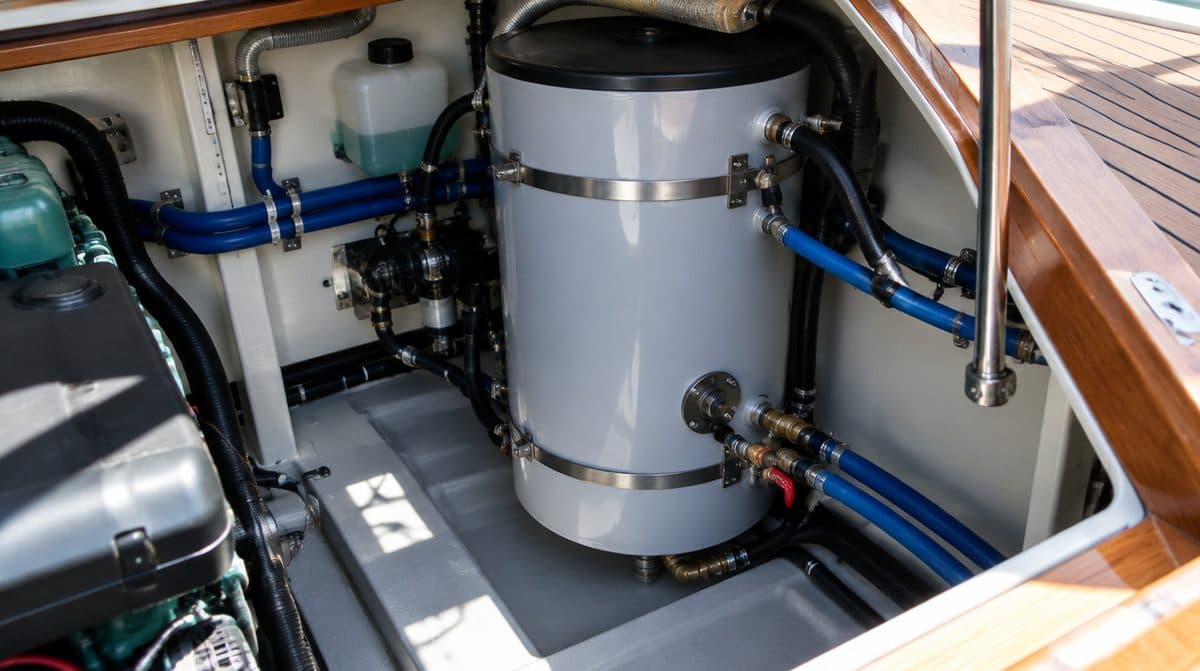
Hot Showers Aboard: A Marine Water Heater Guide
Hot water underway is free once your heater has an engine loop. Tank sizes, heating sources, and what to measure before you order one.
A hot shower after a day of salt and sun turns a boat into a floating getaway. The hardware that makes it happen is refreshingly simple, essentially a well-insulated tank with two ways of heating it, and choosing one comes down to three questions: how much hot water you need, how you will heat it, and where on the boat it can safely live.
Tank size
- Weekend/day boat: 6 gallon
- Cruising couple: 10 to 11 gallon
- Larger liveaboard: 20 gallon or more
Match tank size to how many people shower and how long you are off shore power. Be realistic about habits rather than tank math alone. A quick rinse uses far less than a long hot soak, and the classic navy shower (wet down, water off, soap up, rinse off) stretches a small tank across a surprising number of crew. If your family will not embrace that discipline, and plenty will not, size up and enjoy the peace. Remember too that the tank refills with cold water as you draw hot, so the usable hot water tapers off rather than ending with a hard stop; a bigger tank just moves that taper further down the shower list.
Heating sources
Most marine heaters use a 120V element on shore power plus an engine heat-exchanger loop that heats water as you run. That combo means free hot water underway.
The two sources cover each other's gaps. At the dock, the element does the work like a small household heater while the engine sleeps. Underway, engine coolant routes through a coil inside the tank and the heat your engine makes anyway transfers into your shower water. The one gap is swinging at anchor for days without running the engine. Heating elements are hungry enough that batteries and inverters are rarely a satisfying answer, so plan on engine time, a kettle, or a swim.
Mounting and fit
Measure your space. Water heaters are heavy and need secure, accessible mounting with room for connections.
Remember the water itself: at roughly 8 pounds per gallon, an 11 gallon heater is carrying close to 90 pounds of water before you count the tank. It has to stay put in a seaway, so through-bolt the mounting feet to something structural and keep the tank level. Leave working access to the element cover, the drain, and the pressure relief valve. The locker that technically fits the tank but buries every fitting will cost you a miserable, upside-down afternoon later.
Plumbing the engine loop
The heat exchanger ties into your engine's cooling circuit, usually at ports the engine maker provides for exactly this purpose, so follow the engine manual for connection points. Keep the coolant runs as short and smooth as practical, use hose rated for hot coolant, and burp the air out of the loop when you fill it; an airlock is the usual reason a brand-new loop makes lukewarm water. While you are in there, a thermostatic mixing valve on the tank outlet is a worthwhile add-on. An engine loop can make tank water very hot, and the valve tempers it before it ever reaches a faucet or a kid in the shower.
Electrical realities
The element side of the heater is 120V AC shore power territory, not 12V tinkering. The circuit needs properly sized wire, its own breaker, and correct AC practice throughout, and mistakes at 120V bite much harder than anything on the DC side of the panel. If AC work is not something you do with confidence, this is a quick visit for a verified marine electrician on Waypoint, and the plumbing side remains a satisfying weekend job you can keep for yourself.
Maintenance and lifespan
Flush the tank occasionally to clear sediment, especially if you fill from dockside hoses of uncertain character. Test the pressure relief valve on the manufacturer's schedule, and never plug one that drips; find out why it is dripping instead. If you winterize, drain the tank completely and bypass it when you run antifreeze through the plumbing, because a tank full of antifreeze takes forever to rinse clean in the spring. Whatever the tank material, dry mounting spaces and easy access do more for lifespan than anything printed on the brochure.
Signs it is done
Rust-tinted hot water, weeping seams, or a relief valve that drips constantly at normal pressure are the classic endings. A failed element can usually be replaced on its own, so diagnose before you condemn the whole unit. But once the tank itself leaks, replacement is the only fix, and it is far better done on your schedule at the dock than discovered as a bilge full of fresh water halfway through a trip.
From the Water Run the engine 20 to 30 minutes on the way to your anchorage. If your heater has an engine loop, that's enough for free hot water all evening. A well-insulated tank will often still be warm at sunrise, which makes the first round of coffee and face-washing noticeably more civilized.
Where to Get It Everything in this guide is stocked at Boat Supplies Direct, the Nautical Network marine parts store. Orders ship free all year with Dock Pass, the $49 a year shipping pass.
In stock as this guide goes up: - Whale Seaward 6 Gallon Hot Water Heater with Rear Heat Exchanger (240V) - Kuuma 11850 11 Gallon Water Heater (240V) - Whale Seaward 11 Gallon Stainless Steel Hot Water Heater (120V)
Browse the full range: - Shop water heaters - Read the full buying guide, including FAQs
More from the Wire
 Buying Guides
October 19, 2026
Fuel Filters and Water Separators: Stop Bad Fuel Before It Stops You
Water in the fuel stops more boats than any storm. Micron ratings, flow capacity, and why a clear bowl with a drain is the best early warning system aboard.
Read more Buying Guides
October 19, 2026
Marine Autopilots: Let the Boat Steer While You Watch the Water
The control head is the easy part. The drive unit behind your steering is where autopilots get mismatched, and where the money goes right or wrong.
Read more Buying Guides
October 19, 2026
Marine Gauges: Know Your Engine's Health at a Glance
A gauge wired to the wrong sender moves convincingly while reading fiction. How to build a panel that tells the truth about your engine.
Read more