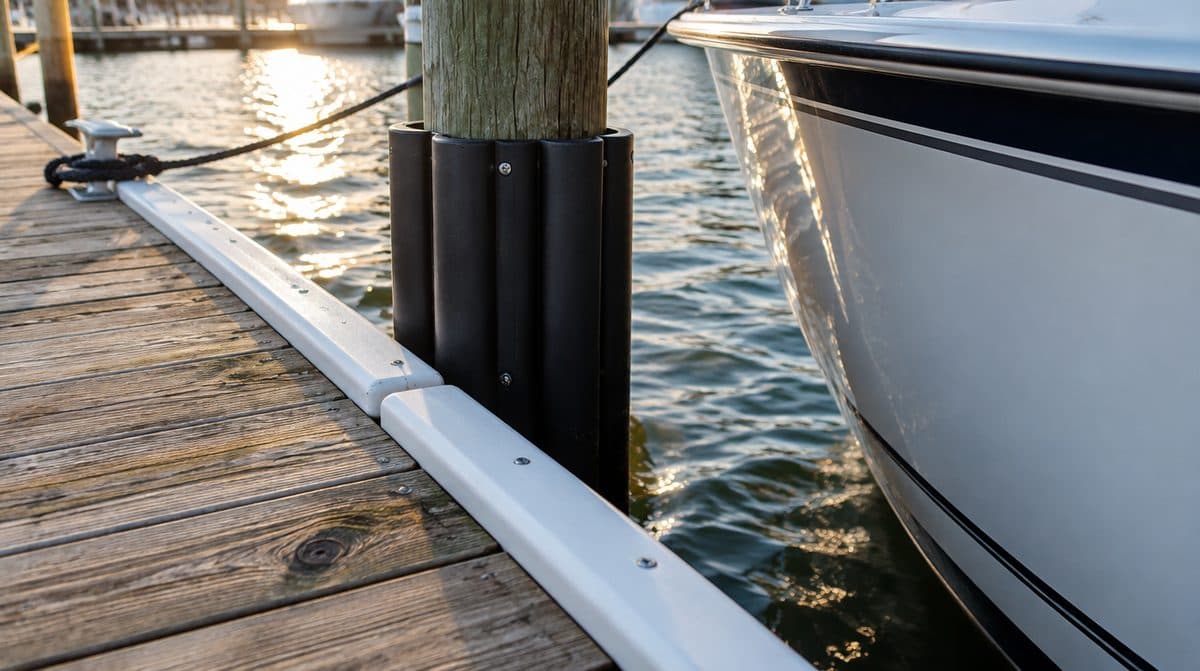
Dock Bumpers and Piling Guards: Protect the Hull From the Dock Itself
Fenders only work when you remember them. Dock bumpers and piling guards protect the hull on every landing, including the ugly ones.
Fenders protect you when you remember to put them out. Dock bumpers protect you every single time you come in. That distinction matters more than it sounds, because the scrapes that hurt most are not the ones from a sloppy landing you saw coming. They are the quiet ones: the wake from a passing boat grinding your hull against a bare piling at two in the morning, the crosswind gust that pinned the bow against the dock corner while you were still rigging lines. Padding the dock itself means the protection is always there, asleep or awake, aboard or ashore.
Bumpers and Fenders Do Different Jobs
Fenders hang from the boat and travel with you, which makes them the right tool for rafting up and visiting strange docks. Bumpers and guards mount to the dock and protect one slip perfectly, forever. If you keep your boat in the same slip all season, the dock hardware does the everyday work and the fenders become your away gear. For choosing the hanging kind, we wrote a full boat fender guide. This one is about armoring the dock.
Where They Go
- Dock edge bumpers: run along the dock edge where the hull contacts.
- Piling guards/wraps: pad pilings and corners.
- Corner bumpers: protect the vulnerable dock corners.
The way to plan the layout is to stand in your slip at low tide and again at high tide, and look at every hard surface the hull or rub rail could touch through that whole range. Tidal water changes the contact zone dramatically: a bumper mounted for the summer afternoon water level can be six inches above the rub rail when you come home on a low tide. Floating docks move with the boat, so the contact zone stays put; fixed docks and pilings need taller coverage.
Material and Mounting
Look for UV-stable, marine-grade material that will not mark your hull, and mounting hardware suited to wood, composite, or concrete docks. The material question is simple: dock gear lives outside every day of its life, so bargain vinyl that chalks and hardens in the sun will eventually do to your gelcoat exactly what the bare dock would have done. Quality PVC and foam profiles stay compliant for years and wipe clean.
Mounting is where most installs go wrong. Wood docks take stainless screws easily. Composite decking wants pre-drilling and sometimes backing blocks. Concrete needs masonry anchors and patience. Whatever the dock, use stainless fasteners, because a rusted screw head sticking through a worn bumper is a hull-gouging machine hiding inside the thing you bought for protection. Set screw heads below the bumper surface or under the mounting flange, never proud of it.
Sizing
Cover the full contact zone. Gaps are where the hull finds the hard edge. Measure the dock lengths that touch your boat. Edge profiles typically come in long strips or rolls, so buy enough to run continuous coverage along the whole contact face rather than patching short sections where you think you touch. Boats shift with wind, tide, and line stretch; the spot that never touches in June is the spot that grinds in October.
For pilings, measure the circumference and the vertical range of contact, then choose wraps or post bumpers that cover that whole band. Corners deserve the heaviest product you can find, in the largest size that fits, because corner strikes concentrate all the boat's momentum on a few square inches of hull.
Installation Tips
Install bumpers with the boat out of the slip so you can work from the dock edge without leaning over your own gelcoat. Dry-fit everything before you drill. On edge profiles, start fastening from one end and work along, keeping the strip straight; a wavy bumper line looks bad and leaves unsupported spans that flatten over time. Leave small drainage gaps at the bottom edge of closed profiles where water could otherwise pool behind them and rot a wooden dock face.
If your marina owns the dock, ask before you drill. Most marinas are delighted that you want to pad your slip, but some have rules about fastener types and removal at the end of a lease.
Maintenance and When to Replace
Dock bumpers are honest gear: you can see their condition at a glance. Give them a wipe-down when you wash the boat and a real inspection once a season. Replace any section that has hardened, cracked, flattened, or worn through to the fasteners. Hardened vinyl transfers shock instead of absorbing it, and a compressed foam profile is mostly decoration. Check that fasteners are still snug and still below the wear surface; dock structures work and flex, and screws back out over the years.
Mistakes to Avoid
The classic mistake is protecting only where the boat sits pretty on a calm day. Wind against tide will press the hull into places it never normally touches. The second mistake is relying on dock hardware alone in a surging slip; in rough weather, dock bumpers plus properly hung fenders is the combination that saves the hull. The third is buying by price alone. The cost difference between bargain and quality bumper stock is small compared to a single gelcoat repair.
From the Water
Pay extra attention to the dock corners. That's where most docking scrapes happen, especially in a crosswind. A boat pivoting into a slip sweeps its quarter right past the corner, and a gust at the wrong moment closes the gap fast. Pad the corners with the biggest, softest protection you can mount, and the ugly landings become stories instead of repairs.
Where to Get It
Everything in this guide is stocked at Boat Supplies Direct, the Nautical Network marine parts store. Orders ship free all year with Dock Pass, the $49 a year shipping pass.
In stock as this guide goes up: - Dock Edge Ultragard 35 Inch PVC Dock Cushion, White - Dock Edge Piling Post Bumper, One End Capped, 6 Foot, Black - Dock Edge Protect Corner HD 16 Inch PVC Dock Bumper
Browse the full range: - Shop bumpers and guards - Read the full buying guide, including FAQs
More from the Wire
 Buying Guides
October 18, 2026
Fuel Additives: Protecting Fuel That Sits Between Trips
Ethanol, water, and fuel that sits between trips: which additives actually protect your engine, and the habits that make them work.
Read more Buying Guides
October 19, 2026
Trailer Bearings: The Number One Reason Boats Don't Make It to the Ramp
That trailer on the shoulder with a wheel off? Usually a bearing. How hubs work, why launch ramps kill them, and the spares that save the trip.
Read more Buying Guides
October 19, 2026
Trailer Maintenance: Keep Your Boat Off the Side of the Highway
Your boat logs more miles on asphalt than on water, and the trailer only gets noticed when it quits. Bearings, straps, bunks, and lights: how to keep all four from ending your day on the shoulder.
Read more