Trailer Bearings: The Number One Reason Boats Don't Make It to the Ramp
That trailer on the shoulder with a wheel off? Usually a bearing. How hubs work, why launch ramps kill them, and the spares that save the trip.
Every boater has passed a trailer on the shoulder with a wheel off. Most of the time, it was a bearing. Not a dramatic failure, either: just a small, cheap part that was asked to run hot, dry, or full of water, and finally quit at highway speed. Trailer bearings are simple, the maintenance is simple, and almost every bearing failure on the side of the road was preventable with an afternoon of attention.
How a Trailer Hub Actually Works
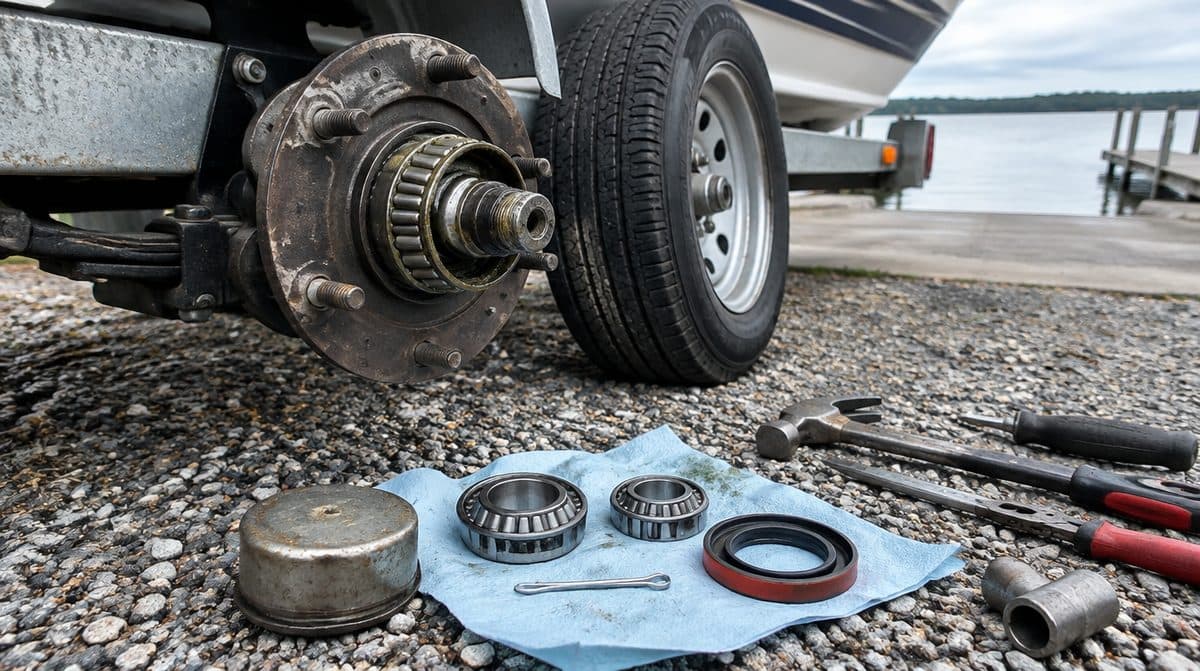
Each wheel spins on a hub, and inside that hub are two tapered roller bearings, an inner and an outer, each riding in a hardened steel ring called a race that's pressed into the hub. The whole assembly rides on the axle's spindle, packed with grease, with a rubber seal at the back keeping grease in and water out, and a cap or protector on the front doing the same job from the other side.
That's the entire machine. When it's greased and sealed, it'll run for years. When water gets in, the grease emulsifies, the rollers start running on rusty metal, heat builds, and the bearing eats itself. The end stage is a seized or collapsed bearing, and sometimes a wheel that passes you on the highway.
Why Boat Trailers Eat Bearings
Boat trailers suffer a special abuse that utility trailers never see: the launch ramp. You tow for an hour and the hubs get hot. Then you back them into cold water. The air inside the hub contracts as it cools, creating a vacuum, and that vacuum pulls water right past the seals. Do that every weekend and the grease turns into gray mayonnaise, which is exactly what you'll find when you pull the cap on a neglected hub.
Salt water makes everything worse, corroding the spindle, the seal lip, and the bearing surfaces themselves. If you launch in the salt, rinse the hubs along with the rest of the trailer, and take the maintenance schedule seriously.
Match the Bearing to Your Hub
Bearings are sized to your spindle and hub. Match the exact bearing and race set, and replace bearings and seals as a set, not piecemeal. The numbers stamped on the old bearing and race are the part numbers you need, so wipe them clean and read them before ordering. A new bearing run in a worn old race fails early, because the two wear together as a matched pair. Seals are cheap; there is never a reason to reuse one, and a seal that went in bent or nicked will quietly let water in all season.
While the hub is apart, inspect the spindle itself. Scoring, bluing from heat, or a groove worn where the seal rides means the spindle needs attention too, and no new bearing fixes a damaged spindle.
Bearing Protectors
Spring-loaded bearing protectors (Bearing Buddy style) keep grease in and water out, which is the biggest factor in bearing life since hot hubs suck in water when you launch. The spring holds light pressure on the grease, so when the hub cools in the water, the pressure pushes grease toward the seal instead of letting the vacuum pull water in.
Use them correctly: add grease until the spring piston just moves, and stop. Overfilling blows out the rear seal, which converts your water-excluder into a grease-slinger that empties the hub onto your wheel. Protectors also don't make repacking optional; they stretch the interval, but the grease inside still ages and the seals still wear.
Repacking, Since Someone Has to Do It
Repacking means pulling the hub, cleaning the old grease out of the bearings and races, inspecting everything, forcing fresh marine-grade grease through the rollers by hand, and reassembling with a new seal. The feel to learn is preload: tighten the castle nut while spinning the hub to seat everything, then back it off so the hub spins freely with no wobble. Too tight cooks the bearing; too loose hammers it. If that's not an afternoon you want, a verified marine service shop on Waypoint can repack a set of hubs quickly, and it's cheap insurance compared to a spindle repair.
Signs a Bearing Is Failing
Bearings usually warn you before they let go. A growl, rumble, or chirp from a wheel that changes with speed. A hub too hot to hold your hand on after a drive (warm is normal, hot is not). Grease slung across the inside of the wheel, which means a seal has failed. Wobble when you grab the tire at top and bottom and rock it. Any one of those is a stop-and-fix, not a note for later. Check hubs by hand at every fuel stop on a long tow; it costs thirty seconds per wheel.
Carry Spares and Service
Repack or replace bearings on schedule, and carry a spare bearing and seal kit plus the tools on long tows. A roadside bearing failure without a spare means a tow truck. The kit that saves the trip is small: matched bearings and races, seals, a tub of grease, and the basic tools to do the job in a parking lot, plus a jack and a block that actually work with your loaded trailer. Some boaters carry a complete pre-greased spare hub instead, which turns a greasy ninety-minute roadside job into a bolt-on swap.
From the Water
Give the hubs a few minutes to cool before backing in after a long drive. Plunging hot hubs into cold water is what sucks water past the seals. Use the time to load the boat gear, pull the transom straps, and let the hubs come down to a temperature you can comfortably touch.
Where to Get It
Everything in this guide is stocked at Boat Supplies Direct, the Nautical Network marine parts store.
In stock as this guide goes up: - Shop the trailering collection for hubs, hardware, and launch-day gear
Browse the full range: - Shop trailering - Read the full buying guide, including FAQs
More from the Wire
 Buying Guides
October 18, 2026
Starting vs. Deep Cycle: The Battery Mistake That Strands Boaters
Starting, deep cycle, or dual purpose, and flooded, AGM, or lithium. How to pick the battery type that will not leave you stranded.
Read more Buying Guides
October 18, 2026
The Onboard Charger: Cheap Insurance for Expensive Batteries
Batteries die young when they sit half-charged. How to size an onboard charger by amps, banks, and chemistry.
Read more Buying Guides
October 18, 2026
Battery Switches and Isolators: Never Get Stranded by a Dead Battery
The switch and isolator setup that keeps your starting battery ready while the house bank runs your gear.
Read more