Fishfinders and Transducers: Seeing What's Really Down There
The screen gets the glory, but the transducer decides what you actually see. Frequency, power, and mounting, explained by what shows up on the water.
Two anglers can buy the same fishfinder and get completely different results. The difference is almost always the transducer and where it's mounted. The screen gets all the attention in the marketing photos, but the transducer is the part doing the real work. It is the speaker and the microphone of the whole system, and if it's the wrong type or sitting in bad water, the fanciest display in the catalog will draw you a very confident picture of nothing.
How Sonar Actually Works
A fishfinder is simple at heart. The transducer sends a pulse of sound down through the water, the pulse bounces off whatever it hits (bottom, fish, your anchor), and the transducer listens for the echo. The head unit measures how long each echo takes to come back and how strong it is, then paints that return on the screen. Each ping draws one thin vertical slice, and the scrolling image you watch is a history of slices stacked side by side as the boat moves.
Two things follow from that. First, the right edge of the screen is now, and everything to the left already happened. You're looking at a recording, not a live camera. Second, anything that disturbs the pulse on its way down or back (air bubbles, turbulence, a badly aimed transducer) wrecks the picture before the head unit ever gets a vote. That's why installation matters as much as the spec sheet.
Frequency: The Depth vs. Detail Tradeoff
- Low frequency (50 kHz): deeper water, wider cone, less detail.
- High frequency (200 kHz): shallower, narrower, more detail.
- CHIRP sweeps a range of frequencies for the best detail and target separation.
Low-frequency sound travels farther through water, which is why deep-water work leans on it, but the wide cone lumps targets together. High frequency gives you the crisp arches and tight target separation that make fishing fun, but it runs out of punch as the bottom falls away. CHIRP splits the difference by transmitting across a band of frequencies instead of one tone, so the unit can tell two fish apart where a single-frequency ping would show a single blob. If you fish a mix of depths, a dual-frequency or CHIRP unit is the easy answer: run high frequency on the flats, switch low when you head deep.
Power: Watts Buy You Reach
More transmit power punches through deeper water and clutter. Deep water and offshore use want higher wattage. On a lake boat sounding modest depths, modest power is fine and spending up buys you little. Offshore, power is the difference between a solid bottom line and a screen full of snow, especially at speed or in churned-up, silty water that soaks up signal. Match the power to where you actually fish, not where you'd like to imagine fishing someday.
Mounting: Where the Transducer Lives
- Transom mount: easiest, fine for most outboards.
- Thru-hull: best performance at speed and in deep water, more involved install.
- In-hull: shoots through the hull, no drilling, slight signal loss.
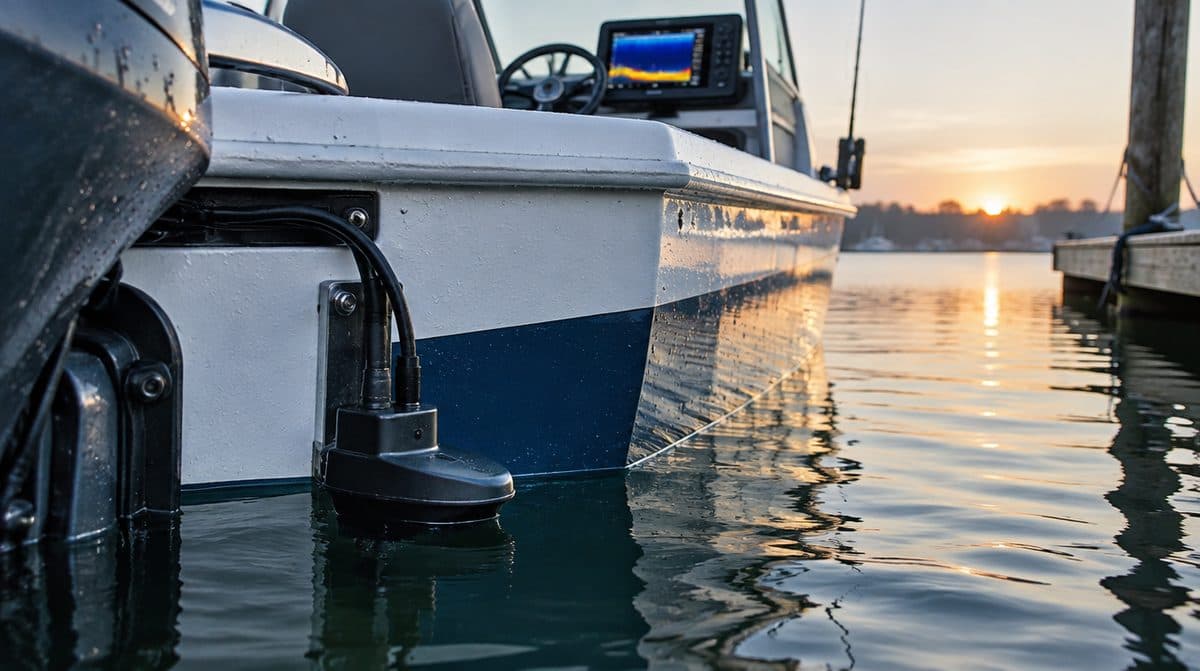
A transom mount bolts to the back of the boat with its face just below the waterline, and for outboard and sterndrive boats it's the sensible default. A thru-hull transducer mounts through a hole in the bottom, sits in clean water ahead of the running gear, and holds a reading at speeds where transom units give up. It's the offshore choice, and yes, that means drilling a hole in your boat, which is a job to do carefully or hire out. In-hull units glue inside the bilge and shoot through solid fiberglass. You lose a little signal and the water temperature reading, but there's no hole and nothing hanging in the water to snag. They don't work through cored hulls, so check your layup before you commit.
Getting the Install Right
Most disappointing fishfinders are installation problems wearing a disguise. The transducer needs smooth, undisturbed water flowing across its face. On a transom mount, that means placing it away from strakes, rivets, water intakes, and the propeller's path, with the face level or angled just slightly down at the trailing edge. Too high and it sucks air; too low and it throws spray and drags. Route the cable away from engine wiring and battery cables, because sonar cables pick up electrical noise and that noise shows up on screen as interference. Never cut the transducer cable to shorten it; coil the extra and zip-tie it somewhere dry.
Reading the Screen
Fish show up as arches because the cone passes over them: the echo is long at the edges of the cone and short in the middle. A fat, bright bottom line means hard bottom; a thin, fuzzy one means mud. A cloud of small returns hovering midwater is usually bait, and the bigger marks hanging under it are the reason you bought the unit. Spend a day driving over structure you already know and matching what you see to what you know is down there. If you're shopping for navigation and sonar in one box, our chartplotter and fishfinder combo guide covers that decision.
Mistakes to Avoid
Buying screen size instead of transducer quality is the classic one. A big display fed by a badly mounted transducer is just a bigger view of a bad picture. Also avoid mismatching frequencies (a head unit is only as good as the transducer it's paired with), leaving every setting on auto forever, and judging a unit at the dock. Sonar in two feet of marina water tells you nothing about how it behaves on plane.
From the Water
If your bottom reading drops out at speed, the transducer is probably sitting in turbulent water. Lowering it slightly or moving it away from strakes often fixes it. Make one small change at a time and run the boat between adjustments; move it a half inch, not an inch and a half, or you'll overshoot the fix and end up chasing the problem back the other way.
Where to Get It Everything in this guide is stocked at Boat Supplies Direct, the Nautical Network marine parts store.
In stock as this guide goes up: - Garmin STRIKER 4 fishfinder with 77/200 kHz transom-mount transducer - Lowrance Eagle 4x sonar - SI-TEX SVS-760 dual frequency sounder, 600W
Browse the full range: - Shop fishfinders - Read the full buying guide, including FAQs
More from the Wire
 Buying Guides
October 18, 2026
Starting vs. Deep Cycle: The Battery Mistake That Strands Boaters
Starting, deep cycle, or dual purpose, and flooded, AGM, or lithium. How to pick the battery type that will not leave you stranded.
Read more Buying Guides
October 18, 2026
The Onboard Charger: Cheap Insurance for Expensive Batteries
Batteries die young when they sit half-charged. How to size an onboard charger by amps, banks, and chemistry.
Read more Buying Guides
October 18, 2026
Battery Switches and Isolators: Never Get Stranded by a Dead Battery
The switch and isolator setup that keeps your starting battery ready while the house bank runs your gear.
Read more