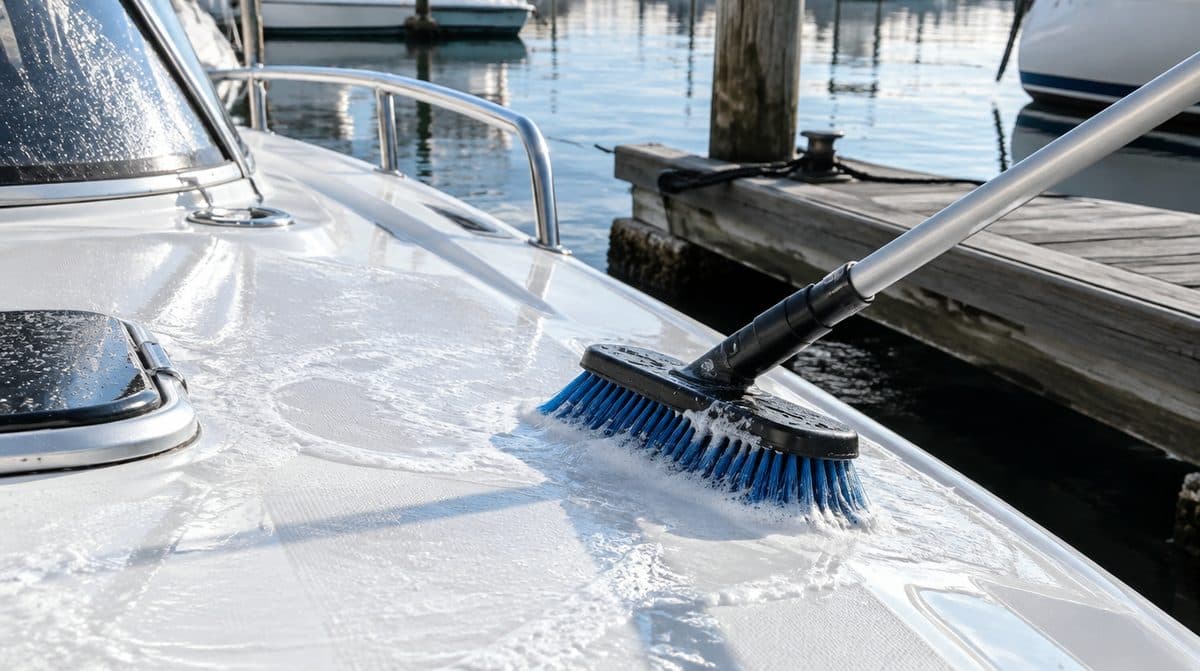
Boat Cleaning Tools: Wash Faster Without Scratching
Soft, medium, or stiff: the right brush for every surface, so you wash faster without scratching.
Washing the boat is part of every trip. Salt, scum, and sunscreen do not wait for the weekend, and the longer they sit, the harder they are to shift. The right brushes and tools make the wash-down faster, and just as important, they protect the finish while you work.
Why the Wrong Brush Costs You Gelcoat is softer than it looks. It is a thin layer of pigmented resin over the fiberglass, and every pass with a too-stiff bristle, or a soft bristle dragging trapped grit, leaves fine scratches behind. You will not see them up close with the hose running. You will see them at ten feet in low morning sun, as a dull haze of swirl marks where a shine used to be.
Once that haze is in, the fix is compounding and polishing, which costs you a full weekend and removes a little more gelcoat every time you do it. A couple of smart choices in the brush aisle prevent the whole cycle.
Brush stiffness by surface - Soft brushes: gelcoat, glass, and delicate surfaces. - Medium brushes: non-skid decks and general scrubbing. - Stiff brushes: tough non-skid and heavy grime only.
Here is the why behind that chart. Soft brushes usually have flagged bristles, meaning the tips are split into finer fibers, so the brush carries a load of soapy water and sweeps dirt along without digging in. That is exactly what smooth gelcoat, glass, and painted surfaces want.
Non-skid is a different animal. The molded texture that keeps your feet planted also grabs dirt and shrugs off soft bristles, so a medium brush earns its keep there. It has enough body to work down into the pattern without chewing up the surrounding deck.
Stiff brushes are a specialty tool. Caked mud in the anchor locker, green growth on a dock-stored swim platform, the nastiest non-skid. Use them there and nowhere else. Using too stiff a brush on gelcoat leaves swirl marks, so match stiffness to the surface, and when in doubt, start softer and step up only if the dirt wins.
Telescoping handles and flow-through A telescoping handle reaches the hull sides and hard-to-reach spots from the dock, which matters more than it sounds. The alternative is leaning over lifelines, balancing on the swim platform, or skipping the waterline entirely until it grows a mustache of scum.
Look for a handle that locks positively at length. A twist-lock that slips every time you lean into the scrubbing will drive you to an early retirement from boat washing. Fixed-length handles have their place too: they are stiffer, lighter, and there is nothing to slip, which is why plenty of owners keep one fixed handle for the deck and a telescoping one for the topsides.
Most quality handles use a standard threaded tip or a quick-connect system, so one handle runs your brush, your mop, and your squeegee. Buy into one system and every head you add afterward is cheaper and easier to stow than another full-length tool rolling around a locker.
Flow-through handles feed water or soap right to the brush through the pole, so you rinse and scrub in a single pass instead of juggling the hose in your off hand. On a bigger boat that saves real time on every single wash.
Microfiber and extras Microfiber cloths and mitts earn their place because the split fibers trap dirt up inside the weave instead of dragging it across the surface. A wash mitt loaded with suds is the gentlest way to do smooth topsides, and microfiber towels handle drying and detailing without scratching.
A chamois or a big waffle-weave drying towel finishes the job properly. Drying is not vanity. Water that evaporates on gelcoat leaves mineral spots, and salt water leaves crystals that pull moisture out of the air and hold grime against the finish all week.
Round out the kit with a deck brush, a bucket, and a nozzle that gives you both a gentle fan and a strong jet. Better still, carry two buckets: one for suds, one for rinsing the grit out of your mitt before it goes back into the soap. That one habit keeps most of the sand off your hull.
Treat the microfiber right and it lasts for years. Wash cloths and mitts separately from household laundry, skip the fabric softener because it clogs the fibers, and retire any cloth that hits the dock to the bilge-rag bag. One embedded pebble turns the softest cloth on earth into sandpaper.
A wash routine that protects the finish Rinse first, always. Flooding the boat with plain water floats off the loose salt and sand before anything touches the surface, and that is most of the scratch battle won before you pick up a brush.
Work top down so the dirt flows off instead of over clean sections. Wash in manageable sections so the soap never dries, and chase the shade: do the shady side first, or wash early or late. Soap that bakes onto hot gelcoat leaves streaks you then get to wash a second time.
Use a proper boat soap, which is formulated to rinse clean without stripping wax. Dish soap cuts grease brilliantly, and it strips your wax exactly the same way. The wax is what actually protects the gelcoat between washes, and a clean boat holds it longer; our boat wax and polish guide covers that half of the job.
Make the tools last Rinse brushes and mitts with fresh water after every wash and hang them to drain, or store them bristles-up so the heads do not deform against a locker floor. A brush stored bent stays bent, and bent bristles scrub with their sides instead of their tips.
Replace a brush when the bristles splay out or the flagged tips wear away. A worn soft brush effectively becomes a medium brush, and that is exactly how "the brush I have always used" turns into swirl marks on the hull.
Mistakes to avoid - Grabbing the deck brush for the hull because it happens to be in your hand. - Dish soap. It strips wax every time, no exceptions. - Washing in full sun and letting soap dry on hot gelcoat. - Letting salt sit all week because the boat "looks clean." - Fabric softener on microfiber, or washing it with lint-shedding cotton towels. - One bucket for everything, so the mitt keeps reloading itself with grit.
From the Water Keep separate brushes for the hull and the non-skid. Grit from the deck brush will scratch your gelcoat. Make it foolproof by buying the two in different colors, so nobody aboard has to remember which is which. They just grab the right color.
Where to Get It Everything in this guide is stocked at Boat Supplies Direct, the Nautical Network marine parts store.
In stock as this guide goes up: - Swobbit 7.5 inch soft flagged brush - Swobbit 7.5 inch medium brush - Shurhold 40 inch fixed length handle
Browse the full range: - Shop cleaning and care - Read the full buying guide, including FAQs
More from the Wire
 Buying Guides
October 18, 2026
Starting vs. Deep Cycle: The Battery Mistake That Strands Boaters
Starting, deep cycle, or dual purpose, and flooded, AGM, or lithium. How to pick the battery type that will not leave you stranded.
Read more Buying Guides
October 18, 2026
The Onboard Charger: Cheap Insurance for Expensive Batteries
Batteries die young when they sit half-charged. How to size an onboard charger by amps, banks, and chemistry.
Read more Buying Guides
October 18, 2026
Battery Switches and Isolators: Never Get Stranded by a Dead Battery
The switch and isolator setup that keeps your starting battery ready while the house bank runs your gear.
Read more