Bilge Blowers: Four Minutes That Can Save Your Life
Gasoline fumes sink into the bilge and wait for a spark. Four minutes of blower time, sized to your engine compartment, is the cheapest insurance on board.
Gas fumes settle in the bilge, and a single spark can ignite them. The bilge blower is your first line of defense. It is a humble piece of gear, a motor and a fan in a plastic housing, and it exists because gasoline vapor is heavier than air. Spilled or leaked fuel does not drift out of the boat on its own; it sinks into the lowest enclosed spaces and waits. The blower's entire purpose is to evict it before anything electrical gets a vote.
Why Fumes Collect in the First Place
An engine compartment is a box full of fuel lines, fittings, a tank vent, and a carburetor or injection system, all sealed away from the breeze. Any small weep, an overfilled tank, or even normal vapor expansion on a hot day can put gasoline vapor into that box. Because the vapor is heavier than air, it pools at the bottom like invisible water. Open-air boats shed fumes naturally underway, but at the dock, at idle, or right after fueling, the compartment needs mechanical help. That is the blower: it pulls air from the bottom of the compartment and pushes it overboard through a vent, drawing fresh air in behind it.
Size by Compartment Volume
Blowers are rated in CFM (cubic feet per minute). Match the CFM to your engine compartment size so it can exchange the air in a few minutes. Bigger compartments need more CFM or multiple blowers.
The arithmetic is friendly. Say your engine compartment is roughly 6 feet long, 4 feet wide, and 3 feet deep: that is 72 cubic feet of air. A 105 CFM blower moves that volume in under a minute on paper. Real installations never hit the paper number, because ducting, bends, and vent grilles all add resistance, so treat the rating the way you treat a bilge pump rating: generous on paper, modest in practice, and worth sizing up. A larger compartment on a bigger boat may call for a 250 CFM unit or a pair of blowers, one pulling from each side.
Check the duct diameter the blower is built for, commonly 3 or 4 inches, and match your ducting to it. A 4 inch blower choked down to a 3 inch hose is just a 3 inch blower that cost more.
In-Line vs. Flange Mount, and Voltage
Blowers come in two main layouts. In-line blowers splice into a run of ducting and can be mounted almost anywhere along it, which makes them the easy retrofit choice. Flange-mount and flex-mount blowers bolt to a bulkhead and take ducting on one or both sides, and they tend to be the tidier permanent installation. Neither is better; pick what fits your space and keeps the blower itself high and dry.
Match voltage to your boat: most runabouts want 12V, many larger twin-engine boats run 24V systems, and continuous-duty rated motors are worth having if your habits lean toward long idle periods with the blower running. Wire it with marine tinned wire through a properly sized fuse or breaker, as with anything electrical on board; our fuse and breaker guide covers getting that circuit right. The blower switch belongs at the helm, labeled, where it is part of the starting ritual rather than a scavenger hunt.
When to Run It
Run the blower for at least 4 minutes before starting a gas engine, and whenever running at low speed where natural ventilation is poor. Sniff the bilge too, since blowers help but do not replace a check.
Those 4 minutes are the cheapest insurance in boating, and they are also the most commonly skipped step on the water. Build them into the routine: blower on, then lines, gear, and passengers sorted, then a sniff of the compartment, then the key. After fueling is the critical moment. Fuel dock pumps are fast, tank vents burp vapor, and the few minutes after you hang up the nozzle are exactly when the compartment is most likely to hold fumes. Blower on, hatch up, nose in, every time. Diesel owners get a pass on the explosion risk, since diesel vapor does not behave like gasoline vapor, but ventilation still matters for heat and engine air supply.
Ducting
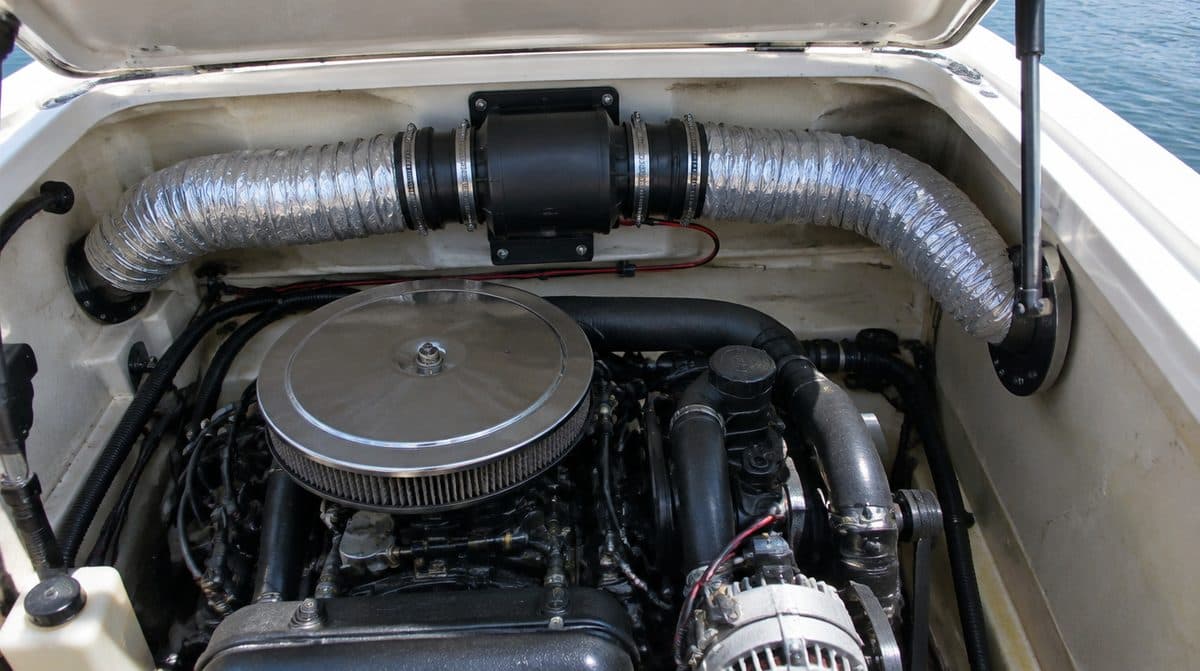
Use the correct diameter ducting routed to pull vapors from the lowest point of the compartment, where fuel vapor settles.
Placement is the whole game. A blower pulling from the top of the compartment is rearranging fresh air while the heavy vapor sits untouched below. The intake end of the duct should reach down low in the bilge area, clear of normal bilge water, and the run to the overboard vent should be as short and straight as the boat allows. Inspect ducting yearly: the spiral hose cracks with age, collapses behind clamps, and a torn duct quietly turns your safety system into a decoration.
Signs Your Blower Needs Replacing
- It hums, rattles, or screeches instead of whooshing
- Weak or no airflow at the vent with the motor running
- A motor that trips fuses or runs hot to the touch
- Cracked housings or corroded terminals from bilge humidity
Blower motors are not rebuildable in any practical sense, and they are inexpensive. If yours sounds like a seagull in distress, replace it before the season, not during it.
From the Water
Make the blower part of your startup routine, along with a quick sniff of the engine compartment. Your nose catches what the blower misses. It is a better gas detector than most electronics, it calibrates itself, and it is always installed. Four minutes and one sniff: that is the whole discipline, and it is one of the few habits on a boat with no downside at all.
Where to Get It
Everything in this guide is stocked at Boat Supplies Direct, the Nautical Network marine parts store.
In stock as this guide goes up: - Jabsco 4 inch 250 CFM Flexmount blower, 12V - Jabsco 3 inch Flexmount blower, 105 CFM, 12V - Rule in-line 4 inch bilge blower, 24V
Browse the full range: - Shop blowers - Read the full buying guide, including FAQs
More from the Wire
 Buying Guides
October 18, 2026
Starting vs. Deep Cycle: The Battery Mistake That Strands Boaters
Starting, deep cycle, or dual purpose, and flooded, AGM, or lithium. How to pick the battery type that will not leave you stranded.
Read more Buying Guides
October 18, 2026
The Onboard Charger: Cheap Insurance for Expensive Batteries
Batteries die young when they sit half-charged. How to size an onboard charger by amps, banks, and chemistry.
Read more Buying Guides
October 18, 2026
Battery Switches and Isolators: Never Get Stranded by a Dead Battery
The switch and isolator setup that keeps your starting battery ready while the house bank runs your gear.
Read more