Winterizing the Engine, Properly: What a Full Service Actually Includes
What a real winterization covers, from stabilized fuel and fogging oil to antifreeze and gear lube, how the job differs by engine type, and where the DIY line sits.
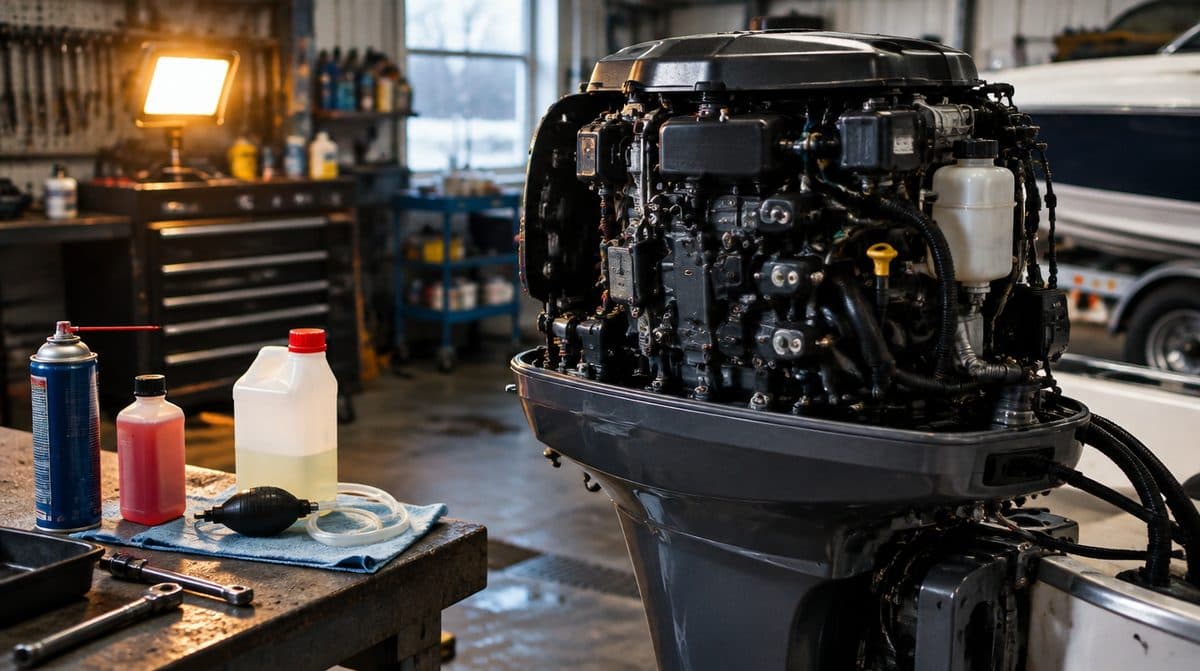
Winterizing is the one service where a shortcut stays hidden until spring, and by then it has become a cracked block or a corroded cylinder. A proper winterization is not one job. It is four or five small jobs done in the right order, and knowing what they are is how you judge any quote, including your own DIY plan.
Fuel comes first
Ethanol gas pulls moisture out of the air all winter, so the tank gets topped up to limit the air space, a marine stabilizer goes in, and the engine runs long enough to pull treated fuel through the whole system. Diesel owners swap in fresh filters and treat for microbial growth instead. Either way, the engine's last meal of the season should be a clean one.
Fogging, oil, and the insides
Fogging oil coats the cylinders and intake surfaces so they do not sit bare in damp air for five months. BoatUS's winterizing guidance notes that gasoline engines are fogged through the carburetor or spark plug holes while diesels are fogged through the intake manifold, with a warning not to spin a diesel on the starter during the job because it can light off on the fogging oil itself. A full service also changes the crankcase oil and filter on four-strokes before storage, not after, because used oil holds acids that should not sit against bearings all winter.
The raw water side and the gear case
Anything that holds raw water can freeze and crack. Blocks, manifolds, and coolers get drained and, on most inboards and sterndrives, filled with non-toxic propylene glycol antifreeze, the pink stuff, never automotive coolant. BoatUS also recommends pulling the raw water impeller and leaving it out until spring so the vanes do not take a set. Then the gear case: lower unit or outdrive lube gets drained and replaced, and this step doubles as a diagnosis. Milky lube means water got past a seal, and winter is exactly when you want to find that out.
Outboard, sterndrive, inboard: the differences
Outboards are the most forgiving. They drain themselves when stored tilted fully down, so the work centers on fuel, fogging, oil, gear lube, and grease. Sterndrives are the trickiest, because they are half inboard and half outdrive: the engine block needs draining and antifreeze like an inboard, the drive needs gear lube and bellows inspection like an outboard, and West Marine's winterizing advisor treats the drive's own drain-and-check as a required step, since moisture in outdrive oil points to leaking seals. Inboards and generators are all about the raw water circuit, the block, the manifolds, and any heat exchangers, plus every other system aboard that holds water: heads, washdowns, air conditioning loops, and the water heater.
DIY or pro
An experienced owner with an outboard, a manual, and a free Saturday can do the whole list. Sterndrives and inboards raise the stakes, because a single missed drain plug or an air-locked passage can crack a casting, and the repair costs more than a decade of winterization services. The honest rule: if you cannot name every drain point on your engine, pay someone who can, and ask them to walk you through what they did. A written checklist from the yard is also the paper trail your insurer may want if something goes wrong.
If you are booking it out, northern calendars fill fast once the first frost warning hits. Waypoint lists mechanical pros around Annapolis and the Chesapeake, on Long Island, and along the Jersey Shore, every listing checked against the business's own website. In Annapolis Harbor, Annapolis Harbor Boat Yard handles winterization, shrink wrapping, and spring commissioning from the same yard. Book the fall and spring visits together, and the boat wakes up the way it went to sleep: ready.
More from the Wire
 Ownership
September 27, 2026
Hurricane Prep for Boat Owners: Write the Plan Before the Cone Shows Up
Haul or stay, doubled lines, stripped canvas, and the insurance fine print: the hurricane decisions Florida boat owners should make in May, not at the storm briefing.
Read more Ownership
September 26, 2026
E10 and Your Marine Engine: Phase Separation, Storage, and Stabilizer Habits
Why the same gas your truck burns happily can wreck a boat engine: what E10 does in a vented marine tank, how phase separation works, and the habits that prevent it.
Read more Ownership
September 25, 2026
Marine Batteries, Explained: Starting vs Deep Cycle, and Why Boats Eat Them
Starting, deep cycle, or dual purpose; flooded, AGM, or lithium. A plain-words guide to picking marine batteries and keeping them alive in Florida heat.
Read more