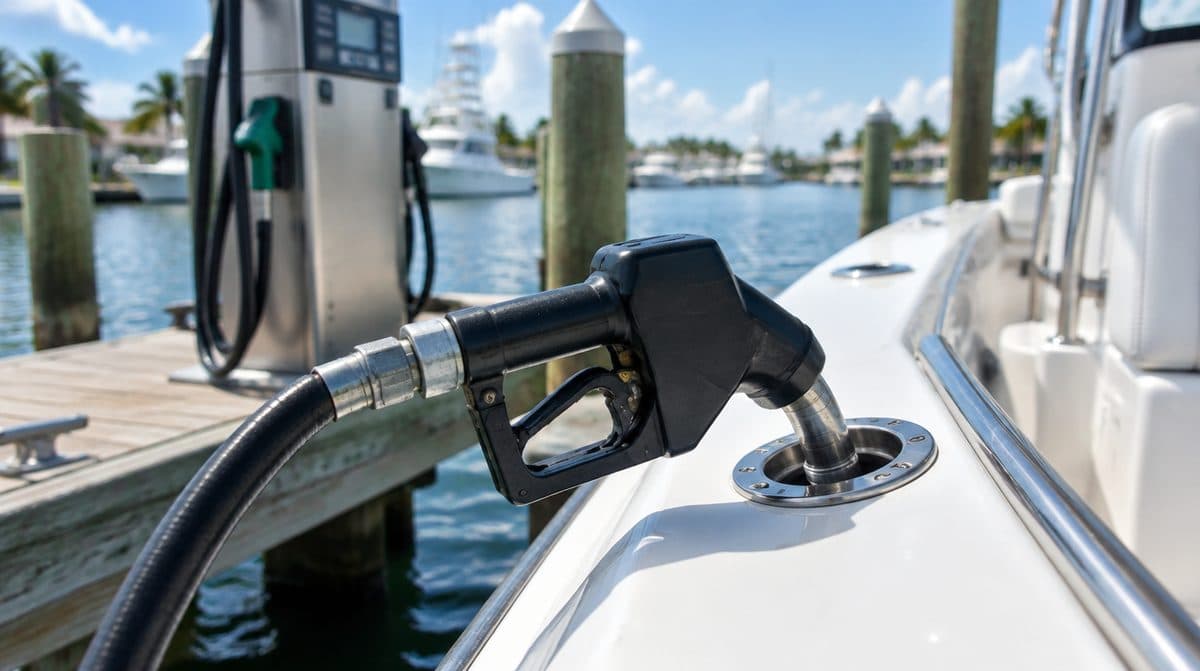
E10 and Your Marine Engine: Phase Separation, Storage, and Stabilizer Habits
Why the same gas your truck burns happily can wreck a boat engine: what E10 does in a vented marine tank, how phase separation works, and the habits that prevent it.
Nearly every gallon of regular gas at a Florida roadside station is E10, meaning it contains up to 10 percent ethanol. In your truck that is a non-event: the tank is sealed, the fuel turns over in a week, and the ethanol does its job invisibly. A boat is a different machine living in a different world, and E10 starts behaving badly the moment it sits in a vented tank in humid air.
What E10 does in a marine fuel system
Ethanol is hygroscopic, which is a chemist's way of saying it grabs water out of the air. Marine fuel tanks are vented to the atmosphere, and in Florida that atmosphere is a swamp, so a part-full tank breathes moist air in and out with every temperature swing while the ethanol soaks it up. Ethanol is also an aggressive solvent. In older boats it scours decades of varnish and gum off tank walls and sends the debris straight to your filters, and it attacks some older fuel lines and the resin in certain early fiberglass tanks outright.
Phase separation, the part you cannot undo
Here is the failure that matters. Ethanol holds absorbed water in suspension only up to a point. Past that point, the ethanol and water bond together and drop out of the gasoline as a distinct layer on the bottom of the tank. That is phase separation, and it is a double hit: the bottom layer is a corrosive water-and-alcohol mix sitting exactly where your fuel pickup drinks, and the gasoline left on top has lost the ethanol that was part of its octane rating. No additive reverses it. Once a tank has phase separated, the only fix is pumping it out and starting over with fresh fuel.
Why non-ethanol fuel earns its price
Boat ownership is mostly waiting between weekends, and sitting fuel is where ethanol does its damage. That is the case for ethanol-free gas, sold at most Florida fuel docks and many stations as REC-90: with no ethanol in the tank, there is nothing to pull in water and nothing to phase separate. It costs more per gallon, and it is still cheap compared to a carb rebuild or a corroded tank. For any boat that will sit more than a few weeks, and especially for summer layups and hurricane-season storage, non-ethanol is the easy call. It is not immortal, though. All gasoline degrades with time, so storage fuel still gets stabilizer.
Stabilizer habits that actually work
Stabilizer preserves fresh fuel. It does not resurrect old fuel, and it does not undo phase separation, so the habit matters more than the brand. Add it at the pump rather than back at the dock, so it mixes as the tank fills. Dose for the whole tank, not the splash you just added. Then run the engine long enough for treated fuel to reach the carburetors or injectors, because stabilizer sitting in the tank protects nothing downstream. Before a layup, fill with non-ethanol, stabilize, run it through, and your spring self will thank you. A clean fuel-water separator on the boat, with a spare element aboard, is the last line of defense either way.
If your engine is already stumbling, surging, or clogging filters, that is fuel-system work worth doing right: find a verified marine mechanic on Waypoint, or arrange fuel and pump-out service if a tank needs to come clean. Filters, separators, and stabilizer live in the shop.
More from the Wire
 Ownership
September 27, 2026
Hurricane Prep for Boat Owners: Write the Plan Before the Cone Shows Up
Haul or stay, doubled lines, stripped canvas, and the insurance fine print: the hurricane decisions Florida boat owners should make in May, not at the storm briefing.
Read more Ownership
September 25, 2026
Marine Batteries, Explained: Starting vs Deep Cycle, and Why Boats Eat Them
Starting, deep cycle, or dual purpose; flooded, AGM, or lithium. A plain-words guide to picking marine batteries and keeping them alive in Florida heat.
Read more Ownership
September 24, 2026
Bottom Paint in Florida Water: Ablative vs Hard, and When to Start Over
How ablative and hard antifouling paints actually work, what Florida water does to both, when a bottom needs stripping and barrier coat, and why your diver's report is gold.
Read more