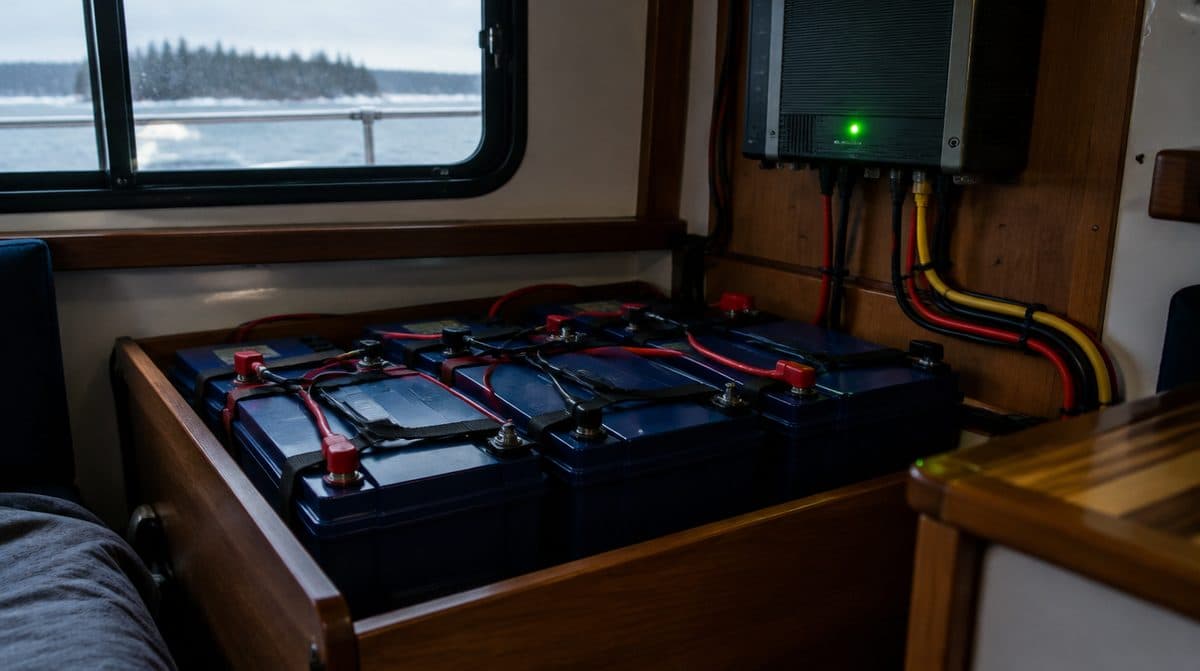
Batteries Over the Winter: Storage Charging Done Right
Tender or disconnect, aboard or at home, and why lithium wants different treatment than AGM: a plain guide to putting marine batteries away so they wake up healthy in spring.
More marine batteries die in storage than ever die on the water. They do not freeze to death so much as they are abandoned to death, left connected to a sleeping boat's small parasitic loads until they sit flat for months. The fix costs almost nothing. It just has to be done on purpose, and it differs by battery chemistry.
The two schools: tender vs disconnect
School one leaves the batteries aboard on a quality marine maintainer all winter, which works well when the boat has reliable shore power and the charger is a proper multi-stage maintainer, not a crude trickle charger from the car aisle. School two charges the batteries full, then disconnects them completely, pulling the negative leads or the battery switch to kill every hidden draw: the stereo memory, the gas detector, the bilge counter. Both schools work. The failure mode is the hybrid nobody chose, batteries left connected with no charger, where the boat's standby loads quietly drain them to a state they never recover from. A boat wintering in the water is the exception: its bilge pump must stay wired and its batteries must stay charged, which makes shore power and a maintainer mandatory, not optional.
Lead-acid and AGM
Flooded and AGM batteries want to be stored full, because a discharged lead-acid battery both sulfates and freezes far more easily than a charged one. They also self-discharge all winter on their own; Continental Battery puts AGM self-discharge at roughly 3 percent per month, which is why a battery stored in October at full charge still wants a top-up or a maintainer before spring. Clean the terminals, check electrolyte on flooded types, charge to full, then either maintain or disconnect. Cool storage is fine. Discharged storage is the killer.
Lithium plays by different rules
LiFePO4 batteries do not sulfate and barely self-discharge, so they do not want a winter on a float charger. Battle Born's own storage guidance is to charge its batteries, then disconnect them from all loads and chargers completely, noting they need no trickle charge and citing self-discharge of around 2 to 3 percent a month. The hard rule is cold charging: lithium cells can be permanently damaged if charged below freezing, a warning marine retailers like Wholesale Marine repeat, so a lithium bank left aboard must have a BMS with low-temperature charge protection or heated batteries before any winter charging source touches it. Storage temperature guidance varies by maker, so check your manual, but the pattern is consistent: charge, disconnect, leave alone.
Aboard or at the kitchen workbench
If the yard offers shore power and allows maintainers, leaving batteries aboard and connected to a good charger is fine for lead-acid and simplest all around. No power at the storage spot? Pull the batteries, take them home, store them off the concrete-floor myth and anywhere cool and dry, and top up lead-acid once or twice over the winter. Label the cables with tape before you pull anything. Spring-you will send thanks.
Come commissioning time, load-test anything older than a few seasons instead of discovering its weakness at the ramp. If the bank is due for an upgrade, winter is the time to have an installer look at the whole charging system rather than just swapping boxes. Waypoint lists marine electricians and mechanics across 13 states, every listing checked against the business's own website, at nautical.network/directory, and if the boat is already asleep somewhere far from home, post what you need at nautical.network/help. Batteries are the cheapest system on the boat to winter correctly, and the most expensive one to winter by accident.
More from the Wire
 Ownership
September 27, 2026
Hurricane Prep for Boat Owners: Write the Plan Before the Cone Shows Up
Haul or stay, doubled lines, stripped canvas, and the insurance fine print: the hurricane decisions Florida boat owners should make in May, not at the storm briefing.
Read more Ownership
September 26, 2026
E10 and Your Marine Engine: Phase Separation, Storage, and Stabilizer Habits
Why the same gas your truck burns happily can wreck a boat engine: what E10 does in a vented marine tank, how phase separation works, and the habits that prevent it.
Read more Ownership
September 25, 2026
Marine Batteries, Explained: Starting vs Deep Cycle, and Why Boats Eat Them
Starting, deep cycle, or dual purpose; flooded, AGM, or lithium. A plain-words guide to picking marine batteries and keeping them alive in Florida heat.
Read more