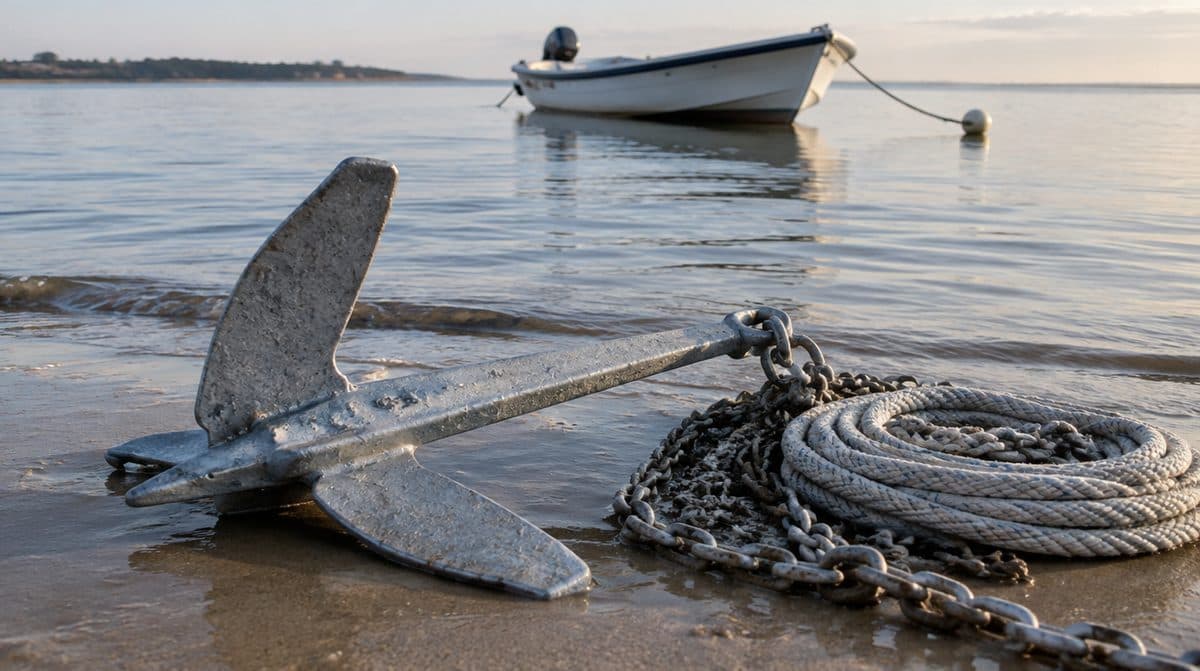
Why Your Anchor Drags (and How to Pick One That Won't)
Most anchors that drag were fighting the wrong bottom from the start. How to match anchor style to the seabed, size up with confidence, and build a rode that actually holds.
Nothing ruins a sandbar day faster than looking up and realizing your boat is drifting toward someone else's. Nine times out of ten, it's the wrong anchor or too little line.
The good news is that dragging is one of the most fixable problems in boating. Anchors are not magic, and they are not interchangeable lumps of metal either. Match the style to the bottom you anchor over, size it honestly for your boat, and give the rode the same attention you give the anchor, and you can set once and actually relax.
How an anchor actually holds
Weight helps, but it is not what keeps you put. An anchor holds by burying itself in the seabed and resisting horizontal pull. The lower and flatter the pull on the shank, the deeper the flukes dig as load comes on. Pull upward on that same anchor and it levers out of the bottom like a shovel, which is exactly how you retrieve it on purpose, and exactly how the wind retrieves it when you anchor lazily.
Almost every anchoring rule flows from that one fact. Chain keeps the pull low. Scope keeps the angle shallow. Backing down sets the flukes. When an anchor drags, something in that chain of events usually broke down long before the anchor itself lost its grip.
Match the anchor to the bottom
No single anchor is best everywhere. Pick for the bottom you anchor in most:
- Sand: fluke (Danforth style) anchors set fast and hold well
- Mud: fluke or plow style, with fluke anchors being the common choice
- Grass and weed: plow or scoop anchors penetrate better than flukes
- Rock and coral: a grapnel or claw style grabs better
If you run mixed bottoms, a modern scoop or plow anchor is the most versatile all-rounder. The fluke design earns its keep in soft bottoms: those big flat blades generate a lot of grip for very little weight, which is why lightweight aluminum fluke anchors are so popular on boats that live over sand and mud. The tradeoff shows up in grass, where the same flat blades tend to skate across the weed mat instead of cutting through to the bottom underneath.
Size by boat length and weight
Anchor sizing follows both boat length and displacement. Heavier boats and more windage need more holding power. A flybridge, a bimini, a tower, a cabin full of canvas: all of it acts like a sail when the wind pipes up, and your anchor feels every bit of it through the rode.
Always follow the manufacturer's sizing chart for your specific anchor model, because anchors of the same weight but different designs do not hold the same. And when you are between sizes, go up. An oversized anchor is cheap insurance, and the only penalty is a little more weight on the bow and a slightly harder haul at the end of the day.
Do not forget the rode
An anchor is only half the system. Your rode (the line and chain) matters just as much:
- Use a length of chain between the anchor and the line to improve the holding angle
- Carry 7 to 1 scope (7 feet of rode for every 1 foot of water depth) for secure anchoring
- Match line and chain size to your boat and anchor
The chain does two jobs. Its weight holds the first stretch of rode down near the seabed, which keeps the pull on the anchor shank low and flat, and it shrugs off the chafe of sand, shell, and rock that would chew through nylon line in a season.
Scope math is simple, so run it honestly. Measure the depth, add the height of your bow roller above the water, and multiply. Say you anchor in 8 feet of water and your bow sits 4 feet off the surface: that is 12 feet of effective depth, and 12 times 7 is 84 feet of rode. If paying out that much line feels excessive, that feeling is exactly why so many anchors drag.
Mistakes that drag boats
A few habits cause most of the trouble. Dropping the anchor and immediately cleating it short, so it never gets the scope to dig in. Throwing the anchor overboard in a heap so the rode fouls the flukes on the way down. Anchoring from the stern, which invites waves aboard and swings the boat in ways the hull was never shaped for. And shortening scope in a crowded anchorage to be polite: if there is not room for proper scope, there is not room to anchor safely. Pick another spot.
Look after the system
Anchors themselves are nearly immortal, but the hardware around them is not. Rinse everything with fresh water after use, especially shackles and swivels. Check the splice or knot where line meets chain, and wire or zip-tie the shackle pins so they cannot back out under load. Watch nylon rode for chafe and stiffness, and retire it when the fibers look fuzzy or glazed. If a fluke or shank comes up bent after a bad snag, replace the anchor rather than bending it back: straightened metal is weakened metal.
Carry two
Experienced boaters carry a primary anchor sized for their boat plus a second, often a different style, for changing conditions or as a backup. A compact fluke or grapnel stows almost anywhere and earns its keep the first time you snag your primary, want a stern anchor to hold the boat square to the beach, or need to lend one to the boat rafted alongside.
From the Water Once the anchor is set, back down on it gently. If the boat stops and the line goes tight, you're hooked. If it keeps creeping, pull it and reset before anyone jumps in. Take a transit while you are at it: find two fixed objects ashore that line up, like a dock piling against a roofline, and glance at them through the day. If they stay lined up, you are holding. If they slide apart, you know before anyone else in the anchorage does.
Where to Get It Everything in this guide is stocked at Boat Supplies Direct, the Nautical Network marine parts store. Orders ship free all year with Dock Pass, the $49 a year shipping pass.
In stock as this guide goes up: - Fortress FX-11 Anchor (7 lb) - Fortress FX-37 Anchor (21 lb) - Ankerplex Stainless Steel Anchor (1.5 kg, for boats to 18 feet)
Browse the full range: - Shop anchors - Read the full buying guide, including FAQs
More from the Wire
 Buying Guides
October 19, 2026
Windlasses: Save Your Back and Anchor Anywhere
A windlass turns anchoring from a back workout into a button press, which means you anchor more and drag less. How to size pulling power, pick a layout, and match the gypsy to your rode.
Read more Buying Guides
October 19, 2026
Dock Lines 101: Size, Length, and the Lines Most Boaters Forget
Bow and stern lines are the easy part. Line diameter, length, and the spring lines most boaters never rig, explained by boat size.
Read more Buying Guides
October 19, 2026
Galvanic Isolators: Stop the Dock From Eating Your Boat
If your anodes vanish at the marina but last on the mooring, the dock is the suspect. What a galvanic isolator actually does, and how to size one without giving up your safety ground.
Read more