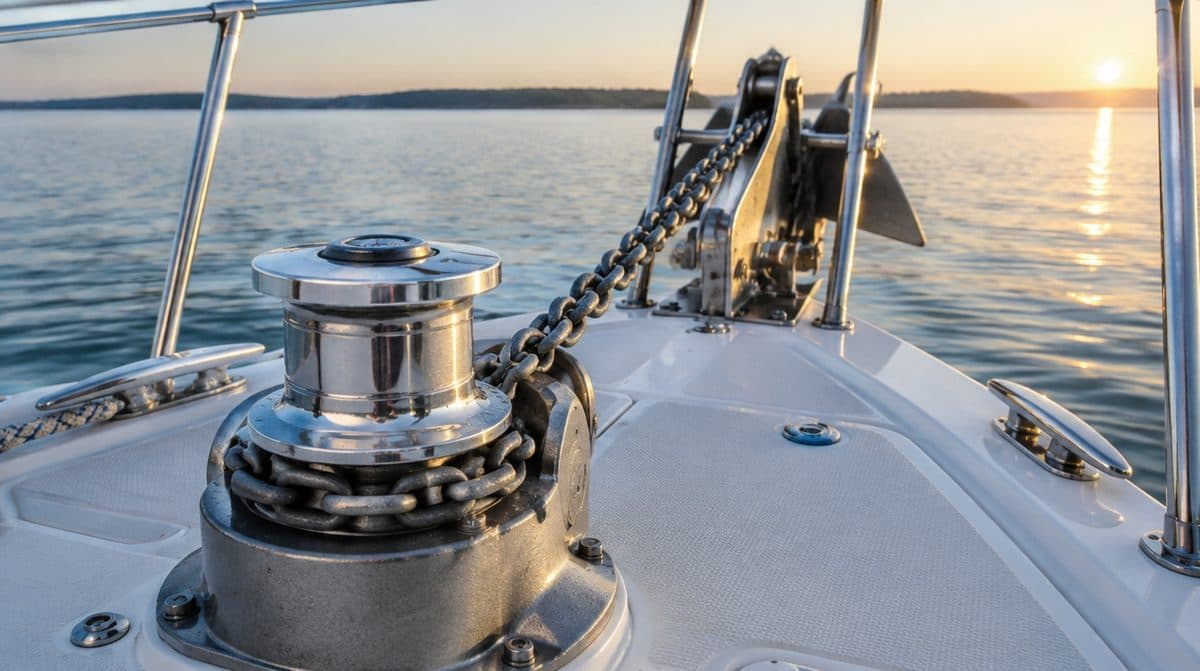
Windlasses: Save Your Back and Anchor Anywhere
A windlass turns anchoring from a back workout into a button press, which means you anchor more and drag less. How to size pulling power, pick a layout, and match the gypsy to your rode.
Hauling an anchor and chain by hand gets old fast, especially in deep water. It is hard on your back, hard on your gelcoat, and hard on your enthusiasm for anchoring at all. A windlass changes the math completely: anchoring becomes a button press, so you do it more often, in more places, and you re-anchor without grumbling when the first set isn't right. That last part quietly makes you a safer boater.
Picking the right windlass comes down to four decisions: how much pulling power, vertical or horizontal, which gypsy, and how you will feed it electricity. Get those right and the install is straightforward. Get one wrong and you will be fighting the thing for years.
How a Windlass Actually Works
A windlass is an electric motor turning a gearbox, which turns a gypsy: the notched wheel that grips your chain or rope and hauls it in. A clutch lets the gypsy freewheel so you can drop anchor under gravity instead of motoring it down, and a manual override gets the anchor up if the electrics ever quit. Many units add a drum (a smooth capstan) above or beside the gypsy for hauling plain line.
Understanding that layout explains most of the buying decisions. The gypsy has to match your rode exactly, the motor has to be strong enough for your ground tackle, and the whole assembly has to physically fit your bow and your anchor locker.
Pulling Power: The 3 to 4 Times Rule
A windlass should be rated to pull at least 3 to 4 times the combined weight of your anchor and all your rode. Add up the anchor, every foot of chain, and every foot of rope, and multiply.
Here is a hypothetical to make it concrete: say your anchor and full rode add up to 100 pounds of ground tackle. You would look for a windlass rated for at least 300 to 400 pounds of maximum pull. That margin is not padding for marketing's sake; the windlass has to break the anchor out of the bottom, lift rode that is heavier when it is wet and muddy, and do it all with the bow pitching. Size up for bigger ground tackle and heavier boats, and when you are between models, buy the stronger one. Nobody has ever complained that their windlass pulls too well.
Vertical vs. Horizontal
- Vertical windlasses put the motor below deck. They save deck space, keep weight low, look clean, and give the chain a generous wrap around the gypsy. They are the pick when you have a deep anchor locker and access below to mount the motor.
- Horizontal windlasses keep the whole unit above deck in one sealed package. Installation is simpler, especially where there is no access below, but you need enough locker depth for the chain to fall away freely, and the unit itself takes up foredeck real estate.
The deciding factor is usually your locker, not your preference. The chain needs room to pile up and fall away from the gypsy; measure that drop before choosing.
Rope, Chain, or Combo Gypsy
Match the gypsy to your exact rode: all chain, or a rope-chain combo. Mismatched gypsy and rode is the top windlass complaint, and it shows up as chain skipping, rope slipping, or the splice jamming at the worst possible moment.
Gypsies are machined for a specific chain size and type and a specific rope diameter. "Close enough" does not exist here. If you are buying the windlass first, commit to the rode it is designed for; if you have rode you love, choose the windlass around it. And if you are running a combo rode, the rope-to-chain splice has to be a proper tapered splice, because that is the part the gypsy has to swallow smoothly on every retrieve.
Power and Wiring Realities
Windlasses draw big current, on the order of a starter motor, and they do it at the far end of the boat from the battery. Plan for heavy cable sized for the round-trip run, a dedicated breaker to protect the circuit, and ideally a battery near the bow so you are not dragging full current the length of the hull. Undersized cable is the silent killer of windlass performance: the motor sees low voltage, pulls weakly, runs hot, and dies young.
Run the engine while hauling anchor so the alternator carries part of the load. And if battery cable sizing and breaker selection are outside your comfort zone, this is a genuinely good job for a verified marine electrician on Waypoint; it is a half-day of work that determines how the windlass behaves for the rest of its life.
Installation: Deck, Locker, and Fall
The windlass mounts through the deck with a backing plate below, because it transmits real load into the laminate. Line it up carefully with the bow roller so the rode feeds straight onto the gypsy; a misaligned feed wears both. Below, confirm the chain pipe drops the rode into the deepest part of the locker and that the pile cannot build up and jam the pipe. A chain stopper or snubber ahead of the windlass takes the anchoring load off the gearbox once you are set, which is how the windlass survives long term.
Maintenance and Lifespan
Rinse the windlass with fresh water after salt trips, and periodically open the clutch, clean and lightly grease it, and check the motor connections below deck for corrosion. Inspect the gypsy for wear where it grips the chain. A windlass that is rinsed, greased, and never used as a mooring cleat will serve for many seasons; one that holds the full anchoring load every night will not.
From the Water
Use the windlass to lift the anchor, not to drag the boat. Idle up slowly over the anchor so the windlass is only ever lifting, never towing a boat against wind and current. The motor and gearbox are sized for vertical work, and driving the boat up to the anchor with the engine is the single best habit for making the whole system last.
Where to Get It
Everything in this guide is stocked at Boat Supplies Direct, the Nautical Network marine parts store.
In stock as this guide goes up: - Davis Shockles anchor snubber, black - Wichard chain grip for 3/8 inch (10mm) chain - Quick SW10 anchor swivel, 10mm stainless, for 16 to 44 pound anchors
Browse the full range: - Shop anchoring accessories - Read the full buying guide, including FAQs
More from the Wire
 Buying Guides
October 18, 2026
Starting vs. Deep Cycle: The Battery Mistake That Strands Boaters
Starting, deep cycle, or dual purpose, and flooded, AGM, or lithium. How to pick the battery type that will not leave you stranded.
Read more Buying Guides
October 18, 2026
The Onboard Charger: Cheap Insurance for Expensive Batteries
Batteries die young when they sit half-charged. How to size an onboard charger by amps, banks, and chemistry.
Read more Buying Guides
October 18, 2026
Battery Switches and Isolators: Never Get Stranded by a Dead Battery
The switch and isolator setup that keeps your starting battery ready while the house bank runs your gear.
Read more