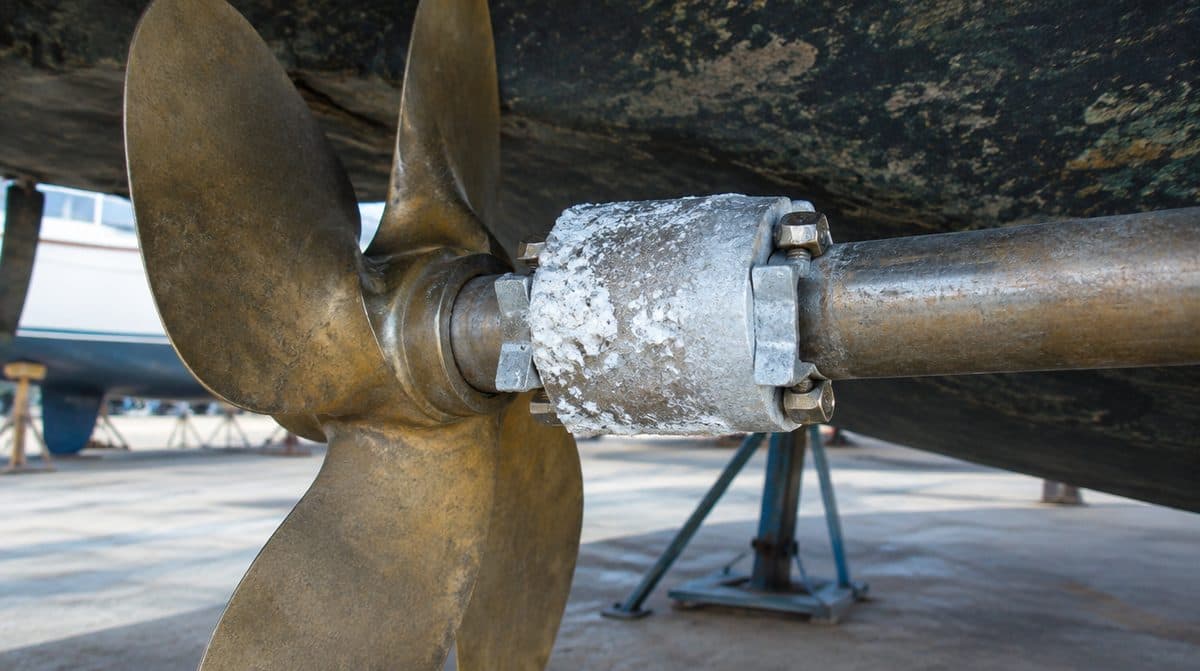
Sacrificial Anodes: The Cheapest Way to Protect Your Engine
The cheapest part on your boat exists to be destroyed. Picking the right anode metal for your water is the difference between quiet protection and an expensive surprise at haul-out.
Anodes are designed to dissolve so your lower unit, shaft, and props don't. That is the entire job description: bolt on an inexpensive chunk of metal, let the water eat it instead of your running gear, and replace it when it is mostly gone. It is the cheapest insurance on the boat, and using the wrong metal for your water is one of the most expensive mistakes in boating.
Why your boat needs a sacrificial part
Put two different metals in water that conducts electricity and you have built a crude battery. Current flows between them, and the less noble metal gives up material to protect the more noble one. Your boat is full of mixed metals living in exactly those conditions: a bronze prop on a stainless shaft, an aluminum outdrive bolted near stainless trim tabs. Left alone, the most vulnerable metal in that lineup corrodes first, and it is usually something expensive. An anode fixes the lineup by volunteering. It is deliberately the most active metal in the water, so the corrosion goes there, and everything bonded to it gets protected. That only works when the anode really is the most active metal in the circuit, which is why matching the metal to your water matters so much.
Match the anode metal to your water
- Zinc: saltwater. The traditional choice, and the reason boaters still call every anode a "zinc."
- Aluminum: saltwater and brackish water, and increasingly the all-around default. It protects well in both and keeps working where zinc struggles in brackish water.
- Magnesium: freshwater only. It is active enough to protect properly in fresh water, but using magnesium in salt destroys it fast.
Using the wrong metal for your water means either no protection or anodes that vanish in weeks. Zinc in fresh water tends to form a crust and go passive, quietly doing nothing while looking fine. Magnesium in salt fizzes away in no time. If your boat moves between waters, aluminum is the sensible pick for salt and brackish, and a swap to magnesium if the boat settles into a freshwater life.
Where anodes go
Outboard and sterndrive anodes, shaft collars, rudder and trim tab anodes, and hull plate anodes. Outboards and sterndrives usually hide several: on the anti-ventilation plate, the gearcase, the trim cylinders, and the mounting bracket. Inboard boats carry collar anodes clamped around the prop shaft, discs or bars on rudders and trim tabs, and sometimes a bolted hull plate tied into the bonding system. Engines and generators with raw water cooling often have pencil anodes threaded into the heat exchanger, easy to forget because you cannot see them from the dock. Find every anode your boat carries (the engine manual lists the hidden ones) and replace any anode when it is about half consumed.
Fit and contact matter
An anode protects only what it is electrically connected to. That means bare, bright metal under the mounting surface: clean off oxidation before installing, never put sealant, paint, or grease under the contact area, and bolt it down snug. Shaft anodes must match the shaft diameter exactly, a 1 inch collar on a 1 inch shaft, tightened so it cannot spin or slide. A loose anode is not sacrificing itself for you; it is just cargo. While the boat is out of the water, give every anode a wiggle check along with your visual once-over.
Do not paint them
Never paint or coat an anode. It has to be bare metal in contact with the water to work. This sounds too obvious to mention, right up until the yard rolls bottom paint over everything in the spring rush, or you discover a previous owner "protected" the anodes with a tidy coat of primer. Mask them before painting and inspect them after.
Read your anodes like gauges
Anodes are a free diagnostic instrument. Even, moderate wear over a season means the system is working as designed. An anode that disappears in weeks is a warning: either the wrong metal for the water, or stray electrical current from your boat or a dock neighbor turning your anodes into a buffet. Stray current corrosion can do serious damage quickly, and finding the source is real electrical detective work with a meter, not guesswork. That is the moment to bring in a verified marine electrician on Waypoint rather than keep feeding the problem fresh anodes.
Mistakes to avoid
- Buying by price instead of metal. The savings on the wrong anode are a rounding error next to a new outdrive.
- Mixing anode metals on the same boat. Pick the right metal for your water and standardize on it.
- Waiting until an anode is completely gone. Half consumed is the replacement line, because the last half never wears predictably.
- Forgetting the hidden ones: pencil anodes in the heat exchanger and the anode tucked inside many water heaters.
From the Water
If an anode still looks brand new after a full season, don't celebrate. It may not be working, usually because it was painted or isn't making good contact. Pull it, clean the mating surface back to bright metal, and remount it snug. An anode that never wears is telling you the protection circuit is broken, and the corrosion is happening somewhere you are not looking.
Where to Get It
Everything in this guide is stocked at Boat Supplies Direct, the Nautical Network marine parts store.
In stock as this guide goes up: - Tecnoseal X3 Shaft Anode, Zinc, 1" Shaft Diameter - Tecnoseal R5 Rudder Anode, Zinc, 5" Diameter - Tecnoseal Anode Kit with Hardware for Mercury Bravo 3 (2004 to Present), Zinc
Browse the full range: - Shop anodes - Read the full buying guide, including FAQs
More from the Wire
 Buying Guides
October 18, 2026
Starting vs. Deep Cycle: The Battery Mistake That Strands Boaters
Starting, deep cycle, or dual purpose, and flooded, AGM, or lithium. How to pick the battery type that will not leave you stranded.
Read more Buying Guides
October 18, 2026
The Onboard Charger: Cheap Insurance for Expensive Batteries
Batteries die young when they sit half-charged. How to size an onboard charger by amps, banks, and chemistry.
Read more Buying Guides
October 18, 2026
Battery Switches and Isolators: Never Get Stranded by a Dead Battery
The switch and isolator setup that keeps your starting battery ready while the house bank runs your gear.
Read more