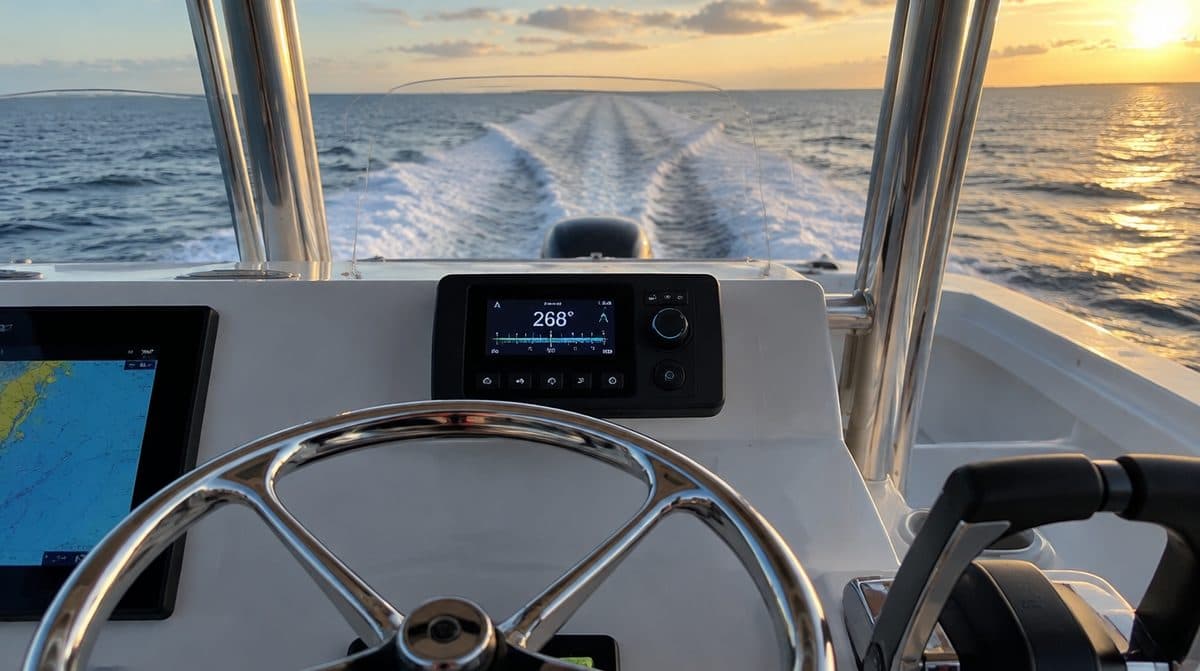
Marine Autopilots: Let the Boat Steer While You Watch the Water
The control head is the easy part. The drive unit behind your steering is where autopilots get mismatched, and where the money goes right or wrong.
On a long run, holding a heading by hand gets old fast. Your eyes lock on the compass, your shoulders tighten, and the fun drains out of the trip mile by mile. An autopilot lets you keep watch, check the spread, grab a sandwich, or just relax while the boat holds a straighter course than most of us can steer by hand.
It is also one of the more confusing purchases in marine electronics, because the right answer depends entirely on your boat. Here is how to sort it out.
How an Autopilot Actually Works
Every marine autopilot is three parts working as a team. A heading sensor, which is a solid-state electronic compass, tells the system which way the bow is pointing. A course computer compares that heading to the course you asked for and decides how much rudder to apply. A drive unit does the physical work, either by pumping hydraulic fluid through your steering system or by moving the mechanical linkage your helm already uses.
The control head at the helm, the part with the buttons and the display, is just the remote. It is the easiest part to shop for and the least important to get right. The drive unit is where boats and autopilots get mismatched, so that is where your homework goes.
Match the Drive to Your Steering
- Hydraulic steering: needs a hydraulic pump drive sized to your steering volume.
- Mechanical/cable steering: needs a mechanical drive unit.
- Outboards: often use a dedicated drive that ties into the engine.
Matching the drive to your steering type and boat size is the key decision.
For hydraulic boats, find the capacity of your steering cylinder before you shop. Pump drives are rated by how much fluid they move, and every autopilot maker publishes which pump pairs with which cylinder sizes. For cable-steered boats, the drive attaches behind the dash or along the cable run, so measure your space before committing. And many late-model outboards with electronic steering accept autopilots that talk straight to the engine, which makes for a much cleaner install than bolting hardware into the bilge.
Not sure what steering you have? Turn the wheel with the engine off. Smooth and silent usually means hydraulic. A faint rasp or visible cable movement back at the motor means mechanical.
Size to Displacement
The drive must be powerful enough for your boat's weight and the conditions. Undersizing means sloppy steering in a seaway.
Size to the boat as it actually leaves the dock: fuel, water, ice, gear, and crew, not the dry weight in the brochure. Manufacturers rate each drive for a maximum displacement, and if your loaded weight lands near the top of a drive's range, step up to the next one. An oversized drive loafs along and lasts. An undersized drive hunts back and forth, chews through its own gears, and steers like a tired helmsman the moment a following sea starts shoving the stern around.
Conditions count double here. A pilot that holds a lovely line on a calm bay works far harder offshore, so buy for the worst day you plan to run, not the best one.
Integration With Your Electronics
Modern autopilots tie into your chartplotter to follow routes, not just hold a heading. Confirm compatibility with your electronics network.
Most current systems connect over an NMEA 2000 network, which lets the pilot steer to a route from the plotter, retrace a track, or run patterns while you fish. Staying inside one brand family usually unlocks the best features, like commanding the pilot straight from the chartplotter screen instead of a separate control head. If you are building a helm from scratch, choose the plotter and pilot as a pair rather than one at a time. Our chartplotter and fishfinder guide covers that half of the system.
Installation Realities
Plan for a full day or more, not an afternoon. A hydraulic install means tee fittings in the steering lines, a pump mounted close to the cylinder, and a careful purge afterward to get air out of the system. Air in the lines makes any hydraulic autopilot feel vague and lazy, and it gets blamed on the electronics every time.
The heading sensor is the sleeper issue. It needs a mounting spot low in the boat, near the centerline, and well away from anything magnetic: speakers, wiper motors, tool boxes, the anchor and chain. A heading sensor mounted next to a subwoofer will have the pilot wandering all day while you blame the wrong component.
After everything is wired, the system needs calibration: a compass swing in open water plus a sea trial so the course computer can learn how your boat responds to the helm. Do not skip it. An uncalibrated pilot steers like a rental.
Mistakes to Avoid
- Sizing to brochure dry weight instead of real loaded weight.
- Falling in love with a control head, then discovering no drive fits your steering.
- Mounting the heading sensor near speakers, pumps, or wiring bundles.
- Skipping the sea trial calibration and blaming lazy steering on the hardware.
- Treating the pilot like a crew member. It holds a course. It does not look out the window.
From the Water
Autopilot does not mean nobody's on watch. Keep someone at the helm scanning ahead, especially near shore and other traffic. The pilot will happily steer a perfect straight line into a crab pot buoy, a floating log, or an anchored boat, because it cannot see any of them. Treat it as a tireless hand on the wheel, never as a lookout.
Where to Get It
Everything in this guide is stocked at Boat Supplies Direct, the Nautical Network marine parts store.
In stock as this guide goes up: - Garmin GPSMAP 8610xsv GPS/Fishfinder Combo, a networked big-screen plotter built to command a Garmin pilot right from the helm - Garmin ECHOMAP Ultra 2 106sv with GT56UHD-TM Transducer (remanufactured), the route-planning brain an autopilot follows
Browse the full range: - Shop electronics - Read the full buying guide, including FAQs
More from the Wire
 Buying Guides
October 18, 2026
Starting vs. Deep Cycle: The Battery Mistake That Strands Boaters
Starting, deep cycle, or dual purpose, and flooded, AGM, or lithium. How to pick the battery type that will not leave you stranded.
Read more Buying Guides
October 18, 2026
The Onboard Charger: Cheap Insurance for Expensive Batteries
Batteries die young when they sit half-charged. How to size an onboard charger by amps, banks, and chemistry.
Read more Buying Guides
October 18, 2026
Battery Switches and Isolators: Never Get Stranded by a Dead Battery
The switch and isolator setup that keeps your starting battery ready while the house bank runs your gear.
Read more