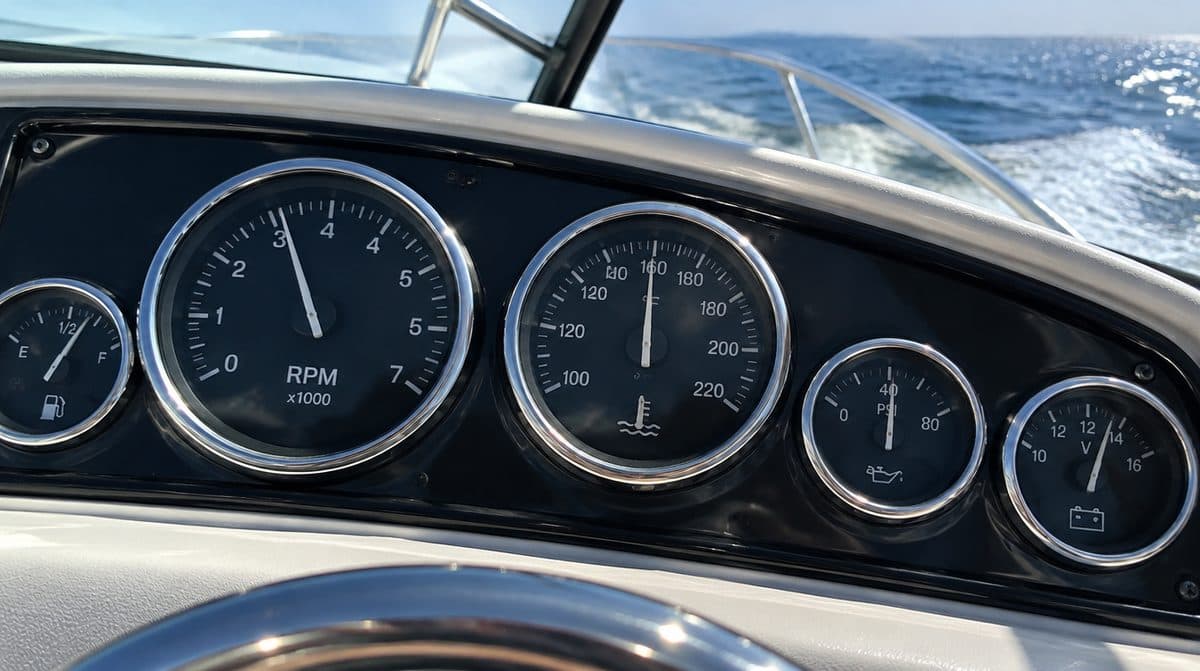
Marine Gauges: Know Your Engine's Health at a Glance
A gauge wired to the wrong sender moves convincingly while reading fiction. How to build a panel that tells the truth about your engine.
Your gauges warn you about trouble before it turns into a breakdown, but only if they're reading correctly. A temperature needle that starts creeping before the alarm ever sounds is the difference between idling home to clear a clogged intake and drifting offshore while everything cools down. Here is how to buy gauges that tell the truth.
Match Brand and Sender
Gauges read from senders, and the gauge must match the sender's resistance range and your engine. Mixing mismatched gauges and senders gives wrong readings, so buy matched sets or confirm compatibility.
A sender is the small transducer on the engine or in the tank that converts temperature, pressure, or fuel level into electrical resistance. The gauge is just a meter calibrated to a specific resistance range, and different brands and regions use different ranges. Put a gauge on a sender from the wrong standard and it will move convincingly while reading fiction: a tank that shows half full when it is nearly dry, or oil pressure that looks healthy on a tired engine. When you replace a gauge, verify or replace the sender at the same time, and when in doubt buy the matched pair from one brand.
Essential Gauges
- Tachometer (RPM) and speedometer
- Fuel level
- Water temperature and oil pressure
- Voltmeter and trim
Prioritize engine-health gauges (temp, oil pressure, volts), since those warn you before a small problem becomes a big one.
The tach earns its keep too: seeing an unusual RPM at your normal throttle setting is an early hint of a fouled prop, a slipping hub, or ventilation. The voltmeter is the cheapest insurance on the panel, because charging problems announce themselves there long before the engine refuses to crank. Trim matters on outboards and sterndrives for both ride and fuel burn. Speed, honestly, is the one reading your GPS already does better.
If you are outfitting a panel from scratch, cover the health gauges first and add the nice-to-haves later. A helm with temp, oil pressure, volts, and a tach tells you nearly everything that matters about the engine's day. An hourmeter, whether standalone or built into the tach, quietly earns its spot too, since oil changes, impellers, and winterization all run on engine hours, not calendar months.
Analog vs. Digital
Analog gauges are simple and proven. Digital and multifunction displays consolidate many readings and can integrate with NMEA 2000. Match the look and function to your helm.
Analog wins on simplicity: one gauge, one sender, a few wires, and your eye learns needle positions so well you can spot wrong without reading a number. Digital multifunction displays consolidate a whole panel into one screen, log history, and alarm on thresholds. The bridge between the two worlds is a gateway that converts your existing analog senders into network data, so the chartplotter can show engine readings without an engine swap. If that route appeals to you, our NMEA 2000 networking guide explains the backbone those displays plug into.
Size and Fit
Standard gauge diameters (like 2 inch and 3 inch) must match your dash cutouts. Confirm the hole size before buying.
Measure the actual hole, not the old gauge's bezel, since bezels overhang the cutout. Tachs and speedos usually take the larger holes, with the supporting cast in the smaller ones. If you are cutting a fresh dash, lay the panel out so the engine-health gauges sit in your natural sight line and the occasional-glance gauges live out at the edges.
Installation and Wiring Realities
Gauge wiring is simple but rewards neatness: a switched 12V feed, a solid ground, the sender wire, and a lighting wire tied into the helm's instrument lighting circuit. Most bad readings trace back to grounds, not gauges. The sender's signal is resistance measured against ground, so a corroded ground path adds resistance and skews readings across the panel. If all your gauges drift together, chase the ground before you replace anything.
When a Gauge Is Lying
The evidence usually points at the sender or the wiring rather than the gauge itself: a needle pegged high or low, readings that bounce with engine vibration, or a fuel gauge that swings wildly in chop, which is often a sticky float in the tank. A fogged lens means the case seal has failed and corrosion is coming for the movement. To split gauge from sender, test the gauge against a substitute resistance per the maker's instructions, or swap in a known-good sender. If you are still unsure, replace gauge and sender as a set. Mismatched guesswork is how panels end up untrusted.
From the Water
Learn your engine's normal temperature and oil pressure at cruise. Any change from normal is your early warning, even if it's still in the green. Snap a phone photo of your panel at cruise on a normal day and keep it, because "the needle usually sits right there" is a genuinely useful diagnostic tool.
Where to Get It
Everything in this guide is stocked at Boat Supplies Direct, the Nautical Network marine parts store.
In stock as this guide goes up: - VDO Cockpit International Gen II 4K RPM Tachometer with Hourmeter, rev counter and engine-hours log in a single hole - VDO Cockpit Marine 52mm Water Temperature Gauge, White Dial with Chrome Bezel, the early-warning gauge every helm needs - Veratron LinkUp Analog to NMEA 2000 Gateway, puts your existing senders on the network and the chartplotter screen
Browse the full range: - Shop gauges - Read the full buying guide, including FAQs
More from the Wire
 Buying Guides
October 18, 2026
Starting vs. Deep Cycle: The Battery Mistake That Strands Boaters
Starting, deep cycle, or dual purpose, and flooded, AGM, or lithium. How to pick the battery type that will not leave you stranded.
Read more Buying Guides
October 18, 2026
The Onboard Charger: Cheap Insurance for Expensive Batteries
Batteries die young when they sit half-charged. How to size an onboard charger by amps, banks, and chemistry.
Read more Buying Guides
October 18, 2026
Battery Switches and Isolators: Never Get Stranded by a Dead Battery
The switch and isolator setup that keeps your starting battery ready while the house bank runs your gear.
Read more