Building a Boat Sound System That Survives Salt and Sun
Car audio on a boat ends in corrosion, usually by the second season. How to build a marine system that plays over wind and engine noise and survives the salt.
A sandbar day without music just isn't the same. But car audio on a boat is a short experiment that ends in corrosion. Salt air finds every unsealed circuit board, sun bleaches every cone, and within a season or two the system that sounded great at the dock is crackling, fading, and growing green fuzz on its terminals. Building a system that lasts on the water is not hard, it just starts with one rule.
Buy marine-rated, always
Marine head units and speakers are sealed and UV-treated against salt, moisture, and sun. Car audio will corrode and fade fast on a boat. The difference is not marketing. Marine gear uses conformal-coated circuit boards that shrug off humidity, stainless or coated hardware, UV-stable cone and grille materials, and sealed connections. Even if you boat in fresh water, your electronics live outside in spray, rain, and direct sun all season. Car gear was designed for none of that.
Head unit features
The head unit is the brain, so pick it for the features you will actually use on the water:
- Bluetooth streaming
- Waterproof or conformal-coated face
- Multi-zone output for separate cockpit and cabin volume
Multi-zone is the sleeper feature. It lets the kids have volume at the bow while the helm stays civilized, or keeps the cabin quiet while the cockpit party continues. A wired remote at the transom or tower is worth planning for too, so nobody has to drip their way back to the helm to skip a song. If you run a chartplotter, many marine stereos can also be controlled right from the MFD screen, which keeps the dash clean.
Speakers and power
Open-air boats lose sound to wind and water, so you need more speakers and more power than a car. There are no walls and no roof to hold the sound in, and at cruise there is a steady headwind trying to blow it all behind you. The fix is coverage: more speakers playing at moderate volume will always sound better than two speakers screaming. Coaxial speakers for general use, tower speakers for watersports boats that need to throw sound across the water.
Place speakers near where people actually sit, aimed at ears rather than shins, and split your coverage between bow and cockpit so no single pair has to do all the work.
Tower speakers
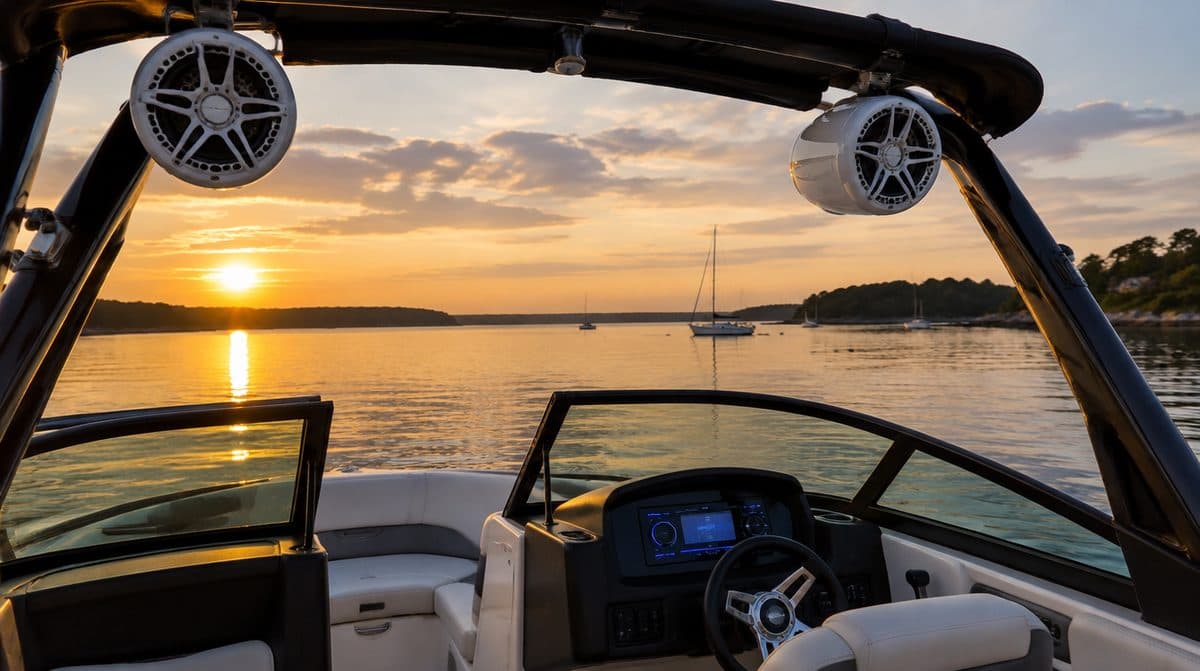
Tower speakers are a different animal. They use horn-loaded or high-output designs made to project sound a rope length behind the boat, so the rider gets music instead of engine noise. Mounted on a wake tower or hardtop, they also double as very capable sandbar speakers. If your boating involves anyone on a rope, they are the upgrade that changes the day.
Amps and subs
An amplifier makes marine speakers come alive over engine and wind noise. Head unit power alone runs out of headroom quickly outdoors, and an underpowered system driven hard distorts, which is what actually damages speakers. A marine subwoofer adds the low end that open air swallows; without one, even good speakers sound thin once you leave the dock. A compact amplified stereo and subwoofer combo can cover a smaller boat in one tidy package.
Power and wiring realities
A real system draws real current, especially at anchor with the engine off. Use marine-grade tinned wire sized for the run, fuse the amplifier feed close to the battery, and seal every connection with adhesive-lined heat shrink. Then think about your battery budget: hours of music at the sandbar comes out of your house bank, and there is no sadder sound than the playlist dying at mid-afternoon because nobody budgeted for it. Our marine battery guide covers how to size a house bank that keeps the playlist alive and still starts the engine.
Maintenance and lifespan
Marine audio is built to survive the environment, not to ignore it. Keep snap-in speaker grilles clear of debris, and pull them once in a while to rinse behind. If your head unit has a protective flip cover, use it; if not, a simple snap cover keeps sun off the face when the boat sits. At winterization, hit exposed connectors with dielectric grease and make sure nothing is sitting in a puddle behind the dash. The usual end-of-life signs are honest ones: a crackling channel that moves when you wiggle the harness means corroded connections, while sun-stiffened cones and surrounds mean the speakers themselves are done.
Mistakes to avoid
- Installing car speakers because they fit the hole. They fit until the cones fade and the frames rust.
- Skipping the amplifier, then blaming the speakers for sounding weak at cruise.
- Undersized power wire that starves the amp exactly when you turn it up.
- Mounting the head unit where spray or downpours hit it directly, even a water-resistant face appreciates a little shelter.
From the Water
Rinse your speaker grilles with fresh water after salty days. Dried salt is what slowly eats grilles and terminals. It takes ten seconds with the wash-down hose while you are rinsing the deck anyway, and it is the difference between grilles that stay clean and grilles that bloom white crust by August.
Where to Get It
Everything in this guide is stocked at Boat Supplies Direct, the Nautical Network marine parts store.
In stock as this guide goes up: - Fusion MS-RA70NSX stereo with AM/FM, Bluetooth, and SiriusXM, 2-zone (remanufactured) - Roswell R1 Pro tower speakers, black, 200W RMS - Aquatic AV SWA6 amplified Bluetooth stereo and subwoofer combo
Browse the full range: - Shop stereos - Tower speakers - Read the full buying guide, including FAQs
More from the Wire
 Buying Guides
October 18, 2026
Starting vs. Deep Cycle: The Battery Mistake That Strands Boaters
Starting, deep cycle, or dual purpose, and flooded, AGM, or lithium. How to pick the battery type that will not leave you stranded.
Read more Buying Guides
October 18, 2026
The Onboard Charger: Cheap Insurance for Expensive Batteries
Batteries die young when they sit half-charged. How to size an onboard charger by amps, banks, and chemistry.
Read more Buying Guides
October 18, 2026
Battery Switches and Isolators: Never Get Stranded by a Dead Battery
The switch and isolator setup that keeps your starting battery ready while the house bank runs your gear.
Read more