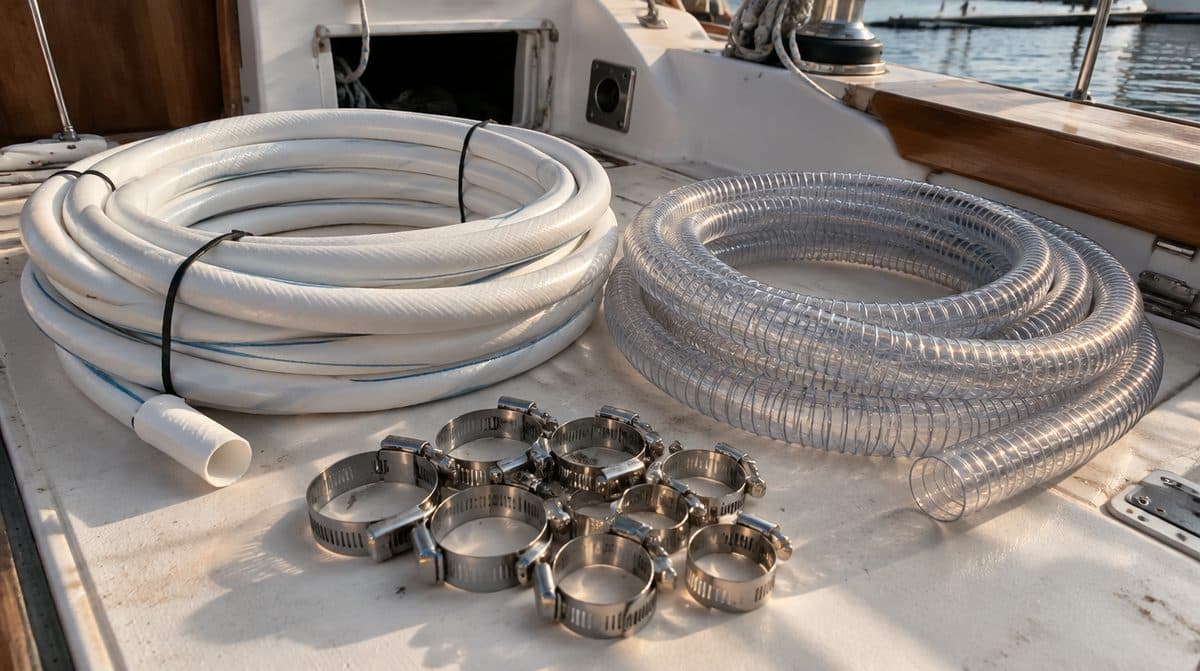
Marine Hose: The Right Hose for Every Job on Board
That head smell you cannot scrub away is probably the hose itself. How to match marine hose to fuel, sanitation, bilge, and freshwater jobs.
A cracked fuel line or a sanitation hose that smells no matter what you do usually comes back to using the wrong hose for the job. Hose is the circulatory system of a boat, and it is also the gear most likely to get substituted with whatever was lying in the garage. The hardware store has hose. The auto parts store has hose. Neither has marine hose, and the difference is not marketing.
Why Marine Hose Is Its Own Category
A hose on a boat lives a harder life than almost any hose ashore. It bakes in an engine compartment, soaks in bilge water, flexes with the hull, and carries everything from raw sewage to gasoline, often within a few feet of each other. Marine hose is built for the specific fluid, pressure, and failure consequences of each job, and it is labeled accordingly. That printed rating along the side of the hose is the whole story: a hose with no rating is a hose with no job on board.
Match the Hose to the Job
- Sanitation hose: odor-resistant, for heads and holding tanks.
- Bilge/livewell hose: flexible, often clear with a helix.
- Fuel hose: fuel-rated and fire-resistant, never substitute.
- Water/pressure hose: for freshwater systems.
Using the wrong hose, especially for fuel or sanitation, causes leaks, odor, or fire risk.
A little more on each. Sanitation hose is engineered against permeation, the slow migration of odor molecules through the hose wall itself. Ordinary hose carrying blackwater will smell within a season or two no matter how clean the system is, and no cleaner on earth fixes it, because the smell is in the plastic. Fuel hose carries ratings printed right on the jacket for a reason: it must resist the fuel inside, the heat around it, and keep holding together long enough to matter in a fire. Anything without the proper marine fuel rating is a substitute, and substitutes are how boats burn. Bilge and livewell hose is about flexibility and flow, and the clear versions earn their keep by showing you what is moving. Freshwater hose should be rated drinking water safe, because hose that is not can leave your tank water tasting like a pool toy. And wet exhaust hose, if your boat has an inboard, is its own specialized, heat-rated animal: never improvise there.
Reinforced vs. Smooth Bore
Reinforced hose resists kinking and collapse under suction. Smooth-bore sanitation hose resists clogs and odor permeation.
The distinction matters most on suction runs. A pump pulling water through an unreinforced hose can collapse it flat, and a collapsed hose looks fine from the outside while passing almost nothing. Anywhere a hose is on the suction side of a pump, or makes a tight bend, you want wire or helix reinforcement. Inside the hose, smooth bore wins: a corrugated interior grabs debris and tissue, which in a sanitation line means clogs exactly where you least want to perform surgery. Heavy, hard-wall smooth bore sanitation hose costs more per foot and is worth every penny of it.
Clamps
Use marine-grade all-stainless clamps (including the screw), and double-clamp below-waterline and fuel connections where space allows.
The screw is the detail that catches people. Plenty of cheap clamps wrap a stainless band around a plated steel screw, and the screw rusts to powder while the band still gleams. A magnet is the honest test at the parts counter: it should not stick anywhere on the clamp. Fit matters too: the clamp should sit squarely over the hose tail's barb, not hanging off the end of the fitting, and two clamps on a below-waterline connection should both actually be on the barb, not stacked for decoration. Snug them firmly without crushing the hose, and check them seasonally, because hose relaxes over time.
Installation Realities
Replacing hose is simple work that becomes miserable work when the old hose has welded itself to the fittings. A heat gun on low, a gentle twist, and patience beat brute force and a hacksawed hose tail. Cut new hose square, lubricate sanitation hose ends with a little dish soap to seat them, and route runs with smooth curves instead of sharp bends. Support long runs with cushioned clamps so the hose is not sagging and chafing with every wave. And buy a couple of feet extra: the amount of hose on the boat is always slightly more than the amount you measured.
Signs a Hose Is Done
- Cracks, checking, or stiffness where the hose flexes
- Soft, spongy, or bulging sections, especially near heat
- Any fuel smell near a fuel line, which is an immediate stop-and-fix
- Permeated sanitation hose (the damp cloth test below)
- Kinked or flattened sections that never recover their shape
Hose is a consumable. It does not owe you an apology when it ages out after years of service; it owes you a replacement before it fails. The hose you really do not want to test this on is the bilge discharge, since that line backs up the pump protecting the whole boat, and our bilge pump guide covers that pairing in detail.
From the Water
Rub a damp cloth along your sanitation hose and smell it. If the cloth smells, the hose is permeated and needs replacing. No treatment, deodorant, or wishful thinking reverses it. Do the test in spring, and you will never spend a season apologizing for the boat.
Where to Get It
Everything in this guide is stocked at Boat Supplies Direct, the Nautical Network marine parts store.
In stock as this guide goes up: - Raritan SANI/FLEX 1.5 inch Odor Shield sanitation hose, sold by the foot - Trident Marine 3/4 inch heavy duty PVC bilge and livewell hose, clear with black helix, sold by the foot - Trident Marine 1/2 inch reinforced PVC hot water feed line hose, drinking water safe, 50 foot box
Browse the full range: - Shop hose - Read the full buying guide, including FAQs
More from the Wire
 Buying Guides
October 18, 2026
Starting vs. Deep Cycle: The Battery Mistake That Strands Boaters
Starting, deep cycle, or dual purpose, and flooded, AGM, or lithium. How to pick the battery type that will not leave you stranded.
Read more Buying Guides
October 18, 2026
The Onboard Charger: Cheap Insurance for Expensive Batteries
Batteries die young when they sit half-charged. How to size an onboard charger by amps, banks, and chemistry.
Read more Buying Guides
October 18, 2026
Battery Switches and Isolators: Never Get Stranded by a Dead Battery
The switch and isolator setup that keeps your starting battery ready while the house bank runs your gear.
Read more