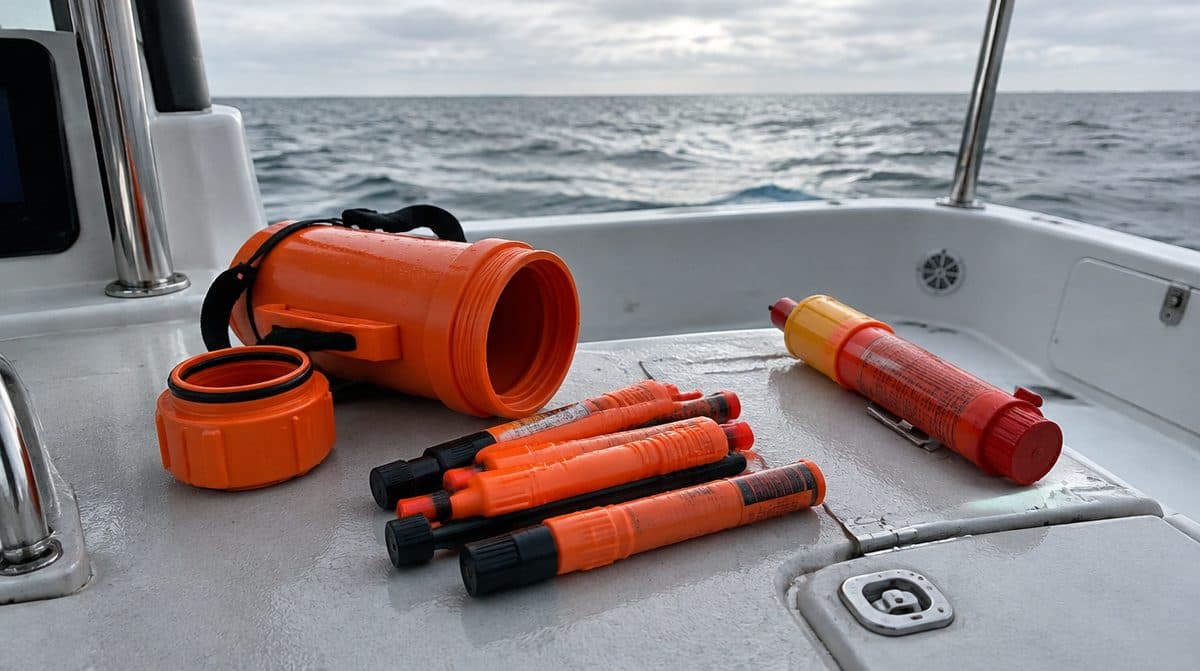
Flares and Distress Signals: Making Sure Rescuers Can Find You
Rescuers can be a mile away and still miss you. The day and night signals that close the gap, and the expiration date most boaters forget to check.
Calling for help is only half the job. You can key the radio, press the beacon, and do everything right, and rescuers still have to physically spot one small boat on a very large piece of water. Distress signals exist for that last mile. They turn "somewhere in this search area" into "right there," and the difference between those two phrases is measured in hours of searching. This guide covers what to carry, how the different signals work, and the expiration dates that catch almost everyone off guard.
Why Being Seen Is the Hard Part
From the deck of another boat, or from a helicopter running a search pattern, a hull in the water is a shockingly small target. Waves hide it, glare washes it out, and at night it simply disappears. Radios and beacons bring help to your general area, and if you go offshore, a registered beacon should be part of your kit too (our EPIRB and PLB guide covers those). But once rescuers are close, they are looking with their eyes, and your job becomes giving those eyes something impossible to miss: bright light at night, colored smoke by day, movement and contrast against the water. That is the entire purpose of a signal kit.
Day and Night Signals
You need signals that work both day and night:
- Handheld and aerial flares: night and day.
- Orange smoke: day.
- Electronic distress lights (eVDSD): a reusable night alternative to pyrotechnic flares.
The logic behind the mix is simple. At night, burning light is unbeatable, so flares and electronic lights do the work. In daylight, a flare's flame is surprisingly hard to see against a bright sky, which is where orange smoke earns its place: a drifting column of colored smoke reads from a long way off and also shows rescuers the wind direction. A kit that only covers one condition is half a kit. Check your local carriage requirements too, since many waters require day and night coverage once you are operating after dark.
How the Different Flares Work
Handheld flares burn like a roadside flare you hold up at arm's length. They are your close-in signal, the one you light when you can already see or hear the rescuer and need them to pick you out of the chop. Aerial flares launch from a pistol-style launcher or a self-contained tube and climb high before burning, which makes them the attention-getter for rescuers beyond the horizon of your deck. Smoke signals are canisters you activate and set on deck or float alongside, pouring out dense orange smoke. Each type has a job: aerial to say "I exist, come this way," handheld and smoke to say "I am exactly here."
Check Expiration
Pyrotechnic flares expire (commonly 42 months from manufacture, and the date is stamped on the casing). That window exists because the chemicals degrade, and a degraded flare may burn weak, burn short, or not light at all. Carry in-date flares, and keep expired ones as backup but not as your only signals. An expired flare that lights is better than no flare, but it does not count toward any carriage requirement, and you should never bet a rescue on one. Make checking the dates part of your routine when you go through the rest of the safety gear, and dispose of old pyrotechnics properly: many marinas, fire departments, and boater education groups run take-back programs.
The Electronic Option
An electronic visual distress signal device never expires and has no disposal hassle, a popular modern choice for nighttime signaling. These are high-intensity LED lights that flash the recognized distress pattern, run for hours on batteries, and can be switched off and reused, which also makes them the only distress signal you can actually practice with. Pair one with a daytime distress flag and you have a no-pyrotechnics setup that satisfies many requirements, though plenty of experienced skippers still carry a few flares alongside, because a burning flare has a visceral visibility that is hard to replicate. Swap the batteries on a schedule and test the light before every long trip.
Building the Kit
A sensible signal kit for a typical coastal boat looks like this: aerial flares to raise the alarm at distance, handheld flares for the final approach, orange smoke for daylight, and an electronic distress light as the reusable night workhorse. Add a signal mirror (free sunlight, never expires) and a whistle or horn, which are signals too. Stow everything together in one waterproof container, mounted or stowed where anyone aboard can reach it in seconds, and make sure every regular crew member knows where it lives and how each item works. A flare nobody can find, or nobody knows how to light with cold wet hands, is dead weight.
Mistakes to Avoid
The classic errors are all preventable. Firing every aerial flare in the first five minutes, before anyone is close enough to see them, leaves you dark when the search plane finally arrives: space your signals and save some for the moment that matters. Storing flares loose in a damp locker ruins them quietly, so use a sealed container. Pointing a launcher anywhere near the boat, fuel, or crew is how a bad day gets worse, so fire downwind and away. And never test-fire a pyrotechnic flare casually; a distress signal seen by anyone triggers a real response, and false alarms pull rescuers away from people who need them.
From the Water
Keep flares in a waterproof container you can grab instantly, not buried under gear. In an emergency you won't have time to dig. The best setups live in a bright, labeled canister near the helm or companionway, and the whole crew gets shown its location on day one, because the person who needs to grab it may not be you.
Where to Get It
Everything in this guide is stocked at Boat Supplies Direct, the Nautical Network marine parts store. Orders ship free all year with Dock Pass, the $49 a year shipping pass.
In stock as this guide goes up: - Flares, electronic distress lights, and signal kits in the safety collection
Browse the full range: - Shop safety - Read the full buying guide, including FAQs
More from the Wire
 Buying Guides
October 19, 2026
Dock Lines 101: Size, Length, and the Lines Most Boaters Forget
Bow and stern lines are the easy part. Line diameter, length, and the spring lines most boaters never rig, explained by boat size.
Read more Buying Guides
November 3, 2026
The Best Life Jacket Is the One You'll Actually Wear
Most drownings happen with a life jacket still on the boat. How to match PFD type to the activity and get a fit that stays put in the water.
Read more Buying Guides
October 19, 2026
Your Phone Is Not a Safety Plan: The Case for a Marine VHF Radio
Your phone can't call the boat a mile away, and offshore it can't call anyone. What a VHF does that a cell signal never will, and how to pick one.
Read more