Boat Horns: Required Gear and Your Voice on the Water
Your horn is required gear, and in fog it is the only way other boats know you exist. Electric vs. air, loudness and tone, mounting, and the signals worth knowing.
In fog, around blind bends, and at a busy ramp, your horn is how you announce yourself. It's also required equipment, not an accessory, and the day you need it is never a day with good visibility and calm traffic. A horn that works every time, is loud enough to carry, and sits where you can hit it without looking is one of the cheapest pieces of real safety gear on the boat.
Required Gear, Not a Nice-to-Have
The navigation rules expect every powered vessel to be able to make an efficient sound signal, and they expect you to use it: in restricted visibility, when maneuvering around other vessels, and any time you need to signal doubt about what another boat is doing. A horn is how you meet that requirement on anything bigger than a dinghy, and carrying a whistle or a portable backup alongside it is cheap insurance. If your current horn produces a sad quack or nothing at all, you are not just under-equipped, you are missing the one tool that works when eyes do not.
Electric vs. Air
Electric horns are wired to the boat and fired from a push button at the helm. They are convenient, always ready, and the common choice for a primary horn: no canister to run empty, no hunting through a locker while a barge bears down on you. Air and compressed-gas horns are very loud for their size and make an excellent backup, but canister types need refills and the canister you forgot about since last season may be empty. Many boats carry an electric horn plus a backup, either a portable air horn clipped somewhere reachable or a whistle on the keychain. That combination covers the failure modes of each.
Loudness and Tone
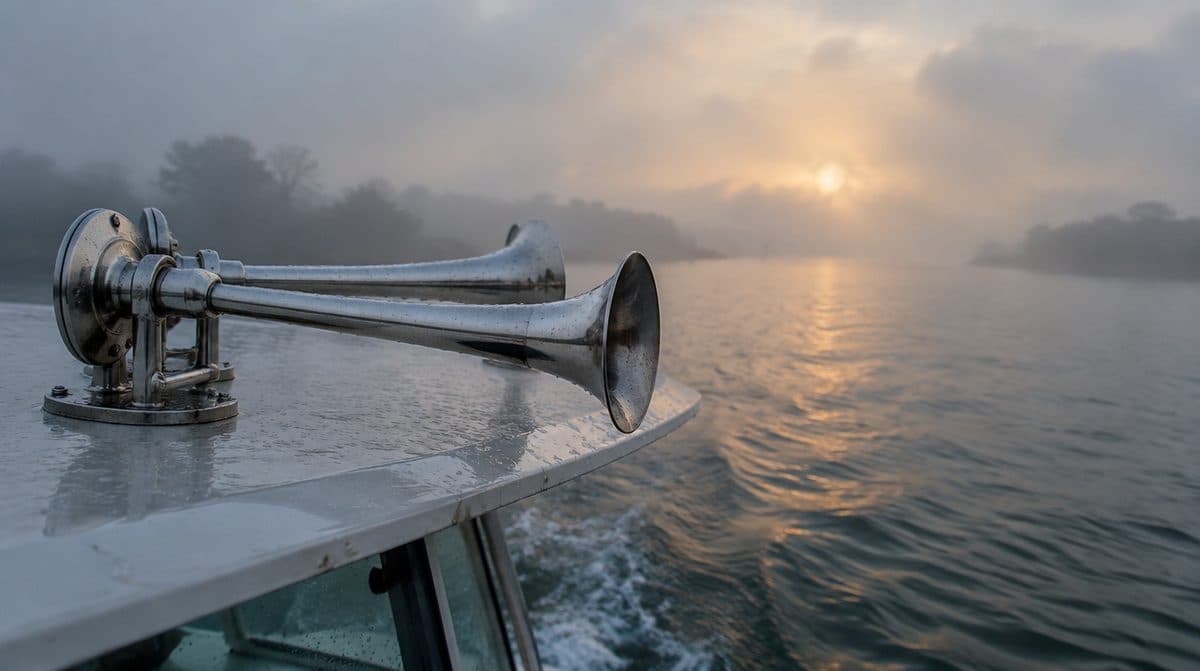
Bigger boats and open water need a louder horn that carries. Loudness is only half of it, though: pitch matters too. Dual-trumpet horns are louder and lower-toned, and the lower tone carries farther over wind and engine noise, which is why ships sound the way they do. A single compact horn is fine for a pontoon working a quiet lake or a small bay boat around the marina. If you run open water, big rivers with commercial traffic, or anywhere fog is a regular guest, step up to a dual-trumpet unit and let physics do the work.
The Signals Worth Knowing
A horn is a language, and it helps to speak a little of it. One short blast signals your intent to pass another boat on your port side, two shorts for starboard, three shorts means you are operating astern propulsion, and five or more short blasts is the universal signal for danger or doubt, the on-the-water equivalent of "what exactly are you doing?" In restricted visibility, a prolonged blast at regular intervals tells everyone around you where you are. You do not need to memorize the whole rulebook, but one, two, three, and five will cover nearly everything you meet.
Mounting
Mount electric horns where the sound projects forward and water drains out, not where spray pools inside. The trumpet should face ahead with a slight downward angle so rain and washdown water run back out the bell. Hull-mount horns sit flush through a cutout and keep the look clean; hidden horns tuck behind a grille or under the hardtop brow and keep the deck uncluttered. Whatever the style, avoid locations where the horn sits in standing spray, faces aft into its own reflection off a cabin bulkhead, or blasts directly at the helm seat. You want the people in front of you to hear it more than you do.
Wiring and Voltage
Match the horn to your electrical system first: a 12 volt horn on a 12 volt boat, a 24 volt horn on a 24 volt system. Then wire it properly: a fused circuit sized to the horn's draw, tinned marine wire, heat-shrink terminals, and a momentary push button at the helm. Larger dual-trumpet horns draw real current, so check whether the maker calls for a relay rather than running full load through the button. Our marine fuse and breaker guide covers picking the right protection. A horn circuit done with household crimps and no fuse is how boats end up with a horn that only works at the dealer.
Maintenance
Horns die quietly. Spray and condensation work into the diaphragm, terminals green over, and the button contacts corrode, all without any outward sign. Rinse the outside with fresh water after salty trips, keep the drain path clear, and hit the terminals with corrosion inhibitor once a season. If the sound gets weak or raspy, chase the wiring and connections before replacing the horn, because half the time the horn itself is fine and a ring terminal is not.
From the Water
Test the horn before every trip. Corrosion inside it or at the connections can silence it without warning, and you will not find out until the moment you need it most. Make the test part of the same thirty-second habit as checking your nav lights and bilge pump: one short beep at the dock tells you everything.
Where to Get It
Everything in this guide is stocked at Boat Supplies Direct, the Nautical Network marine parts store.
In stock as this guide goes up: - Marinco 12V Dual Trumpet Electric Horn - Innovative Lighting Marine Hull Mount Horn, White - Sea-Dog Pontoon Boat Mini Compact Horn with Bracket
Browse the full range: - Shop horns - Read the full buying guide, including FAQs
More from the Wire
 Buying Guides
October 18, 2026
Starting vs. Deep Cycle: The Battery Mistake That Strands Boaters
Starting, deep cycle, or dual purpose, and flooded, AGM, or lithium. How to pick the battery type that will not leave you stranded.
Read more Buying Guides
October 18, 2026
The Onboard Charger: Cheap Insurance for Expensive Batteries
Batteries die young when they sit half-charged. How to size an onboard charger by amps, banks, and chemistry.
Read more Buying Guides
October 18, 2026
Battery Switches and Isolators: Never Get Stranded by a Dead Battery
The switch and isolator setup that keeps your starting battery ready while the house bank runs your gear.
Read more