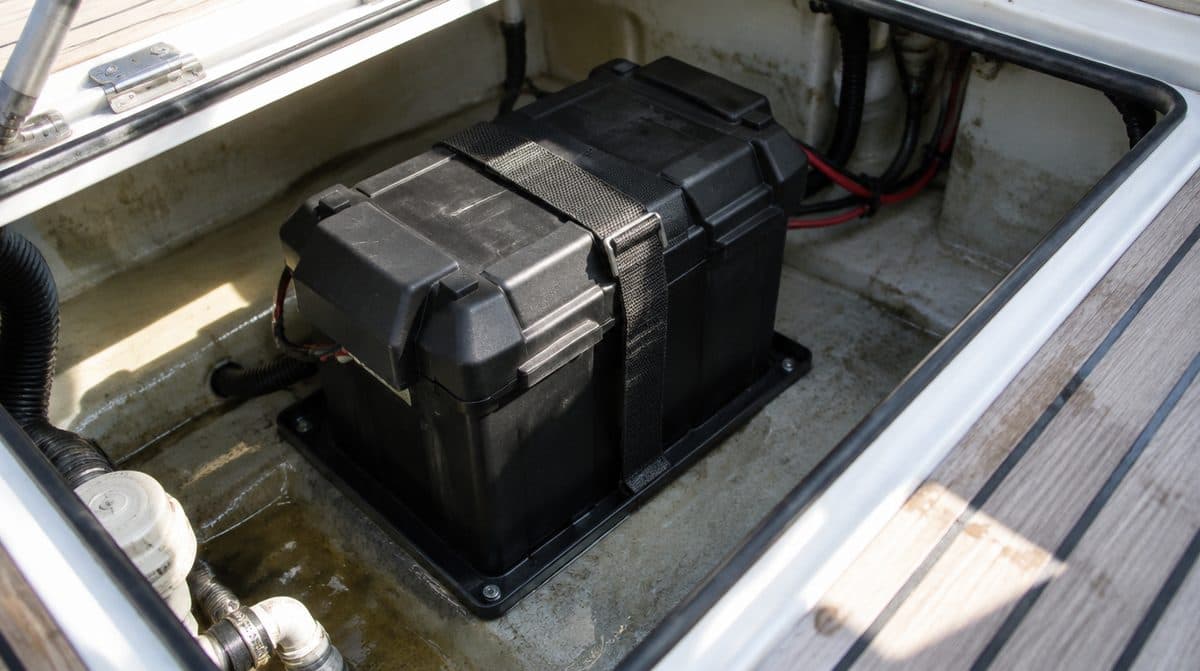
Battery Boxes and Trays: Keep Your Battery Locked Down
A loose battery in a chop is a projectile, a short circuit, and an acid leak waiting to happen. How to match a box or tray to your battery group and lock it down properly.
A loose battery bouncing in a chop can short out, leak acid, or start a fire, and none of those improve a day on the water. The fix is a proper box or tray, which is some of the cheapest safety gear on the whole boat and also some of the most commonly skipped. Plenty of boats are running around right now with a battery sitting on bare fiberglass, held in place by optimism and the weight of the battery itself.
Why a loose battery is a real problem
A marine battery is a dense brick of lead and electrolyte, and your hull is a machine for turning waves into vertical acceleration. Hit a wake wrong and everything in the bilge that is not fastened down briefly becomes airborne. When the heavy thing that goes airborne also has exposed terminals and a case full of acid, you have three separate problems stacked on top of each other: a projectile, a short circuit waiting for any piece of metal it lands against, and a cracked case that leaks electrolyte into the bilge.
That is why batteries must be secured against movement, full stop. Not wedged against a stringer, not held by the cables, secured. A loose battery in a seaway is dangerous even when nothing visibly goes wrong, because every slam fatigues the plates inside and shortens the battery's life.
Box or tray: pick the right style
A battery box is a full enclosure: a base, a lid, and a strap. It contains any leaked acid, shields the terminals from dropped gear, and keeps casual splash off the battery. It is the right call when the battery lives in a shared compartment with tools, anchor gear, or anything metal that could land across the terminals.
A tray is an open base with a hold-down strap or a crossbar clamp. It gives you better airflow, easier access for checking terminals, and a lower profile, which matters in tight compartments. Trays are the usual choice for dedicated battery compartments and for bigger batteries and multi-battery banks, where wrestling a lid on and off gets old fast. If you run a tray, put a rubber boot over the positive terminal, because the tray is not going to shield it for you.
Either way, the unit has to be fastened to the boat. Screw or bolt the box or tray into solid structure. A strapped battery inside an unfastened box is still a loose battery; it just brought a friend.
Match the group size
Battery boxes are sized to battery group (24, 27, 31, etc.), which is a standardized footprint and height. Check the label on your battery for its group size and buy the matching box or tray. A group 27 battery will not close inside a group 24 box, and a small battery rattling around a big box defeats the entire purpose; you want a snug fit so the case cannot build momentum before the strap catches it.
Think ahead before you buy, too. Say you are planning to step up from a group 24 to a group 27 for more capacity next season: buy the compartment check first, then the box. Measure the space, confirm the bigger footprint and the extra height fit with the lid on and the cables connected, and then commit. If the battery itself is the open question, start with our marine battery guide and size the box to whatever you land on.
Containment and venting
A box contains acid and protects terminals from shorting against metal, but containment has a limit: ventilation. Flooded lead-acid batteries vent hydrogen while charging, so do not fully seal a vented battery. Quality boxes have vent openings or accept a vent fitting for a reason. Trapped hydrogen plus one spark is exactly the scenario the box was supposed to prevent.
Sealed AGM and gel batteries are far more forgiving, but they still prefer airflow and a cool mounting spot. Heat is the quiet battery killer, so the engine-adjacent corner that was convenient for cable runs may be the worst spot in the boat for battery life.
Installation realities
Mount low and central where you can; that much weight affects trim more than people expect. Keep the cable runs short enough to reach without strain but with enough slack that you can lift the battery out for service without unbolting half the boat. Route cables so they cannot chafe on the box edge or the strap buckle. And keep the compartment clean: a battery compartment that doubles as storage for pliers, shackles, and spare anchor hardware is a short circuit with a calendar.
Signs it needs replacing
Plastic boxes and straps live a hard UV life. Replace the box when the plastic goes chalky, brittle, or cracked, and replace the strap the moment it frays, stretches, or the buckle stops biting. Look for acid staining in the bottom of the box, which means the battery has been leaking, and for any melted or discolored spot near a terminal, which means something has been arcing and you have a wiring problem to chase, not just a box problem.
From the Water
Cover exposed positive terminals with a rubber boot. A dropped wrench across a bare terminal can throw sparks or start a fire. A wrench across a battery becomes a welder instantly, and in a cramped bilge you may not be able to knock it clear before the damage is done. Boots cost almost nothing, take seconds to fit, and are the kind of thing you only regret not having once.
Where to Get It Everything in this guide is stocked at Boat Supplies Direct, the Nautical Network marine parts store.
In stock as this guide goes up: - Battery hold-down and wiring gear in the electrical collection
Browse the full range: - Shop electrical - Read the full buying guide, including FAQs
More from the Wire
 Buying Guides
October 18, 2026
Starting vs. Deep Cycle: The Battery Mistake That Strands Boaters
Starting, deep cycle, or dual purpose, and flooded, AGM, or lithium. How to pick the battery type that will not leave you stranded.
Read more Buying Guides
October 18, 2026
The Onboard Charger: Cheap Insurance for Expensive Batteries
Batteries die young when they sit half-charged. How to size an onboard charger by amps, banks, and chemistry.
Read more Buying Guides
October 18, 2026
Battery Switches and Isolators: Never Get Stranded by a Dead Battery
The switch and isolator setup that keeps your starting battery ready while the house bank runs your gear.
Read more