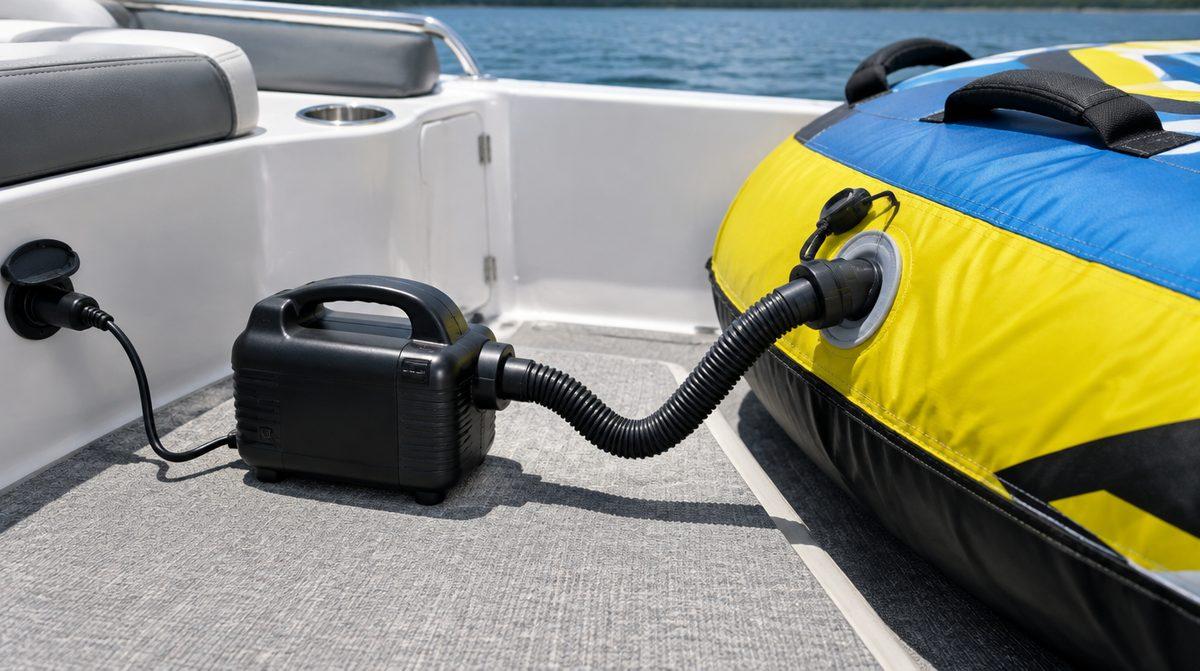
Inflation Pumps: Get Tubes and SUPs Ready in Minutes
The first hour of a lake day should not go to blowing up a tube. Which pump actually fits the job, from big soft towables to paddleboards that need real pressure.
Nobody wants to spend the first hour of the day blowing up a tube. Inflatables are the best fun-per-dollar gear on the water, right up until you are hunched over a foot pump in a hot parking lot while the kids ask if it is ready yet. The right pump turns that hour into minutes, and the surprise for most buyers is that there is no single right pump: the tool depends entirely on what you are inflating.
Electric vs. Manual
A 12V electric pump plugs into the boat or car and moves a huge volume of air fast, which makes it the practical choice for towables, inflatable mattresses, and anything else big and baggy. High-pressure SUP pumps are a different animal: they are built to reach the firm PSI a paddleboard requires, which standard tube pumps simply cannot hit, no matter how long you run them. Manual pumps, whether hand or foot style, still earn a place as the backup and the take-anywhere option, because they never run out of battery and never care where the nearest 12V socket is.
Volume vs. Pressure: Why One Pump Can't Do Both
This is the concept that sorts the whole category out. Towables need volume at low pressure: a big tube holds a lot of air, but the air inside barely needs to push back. Paddleboards are the opposite, needing modest volume at high pressure, because a rigid inflatable board is only rigid when the air inside is packed in tight. Pump design reflects the trade: a high-volume tube pump moves buckets of air per stroke but tops out at soft pressures, while a high-pressure pump moves less air per stroke through a mechanism built to keep pushing as resistance climbs. Use the pump built for the job, since a tube pump will not firm up a SUP, and inflating a big towable with a small high-pressure pump takes patience you do not have on a Saturday morning.
Match the Pump to Your Fleet
Think about everything inflatable you own, not just the newest toy. A family running a couple of towables is served perfectly by a fast 12V inflator. Add a paddleboard and you need high-pressure capability in the mix, either a dedicated SUP pump or an electric unit designed to reach board pressures. Boats that live around inflatables, with fenders, dinghies, and water toys in the mix, are where a permanently installed air station starts to make sense, plumbed into the boat's 12V system with a hose that reaches the swim platform. If towables are a big part of your boating, the towable tube guide pairs naturally with this one.
Nozzles, Valves, and Power
Confirm the nozzle fits your valves before you buy, because the pump that cannot seal to your gear is just noise. Towables commonly use wide Boston valves, boards use their own high-pressure valve style, and a good pump ships with a set of adapters to cover them. Then look at power: a 12V plug is the classic, rechargeable battery pumps add freedom from the socket, some charge over USB, and an AC option is handy for topping things up at home the night before. Match the power source to where you actually inflate, which for most people is the boat, the tow vehicle, or the dock.
Deflation Is Half the Job
A pump that also deflates is a quietly massive upgrade. Sucking the air back out of a big towable or a board collapses it to a fraction of the size it reaches when you squeeze and roll by hand, which means smaller storage bags, easier packing, and gear that actually fits back in the locker it came from. If you have ever knelt on a tube in a parking lot trying to squeeze the last air out, the deflate port alone justifies the electric pump.
Care and Longevity
Electric pumps are simple, but they have limits. Most are built for a duty cycle, not continuous running, so let the pump rest and cool between big inflations instead of running it back to back to back. Keep sand out of the intake, rinse salt spray off the housing, coil the hose without kinking it, and store the whole kit dry. Replace a pump when it gets slow, hot, and loud, because a dying motor that cannot reach pressure will have you back on the foot pump anyway.
Mistakes to Avoid
Do not buy a pump without checking the pressure it can actually reach against what your gear needs. Do not run a 12V pump off a questionable socket with a weak battery and expect full performance. Do not leave the pump running unattended against a closed valve. And do not chase a perfect reading on a cheap built-in gauge; firm and holding is the goal for a tube, while boards deserve a pump with a gauge built for the job.
From the Water
Don't max out tube pressure on a hot day. Air expands in the sun, and an overinflated tube stresses its seams. Inflate to firm in the cool of the morning and the sun will finish the job by noon; a tube that goes in drum-tight at launch can be dangerously overstressed by the afternoon.
Where to Get It
Everything in this guide is stocked at Boat Supplies Direct, the Nautical Network marine parts store. Orders ship free all year with Dock Pass, the $49 a year shipping pass.
In stock as this guide goes up: - Rule ID20 High-Speed Inflator/Deflator, 12V Portable Pump with Multiple Valve Options - Scanstrut ATMOS 12V Integrated Air Station - Seipel Marine Handheld Air Pump with USB Charger
Browse the full range: - Shop air pumps - Read the full buying guide, including FAQs
More from the Wire
 Buying Guides
October 28, 2026
Freshwater Pumps: Real Water Pressure on Your Boat
A sputtering shower or a pump that clicks all night is your freshwater system asking for help. GPM ratings, pressure switches, and accumulator tanks, explained in plain English.
Read more Waypoint
October 12, 2026
Hiring a Mobile Marine Mechanic: What to Know Before You Call
What a mobile marine mechanic can fix at your slip, which jobs still need a yard, and the five details to have ready so the first call gets a real answer.
Read more Buying Guides
November 16, 2026
Trailer Jacks: Hitching and Moving Your Trailer Easily
Hitching up should be a one person job. How to size a trailer jack for your real tongue weight and pick the right wheel for the ground you actually park on.
Read more