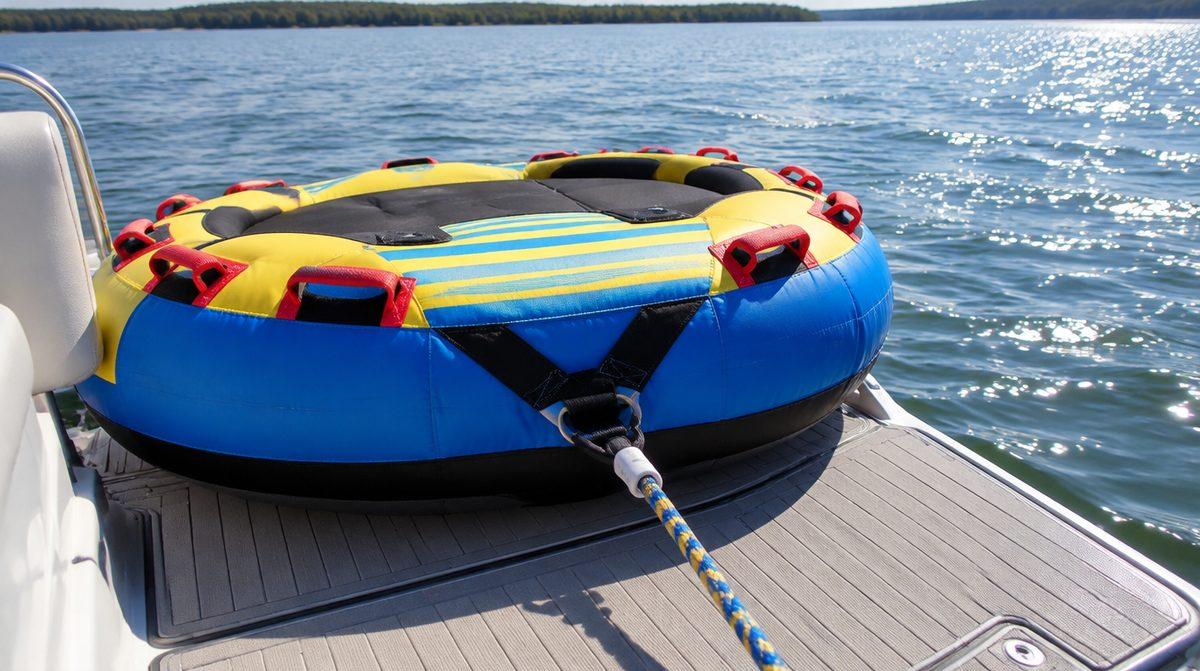
Towable Tubes: The Easiest Way to Get the Whole Crew Smiling
The fastest way to get a whole crew laughing is a tube behind the boat. How to pick the right rider count, shape, and build quality so the fun outlasts the summer.
Nothing gets kids and adults laughing like a towable. There is no learning curve, no lessons, no falling over for an hour before the fun starts. You climb on, hold tight, and the boat does the rest. That simplicity is exactly why tubes are the gateway drug of watersports, and it is also why it is worth picking the right one, because the difference between a great tube and a cheap one shows up in both the fun and the safety of the ride.
Rider Count and Style
Start with the honest question: who is actually riding? One and two rider tubes are smaller, lighter, cheaper, and far more agile behind the boat, whipping across the wake in a way the big barges never will. Three and four rider deck tubes are the family favorites, stable platforms where kids can pile on together and nervous first-timers feel secure. The split in personality matters too. Flat deck tubes are social and stable, built for grins rather than terror. Shaped tubes, wings, and the rocket-style designs trade stability for chaos, catching air off the wake and flinging riders around. Match the tube to the crew you really have, not the crew in the promo video.
How a Tube Actually Rides
A towable is a simple machine: an air bladder provides the float, a cover provides the shape and takes the abuse, and a tow harness transfers the pull of the boat. Deck styles ride flat on top of the water and slide wide in turns, which is where the screaming comes from. Cockpit and chariot shapes seat riders down inside, adding security for smaller kids. Ride-on shapes with a nose rocker lift over chop instead of plowing through it, which keeps faces drier and spines happier. Firm, correct inflation is what makes any of them work; a soft tube folds in the middle, plows water, drags hard on the boat, and rides worse in every way.
Match the Tube to Your Boat's Power
More riders and bigger tubes need more boat power to pull. A big four-person deck tube loaded with adults creates a surprising amount of drag, especially getting up to speed, and an underpowered boat will wallow trying to drag it out of the hole. Before buying the biggest tube on the shelf, make sure your boat can actually pull the tube and riders you choose at a speed that makes the ride fun. A smaller tube your boat tows crisply beats a huge one it tows at a crawl, every time.
Durability: Where Cheap Tubes Die
Look for heavy-gauge PVC bladders, tough full-nylon covers, and reinforced, properly backed tow points. Cheap tubes split at the seams fast, and they almost always fail in the same three places: the bladder seam lets go, the cover seam chafes through, or the tow point rips out mid-ride, which is as abrupt an ending as it sounds. A thick bladder resists stretching and pinholes, a full cover protects it from UV and dock rash, and a tow harness that spreads load across a wide patch of the cover survives the snap loads of whip turns. This is the one place in the towable aisle where spending a bit more is obviously worth it.
The Tow Connection
The tube is only half the system. It must be matched with a tubing rope rated for the rider count, attached to a proper tow point on the boat, never to a cleat on one corner of the transom. A rope rated for fewer riders than you are pulling is a safety problem, not a durability problem. Ropes deserve their own decision process, and the tow rope guide walks through matching rope to sport and rider count.
Care, Storage, and Lifespan
Tubes die of sunburn and mildew more than they die of riding. Rinse off salt and lake scum, let the tube dry completely, then deflate and store it out of the sun. Leaving a tube inflated on the bow for weeks cooks the PVC and stretches the seams; stuffing it away wet grows a science experiment inside the cover. Check the valve and the tow point webbing at the start of each run of use. A tube treated this way lasts many summers; a tube left baking on the dock rarely survives its second.
Mistakes to Avoid
Do not exceed the rider rating, even for small kids, because ratings are about load and control rather than seat space. Do not tow with a frayed or undersized rope. Do not whip the tube toward docks, pilings, or shallow water, since the tube swings far wider than the boat in a turn. And do not skip proper life vests for every single rider, no exceptions, no matter how good a swimmer anyone claims to be.
From the Water
Agree on hand signals before anyone climbs on: thumbs up for faster, thumbs down for slower, a pat on the head to stop. Go over them on the swim platform every time, even with crews who know them cold, because the one ride you skip the briefing is the one with the new kid who has never heard them.
Where to Get It
Everything in this guide is stocked at Boat Supplies Direct, the Nautical Network marine parts store. Orders ship free all year with Dock Pass, the $49 a year shipping pass.
In stock as this guide goes up: - Full Throttle Mega Enforcer Towable Tube, 3 Rider, Yellow - Full Throttle Wake Shocker Towable Tube, 2 Rider, Red
Browse the full range: - Shop towables - Read the full buying guide, including FAQs
More from the Wire
 Buying Guides
October 19, 2026
Marine Autopilots: Let the Boat Steer While You Watch the Water
The control head is the easy part. The drive unit behind your steering is where autopilots get mismatched, and where the money goes right or wrong.
Read more Buying Guides
October 19, 2026
The Right Prop Changes Everything About How Your Boat Runs
One inch of pitch moves your engine roughly 150 to 200 RPM. How to read prop numbers, pick your material, and dial in wide-open throttle.
Read more Buying Guides
October 19, 2026
Engine Controls: The Throttle and Shift That Command Your Boat
That mushy shift lever is trying to tell you something. How to match a control to your engine, pick single or dual lever, and measure cables right the first time.
Read more