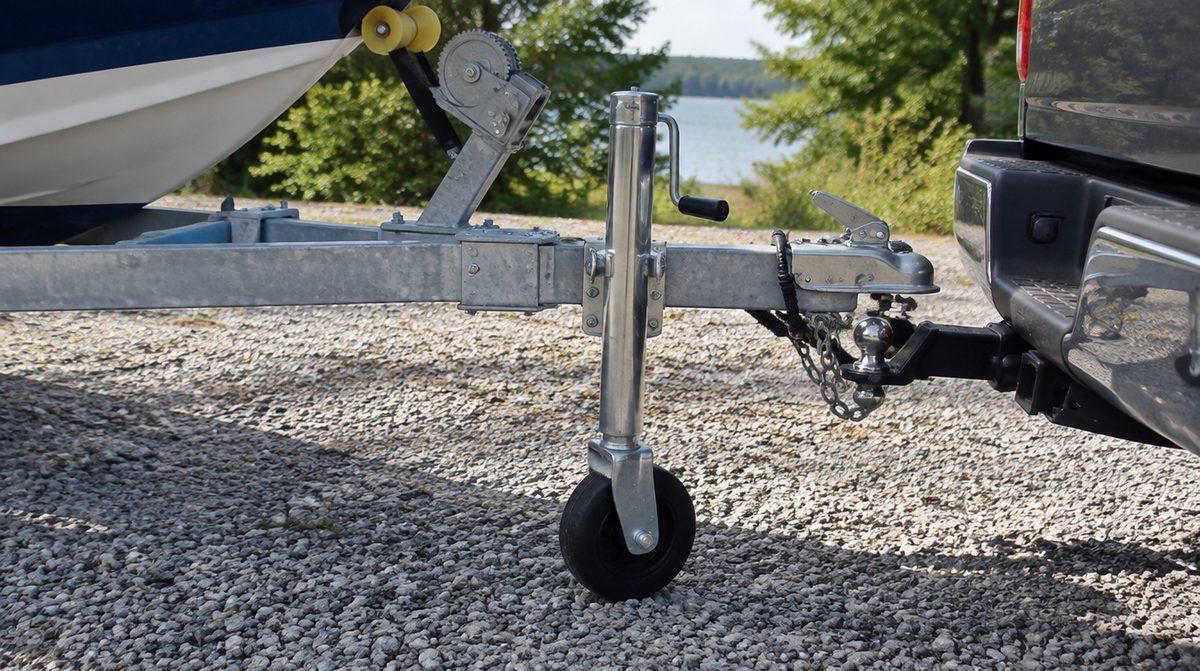
Trailer Jacks: Hitching and Moving Your Trailer Easily
Hitching up should be a one person job. How to size a trailer jack for your real tongue weight and pick the right wheel for the ground you actually park on.
Hitching up shouldn't take two people and a lot of grunting. The jack on the front of your trailer is the humble piece of gear that turns coupling, uncoupling, and shuffling the rig around the yard into a one-person job. It is also a part most people never think about until the day it bends, seizes, or spins uselessly under a tongue it was never rated to lift. Ten minutes of thought when you buy one saves years of annoyance.
What a Trailer Jack Actually Does
A trailer jack has three jobs. First, it lifts the coupler up off the hitch ball and holds the tongue at whatever height you need, so you can drive the tow vehicle away and back it up again later. Second, on wheeled models, it lets you roll the trailer around by hand for storage and tight parking. Third, it holds the front of the trailer stable and level while the boat sits in storage, keeping drainage running the right direction and the outboard skeg off the ground. A jack that does all three smoothly is one of those quality-of-life upgrades you notice every single time you use the boat.
Capacity: Size for Tongue Weight, With Margin
The jack must handle the tongue weight, which is the downward force the coupler puts on the hitch, a portion of your total loaded trailer weight rather than all of it. That distinction trips people up in both directions. You do not need a jack rated for the whole rig, but you absolutely need one rated above the real tongue weight with margin to spare, because the jack also takes abuse the rating sheet never mentions: cranking on uneven ground, side loads while maneuvering, the bounce of a boat being winched on. Jacks commonly come in rating tiers, and the honest advice is to buy the next tier up from what you think you need. Say your fully loaded rig puts a few hundred pounds on the tongue; a jack rated well above that figure cranks easier, lasts longer, and shrugs off the day you forget the drain plug and the bilge adds water weight you didn't plan for.
Wheel Type
A standard swivel-wheel jack is the default for a reason: it pivots up out of the way for towing and drops down to let you push the trailer around by hand. A dual-wheel jack spreads the load across two wheels, which makes an obvious difference rolling across gravel, grass, or soft ground where a single narrow wheel wants to dig in. Caster-style dolly wheels shine for tight maneuvering in a garage or storage yard, where you are pivoting the trailer as much as pushing it. Think honestly about where you actually park, not the smooth concrete in the catalog photo.
Manual, Powered, and Drop-Leg
A manual crank jack is simple, reliable, and cheap to keep, and for most tongue weights it is all you need. Powered jacks take the cranking out of heavy tongues, which your back will appreciate on a big rig you hitch and unhitch constantly. A drop-leg design splits the travel: you pull a pin, let the inner leg fall to rough height, then crank only the last bit, which makes big height changes fast instead of fifty turns of the handle. Fold-up and swivel mounts matter too, since the jack has to tuck clear of the frame and your feet when towing.
Mounting and Corrosion
Bolt-on jacks install with basic tools and are easy to replace down the road; weld-on models make sense when a shop is setting up a frame permanently. For boat trailers the real enemy is the environment. A jack lives at the splash zone of every launch and retrieve, and a saltwater ramp will eat a bare-steel unit alarmingly fast. Look for serious zinc plating or galvanizing, rated for salt exposure if you boat in the salt, and rinse the jack with the rest of the trailer. A seized jack screw at a busy ramp is a miserable way to learn this.
Maintenance and Signs It's Done
Grease the screw mechanism and the swivel pivot once a year and the jack will likely outlast the trailer tires. Replace it when the crank gets gritty and tight even after greasing, when the tube is bent from a side load, when the wheel no longer turns freely, or when rust is flaking rather than staining. A jack that collapses or free-spins under load can drop the tongue on your foot, and nothing on a trailer is worth that gamble.
Mistakes to Avoid
Do not tow with the jack down or half-retracted; one driveway lip will fold it. Do not use the jack wheel as a brake on a slope, because that is not what it is for and it will lose. Do not crank the bow sky-high to force a coupler onto a ball that really needs the vehicle moved back three inches. And once you are hitched, remember the jack is only step one of towing prep; strapping the boat down properly is covered in the trailer tie-down strap guide.
From the Water
Chock the trailer wheels before you unhitch. On even a slight slope, a trailer can roll the moment it's free of the ball, and a few thousand pounds of boat does not care what is behind it. A pair of chocks lives in the truck bed for exactly this moment, and setting them takes less time than reading this sentence.
Where to Get It
Everything in this guide is stocked at Boat Supplies Direct, the Nautical Network marine parts store. Orders ship free all year with Dock Pass, the $49 a year shipping pass.
In stock as this guide goes up: - Attwood Fold-Up Trailer Jack, 1,500 lb Capacity, Dual Wheel - C.E. Smith 2,500 lb Drop Leg Trailer Jack - Powerwinch Saltwater Series Jack, 2,500 lb, Bolt-On Flat Plate
Browse the full range: - Shop jacks and dollies - Read the full buying guide, including FAQs
More from the Wire
 Buying Guides
November 14, 2026
Trailer Lights That Actually Survive the Ramp
Hot lights plus cold water equals dead lights. Why LED wins on a boat trailer, and how to wire and ground a kit so it survives the ramp.
Read more Buying Guides
October 26, 2026
Why Your Anchor Drags (and How to Pick One That Won't)
Most anchors that drag were fighting the wrong bottom from the start. How to match anchor style to the seabed, size up with confidence, and build a rode that actually holds.
Read more Buying Guides
October 19, 2026
Galvanic Isolators: Stop the Dock From Eating Your Boat
If your anodes vanish at the marina but last on the mooring, the dock is the suspect. What a galvanic isolator actually does, and how to size one without giving up your safety ground.
Read more