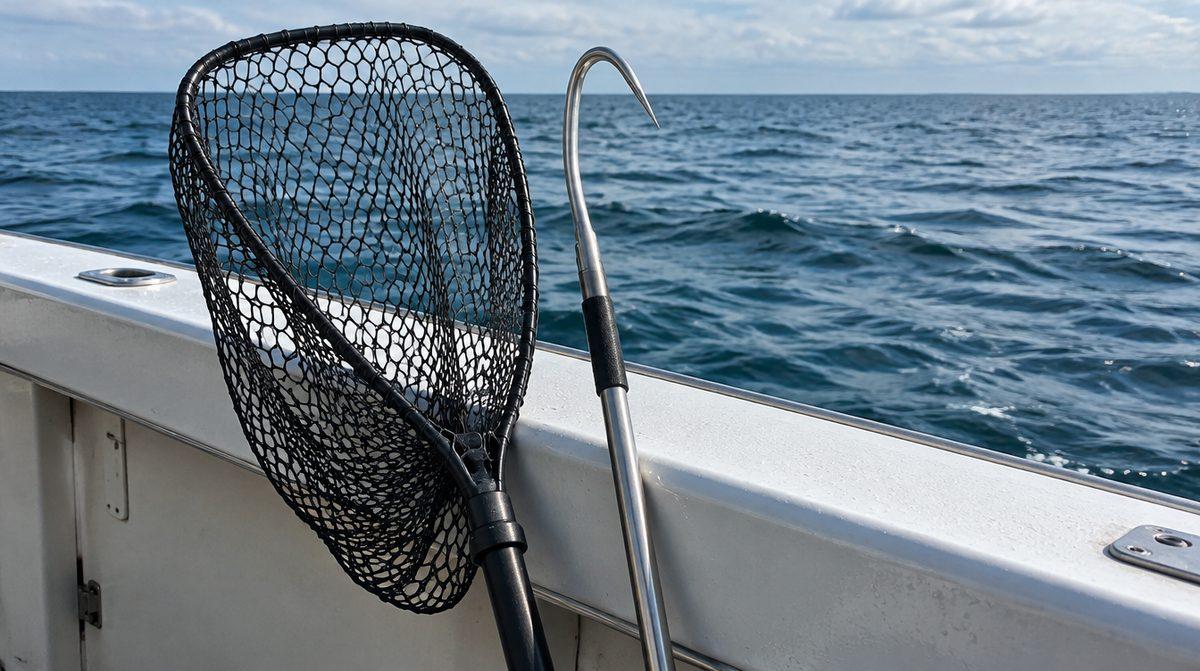
Gaffs and Landing Nets: Closing the Deal at the Boat
The last six feet of the fight is where fish are lost. How to size a gaff, pick a release-friendly net, and close the deal boatside.
More fish are lost at the side of the boat than anywhere else. The hookset held, the drag did its job, the knots survived, and then everything fell apart in the last six feet. The gaff and the net are the least glamorous gear on the boat right up until the moment they are the only gear that matters. Here is how to pick both, and how to use them so the story ends with a photo.
Gaff or Net: Decide Before the Hookup
A gaff is for a large fish you are absolutely keeping: fast, secure, and final. A landing net is for everything else, and it protects both the fish and your crew. The decision has to happen before the fish is boatside, not during the chaos. If there is any chance the fish is going back, it is a net fish, period. Most boats that fish seriously carry both, stowed where either can be in hand in seconds.
Sizing a Gaff
Two measurements matter: hook gap and handle length. The gap, the distance between the point and the shank, should match the body size of your target. Too small a gap and you are trying to thread a big fish onto a small hook; too large and small fish swim through it. Handle length should match your freeboard, the height from the waterline to where you stand. A low cockpit works fine with a short handle, while high gunwales need the reach so you are not folded over the side at the worst possible moment. Bigger fish and higher gunwales both push you toward more gaff.
Handle material matters too. Aluminum handles are light and tough, while fiberglass adds some forgiving flex when a big fish lunges. Either way, look for a grippy wrap along the handle, because a gaff is always wet when it is working, and a hand that slides at the moment of truth is a lost fish.
When the shot comes, aim for the shoulder area ahead of the dorsal fin, gaff over the fish, and pull toward the boat in one smooth motion. No stabbing, no second tries if the first one lands.
Choosing a Landing Net
Hoop size comes first: the hoop has to fit the longest fish you expect, with room to spare, because a fish that does not fit the bag was never going to stay in it. Handle length follows the same freeboard logic as the gaff. Then look at the mesh. Rubber-coated nets protect the fish's slime coat, which is its barrier against infection, and they shed treble hooks instead of weaving them into a knotted mess. Flat-bottom bags support a fish horizontally instead of folding it in half, which matters for a healthy release. Folding and telescoping nets trade a little rigidity for a lot less stowage headache on a crowded boat.
Boatside Habits That Save Fish
Keep the net out of the water until the fish is actually ready, because a net waving around early spooks fish into one more run. Lead the fish with the rod, keep its head up, and let your net person do one smooth scoop. With a fish you are releasing, leave it in the net alongside the boat while you grab pliers, wet your hands before touching it, and get it back in the water quickly. If you are handling the leader at the boat, never wrap it around your hand; our fishing line and leader guide covers building leaders heavy enough to grab with confidence.
Stow Them Where You Can Grab Them
A net buried under life jackets might as well be at home. Dedicated holders mount a net and gaff along a gunwale or on a tower leg, out of the way but one motion from ready. Rig your boat so the person clearing lines can reach the landing gear without crossing the angler.
Maintenance
Rinse both after every salty trip. Keep the gaff point sharp with a few strokes of a file, and keep a point cover on it, because a sharp gaff in a rocking cockpit is a hazard to shins and upholstery alike. Check net mesh for hook tears and re-hang or replace the bag before the hole graduates to fish-sized. Look over the hoop-to-handle joint and any telescoping locks, since that joint takes the full load of a thrashing fish.
Mistakes to Avoid
- Chasing the fish with the net instead of letting it swim in.
- Gaffing a green fish that still has a full tank of energy.
- A handle too short for your freeboard, which turns landing into leaning.
- Knotted nylon mesh on a boat that releases most of its fish.
- Stowing the landing gear where nobody can reach it in a hurry.
From the Water
Net fish head first and let them swim in. Chasing a fish's tail with the net is how most of them get away at the boat. Fish do not swim backward, so when the net is in front of the head, a last-second surge sends the fish into the mesh instead of out of it. Be patient, stay smooth, and make the first scoop the only scoop.
Where to Get It
Everything in this guide is stocked at Boat Supplies Direct, the Nautical Network marine parts store. Orders ship free all year with Dock Pass, the $49 a year shipping pass.
In stock as this guide goes up: - Shurhold Shur-LOK Gaff Hook - Shurhold Shur-LOK Landing Net, 17" x 20" x 30" - Frabill Net and Gaff Holder
Browse the full range: - Shop nets and gaffs - Read the full buying guide, including FAQs
More from the Wire
 Buying Guides
November 10, 2026
Boarding Ladders: Getting Back Aboard Safely From the Water
The hardest part of any swim is the last three feet. How to size a boarding ladder so you can actually climb it, plus mounts, materials, and the solo-swimmer test.
Read more Buying Guides
October 19, 2026
Galvanic Isolators: Stop the Dock From Eating Your Boat
If your anodes vanish at the marina but last on the mooring, the dock is the suspect. What a galvanic isolator actually does, and how to size one without giving up your safety ground.
Read more Buying Guides
November 24, 2026
Downriggers: Put Your Bait Exactly Where the Fish Are
When fish hold deep, surface trolling just drags bait over empty water. How downriggers work, when electric beats manual, and the boom, ball, and counter details that make depth repeatable.
Read more