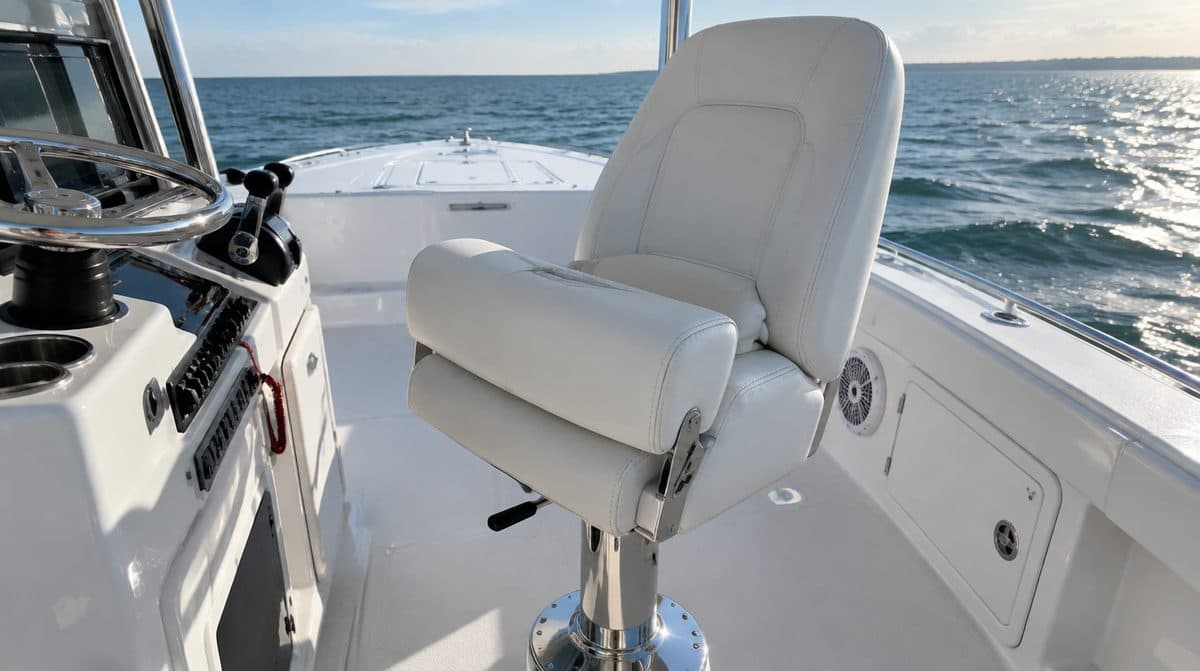
Boat Seats That Save Your Back in a Chop
On flat water any seat works. How vinyl, closed-cell foam, and the pedestal under it all decide whether a rough ride home is a ride or a beating.
On a calm day, any seat works. On a rough run home, a good helm seat or leaning post is the difference between a ride and a beating. Seats are also one of the first things to look tired on an otherwise clean boat, since they sit in the sun and weather every single day. Whether you are replacing a cracked original or upgrading the helm so your back stops filing complaints, here is what actually matters.
Seat types
- Helm/captain's chairs: support and often adjustable, bolsters, armrests.
- Bench and jump seats: capacity and casual seating.
- Leaning posts: common on center consoles, lean rather than sit in a seaway.
- Folding and pedestal seats: flexible layouts for smaller boats.
Match the seat to how you actually run the boat. A helm chair with a flip-up bolster lets you drive standing in chop and drop into real support on the smooth stretches. A leaning post works because standing with bent knees is the best suspension a human has; your legs absorb what a fixed seat would send straight up your spine. Bench and jump seats carry the crew, and folding pedestal seats earn their place on fishing boats where the cockpit has to clear out in a hurry.
Build quality that lasts
Look for marine-grade vinyl (UV and mildew resistant), closed-cell foam that does not soak up water, and non-corroding frames and hardware. Stitching and seams are where cheap seats fail first.
Each piece has a job. Marine vinyl is formulated to survive sun that would chalk and crack furniture vinyl in a season or two. Closed-cell foam is the unsung hero: open-cell foam drinks water like a sponge, stays wet inside for days, and becomes the mildew farm you smell but cannot find. Frames and fasteners should be stainless, anodized aluminum, or composite, because a steel staple or bracket will bleed rust stains down your upholstery long before anything actually breaks. On stitching, look for heavy UV-stable thread and tight, even seams; sun eats cheap thread first, and once a seam opens, water gets to the foam and the clock starts.
Mounting
Confirm the seat matches your pedestal or mounting pattern, or buy the matching base and slide/swivel hardware. Seat mounts are not universal. Measure your existing bolt pattern and pedestal post diameter before ordering anything, and decide what motion you want: a swivel for fishing, a slide for sharing the helm between drivers of different heights, or a locking base so the seat stays put underway.
The pedestal matters as much as the seat
The post under the seat decides how the ride feels. A fixed-height pedestal is simple and solid for a dedicated helm. An adjustable post fits multiple drivers. And a wave-dampening pedestal, with a shock-absorbing element built into the post, takes the edge off exactly the hits this guide is named for. If your home water is a windy bay or a busy weekend chop, a dampening pedestal under a good seat is the back-saving combination. Locking versions keep the seat from launching free of the base when the bow drops out from under you.
Installation realities
A seat is only as strong as what it is bolted to. Through-bolt pedestal bases with a backing plate or oversized washers under the sole whenever you can reach; screws alone in thin fiberglass will wallow out after enough chop. If your deck is cored, seal the fastener holes with marine sealant so water cannot reach the core, because a soft spot under the helm seat is a far more expensive problem than the seat itself. Dry-fit everything, confirm the swivel clears the gunwale and wheel, then do the final bolt-up.
Maintenance and lifespan
Rinse vinyl with fresh water, clean it with mild soap rather than harsh solvents, and let cushions dry before you snap covers over them. Removable cushions appreciate a winter indoors. Hit metal hardware and pedestal posts with a little corrosion inhibitor at the start of the season. The replacement signals are easy to read: vinyl that has gone stiff or cracked at the corners, foam that stays flat after you stand up, a swivel that clunks, or a wobble at the base that tightening no longer fixes.
Mistakes to avoid
- Ordering a seat before measuring your bolt pattern and post diameter, then discovering nothing lines up.
- Judging a seat by showroom comfort alone. Soft foam that feels plush at the dock bottoms out on the first hard landing; supportive foam is what your back wants at the end of a long day.
- Screwing a pedestal base into thin sole with no backing and trusting it in chop.
- Putting bargain non-marine vinyl in full sun and expecting more than a couple of seasons.
From the Water
Stand cushions on edge to dry after rain instead of leaving them flat. Trapped water is what breaks down foam and grows mildew from the inside. The habit costs five seconds at the dock, and it is the single biggest difference between cushions that last and cushions that smell like a forgotten gym bag by midsummer.
Where to Get It
Everything in this guide is stocked at Boat Supplies Direct, the Nautical Network marine parts store.
In stock as this guide goes up: - Springfield 2-7/8" EZ-Ride wave dampening pedestal with swivel - Whitecap teak directors chair with black cushion - Springfield 2-3/8" plug-in locking 3-piece pedestal package, 12"
Browse the full range: - Shop boat seating - Read the full buying guide, including FAQs
More from the Wire
 Buying Guides
October 18, 2026
Starting vs. Deep Cycle: The Battery Mistake That Strands Boaters
Starting, deep cycle, or dual purpose, and flooded, AGM, or lithium. How to pick the battery type that will not leave you stranded.
Read more Buying Guides
October 18, 2026
The Onboard Charger: Cheap Insurance for Expensive Batteries
Batteries die young when they sit half-charged. How to size an onboard charger by amps, banks, and chemistry.
Read more Buying Guides
October 18, 2026
Battery Switches and Isolators: Never Get Stranded by a Dead Battery
The switch and isolator setup that keeps your starting battery ready while the house bank runs your gear.
Read more