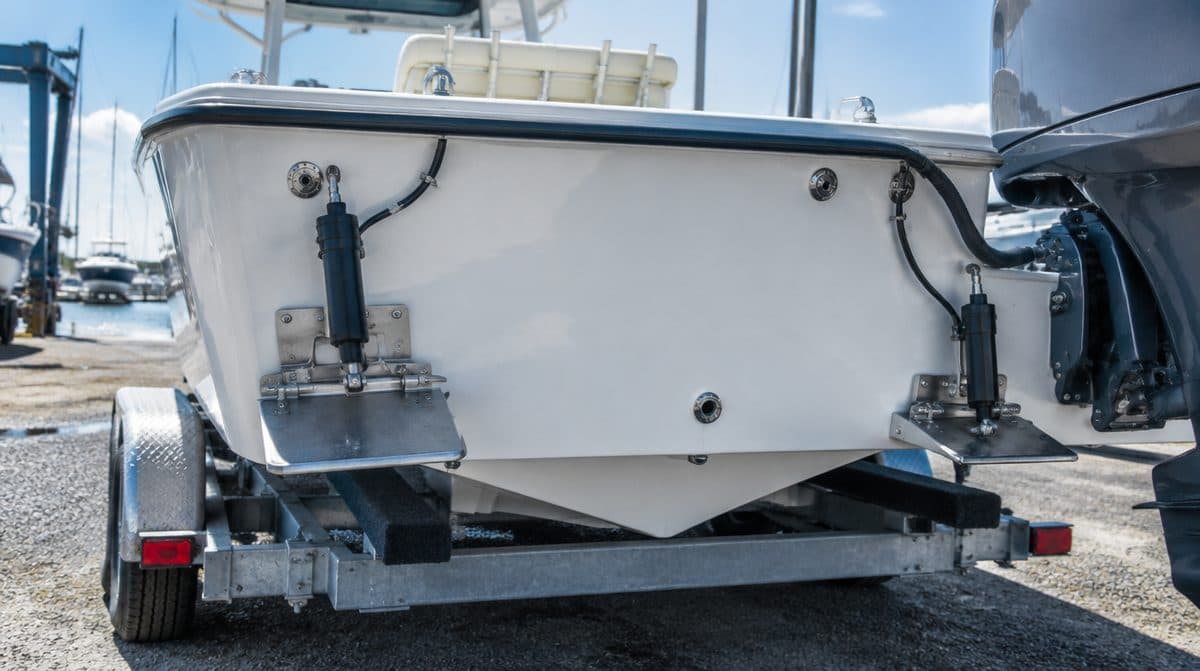
Trim Tabs: Get on Plane Faster and Ride Smoother
Bow in the sky, boat leaning toward the heavy side, spray over the beam. Trim tabs fix all three, if you size them to your boat and learn to tap instead of hold.
If your bow points at the sky every time you hit the throttle, or the boat leans whenever your buddy moves to one side, trim tabs are the fix. They are one of the few upgrades that change how the whole boat behaves, every single trip, in a way you feel within the first hundred yards.
Here is how tabs work, how to size them, and how to choose between electric and hydraulic without overbuying.
How trim tabs actually work Tabs are adjustable plates mounted at the bottom corners of your transom, pushed down into the water flow by actuators. Deflect a tab down and the water rushing past it shoves that corner of the stern up, which drops the bow on the same side. Deploy both tabs and the whole bow comes down. Deploy one and you correct a lean. That is the entire trick: two small plates giving you independent control over each corner of the stern, which your engine trim alone cannot do. Engine trim adjusts the thrust angle on the centerline; tabs adjust the hull's attitude side to side. Boats that run flat and level use both together.
What tabs fix - Slow time to plane - Porpoising - Listing to one side from uneven weight or wind - Poor visibility from bow-high running
If a chine-walking, bow-high hole shot has you standing up to see over the bow with a crowd aboard, that is the tab-shaped hole in your boat's equipment list.
Size to boat length and power Tab size is driven by boat length, weight, and horsepower. Bigger and heavier boats need larger tabs for enough lift. Follow the manufacturer's sizing chart by boat length and power, and when between sizes, go larger for more control. Larger tabs generate the same correction with less deflection, which means less drag for the same result, so oversizing slightly is the forgiving direction. The real constraint is physical: measure the flat transom width available between the engine and the chine, and check clearance for the trailer, swim platform, and transducer before you fall in love with a size.
Electric vs. hydraulic - Electric tabs: easier install, no hydraulic lines, popular on smaller and mid-size boats. The actuator is self-contained, so installation is mounting hardware plus a wire run to the helm switch. - Hydraulic tabs: more lifting force, favored on larger and offshore boats. A pump unit inside the boat drives fluid to the actuators, which adds install complexity but brings serious muscle and a long track record in rough water.
For most trailer boats and bay boats, electric is the simple, modern answer. Offshore hulls that carry heavy loads and run big seas are where hydraulic systems have earned their reputation.
Controls and indicators The switch matters more than it looks like it should. Basic rocker switches work, but you are flying blind on tab position. Indicator switches with LED position displays show where each tab sits at a glance, which shortens the learning curve a lot. Auto-leveling controls go further and trim the boat for you as speed and load change. If more than one person drives your boat, position indicators are worth having, because the first thing a guest helmsman does is forget the tabs are down.
Installation realities Tabs mount at or below the waterline, so this is a job to take seriously rather than fear. Drill the transom, bed every fastener and the actuator bases in quality marine sealant, and follow the template placement so the tabs sit where the manufacturer intended. Electric installs then come down to running wire: a clean, fused feed, proper routing above the bilge water line, and solid crimps with heat-shrink terminals. Our marine wire and terminal guide covers how to make those connections live a long life. Hydraulic installs add mounting the pump unit somewhere dry and accessible and routing lines aft.
Using them well Tabs reward a light touch. Deploy them for the hole shot, then bleed them off as the boat levels out. Correct a lean with the single tab on the high side's opposite corner. Running into a head sea, a touch of tab drops the bow and softens the ride; running down-sea, get them up so the bow stays free. The common thread: small inputs, then wait and feel what the boat does.
Maintenance and lifespan Tabs live underwater, so give them the same respect as the rest of your running gear. Rinse after salt use, check the actuator seals and fasteners each season, and keep sacrificial anodes on the tabs fresh so stray current eats the zinc instead of your actuators and plates. Cycle the tabs through full travel occasionally in the offseason. Actuators are replaceable units, so a tired actuator years from now is a swap, not a new system.
Signs of trouble - One tab responds slower than the other, or not at all. - The boat develops a list it never had, with the tabs reading level. - Fluid streaks below a hydraulic actuator, or a pump that runs longer than it used to. - Corrosion blooming around fasteners, or anodes wasted to nothing.
Mistakes to avoid - Undersizing because the smaller kit was cheaper. Small tabs working at full deflection make more drag than big tabs barely working. - Mounting without consulting the template, then discovering the trailer bunks land on the tabs. - Skipping the anodes on a saltwater boat. - Leaving the tabs down at the dock, where growth and stray current do their best work.
From the Water Use your tabs in short taps, not long holds. A little goes a long way, and over-trimming makes the bow plow into waves. If you ever find yourself fighting the wheel in a down-sea run, check the tabs first: a buried bow with tabs down is steering the boat more than you are, and two taps up usually hands the helm back.
Where to Get It Everything in this guide is stocked at Boat Supplies Direct, the Nautical Network marine parts store.
In stock as this guide goes up: - Lenco 9 x 12 edge mount trim tab kit with standard tactile switch - Bennett BOLT 12 x 9 electric trim tab system, control switch required - Bennett 129ATP hydraulic trim tab complete kit with Auto Trim Pro
Browse the full range: - Shop trim tabs - Read the full buying guide, including FAQs
More from the Wire
 Buying Guides
October 18, 2026
Starting vs. Deep Cycle: The Battery Mistake That Strands Boaters
Starting, deep cycle, or dual purpose, and flooded, AGM, or lithium. How to pick the battery type that will not leave you stranded.
Read more Buying Guides
October 18, 2026
The Onboard Charger: Cheap Insurance for Expensive Batteries
Batteries die young when they sit half-charged. How to size an onboard charger by amps, banks, and chemistry.
Read more Buying Guides
October 18, 2026
Battery Switches and Isolators: Never Get Stranded by a Dead Battery
The switch and isolator setup that keeps your starting battery ready while the house bank runs your gear.
Read more