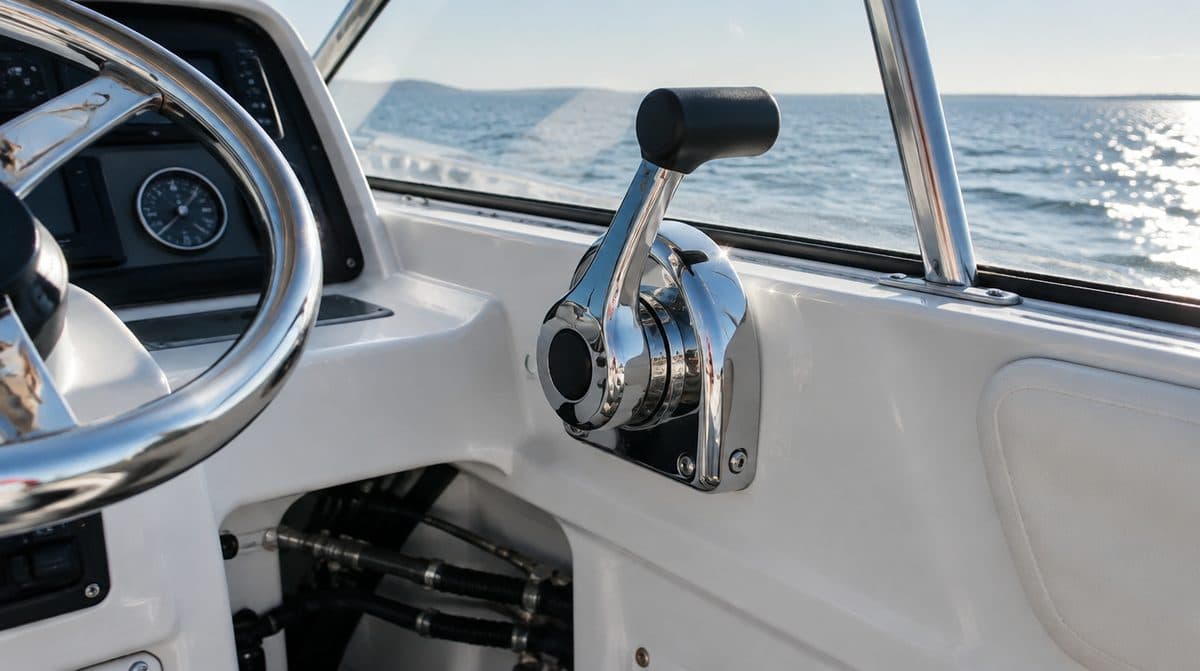
Engine Controls: The Throttle and Shift That Command Your Boat
That mushy shift lever is trying to tell you something. How to match a control to your engine, pick single or dual lever, and measure cables right the first time.
Sticky throttles and hard shifting make docking stressful. You feather the lever coming into the slip, it hangs up, then breaks free and gives the boat twice the throttle you asked for, right as the piling gets close. The right control, properly matched to your engine, makes the boat feel effortless: a crisp click into gear, smooth throttle response, and no drama at idle.
The control itself is simple hardware. Matching it correctly is the whole game, so here is how to think it through before you spend anything.
How a control actually works On a mechanical setup, the lever at the helm pushes and pulls two cables: one for shift, one for throttle. Move the lever out of its center detent and the shift cable drops the engine into gear first. Keep pushing and the throttle cable starts opening things up. That detent is why a healthy control gives you a clean little click into forward and reverse. When the click turns to mush, something in the chain is wearing out, and it is usually the cables rather than the control head.
Digital throttle and shift (DTS) replaces the cables with electrical signals. The lever is a sensor, the engine receives a command, and actuators on the engine do the physical work. The feel is lighter and more precise, and features like engine syncing become possible. The catch: the control head, harness, and engine all have to speak the same language.
Match brand and type first Controls must match your engine brand and type (mechanical cable vs. digital/electronic). This is the step people skip, and it is the one that burns them. Mechanical controls differ in cable travel and end fittings from brand to brand, so a control that bolts neatly to your console can still shift your engine badly if the geometry is wrong. Universal-style controls exist and work well, but you have to pair them with the correct cables for your specific engine.
DTS systems need matching compatible controls, full stop. A digital control head is part of the engine's electronic ecosystem, not a generic lever. If you run a digital engine, buy the control its maker certifies, or an aftermarket head that explicitly lists your engine and rigging as compatible.
Single lever vs. dual lever - Single lever: throttle and shift on one lever, clean and common. One hand does everything, and you cannot grab a gear without passing through idle first. - Dual lever: separate throttle and shift, preferred by some for fine control. Sailors and owners of older cruisers often like a throttle that stays put while the shift lever works independently.
If you are not sure, go single lever. It is the modern standard for a reason, and it is the harder of the two to make an expensive mistake with.
Twins, triples, and beyond Multi-engine controls put two or more levers in one binnacle so your hand falls on both throttles at once. Docking a twin-engine boat is all about splitting the engines, one ahead and one astern, and a proper twin control makes that second nature. Match the control to your engine count. Rigging two separate single controls side by side technically works, but the spacing and feel will fight you every time you dock.
Side mount or top mount - Side mount: bolts to the vertical side of the console. Compact, simple, common on smaller boats, and it keeps the dash top clear. - Top/flush mount: sits on the horizontal dash surface, the standard look on most modern center consoles and runabouts.
Confirm the control fits your helm and engine count before you order. Measure the cutout of the control you are replacing; staying with the same mounting style turns the job from fabrication into a bolt-in swap.
Measure cables like they cost real money Control cables are sold by length, so measure the actual routing path from the helm, through the rigging tube or gunnel, back to the engine, following every bend along the way. Then round up to the next available length. A cable that runs slightly long can absorb the extra in gentle loops. A cable that comes up short is a paperweight. Keep every bend as wide as the boat allows, because tight radiuses add friction, and friction is exactly the stiff, sticky feel you are trying to get rid of.
Installation realities A mechanical swap is a satisfying weekend job: pull the old head, transfer or replace the cables, set the shift cable so the detent engages gear positively, then adjust the throttle cable so idle is actually idle. Take photos before you disconnect anything, and set the lever friction so the throttle holds position at cruise without a death grip.
DTS is a different animal. There is wiring, there is often calibration, and mistakes show up as an engine that will not start or will not shift. If that is outside your comfort zone, a verified marine mechanic on Waypoint can handle the changeover and spare you the guesswork.
Maintenance and lifespan Controls live a hard life in salt spray. A few times a season, hit the pivot points with a corrosion-blocking lubricant, run the lever through its full travel, and grease the cable ends at the engine. Replace cables in pairs; if one has corroded internally, its twin has been living in the same environment and is not far behind. A quality control head, kept lubricated, will outlast several sets of cables.
Signs it is time - Shifting takes real muscle, or the lever creeps off your throttle setting at speed. - The gear detent feels vague, so you find neutral by ear instead of by feel. - Visible rust, cracked jacket, or kinks anywhere on the cables. - Slop in the lever: you move it and nothing happens for the first inch of travel.
Mistakes to avoid - Reusing ancient cables with a new control head. You just bolted a new handle onto the old problem. - Mixing mechanical and digital parts. No adapter makes a cable head run a DTS engine. - Buying on looks. Polished chrome is nice; correct travel and fitment are nicer. - Ignoring the neutral safety switch. Wire it, test it, and make sure the engine cranks only in neutral.
From the Water If shifting suddenly gets stiff, check the cables before blaming the control. Corroded or kinked cables are the usual cause. Disconnect the cable at the engine end and work the lever by hand: if it now swings freely, the cable or the engine linkage is your culprit, not the head. Five minutes of diagnosis beats buying the wrong part.
Where to Get It Everything in this guide is stocked at Boat Supplies Direct, the Nautical Network marine parts store.
In stock as this guide goes up: - UFlex Power A Mark II twin engine control head, no trim switch - Uflex MACH Series 33C universal engine control cable, 18 ft - Uflex MACH Series engine control cable for Mercury Gen II, 20 ft
Browse the full range: - Shop engine controls - Read the full buying guide, including FAQs
More from the Wire
 Buying Guides
October 18, 2026
Starting vs. Deep Cycle: The Battery Mistake That Strands Boaters
Starting, deep cycle, or dual purpose, and flooded, AGM, or lithium. How to pick the battery type that will not leave you stranded.
Read more Buying Guides
October 18, 2026
The Onboard Charger: Cheap Insurance for Expensive Batteries
Batteries die young when they sit half-charged. How to size an onboard charger by amps, banks, and chemistry.
Read more Buying Guides
October 18, 2026
Battery Switches and Isolators: Never Get Stranded by a Dead Battery
The switch and isolator setup that keeps your starting battery ready while the house bank runs your gear.
Read more