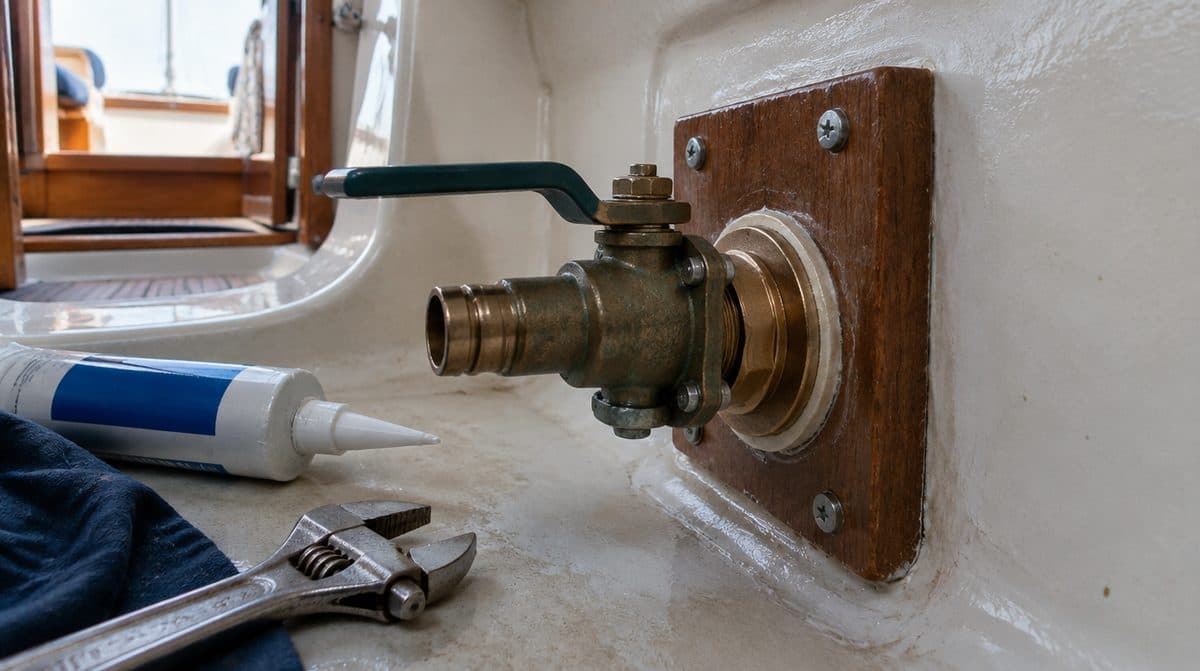
Thru-Hull Fittings: The Holes in Your Boat You Can't Ignore
Every fitting below the waterline is a hole in your boat. Materials, sizing, and the seacock habit that prevents sinkings.
Every hole below your waterline is a potential sinking. The right thru-hull and seacock make sure it never becomes one. Boats need those holes: engines drink cooling water, livewells fill and drain, heads discharge, bilge pumps push water out. The average boat has more deliberate holes in it than most owners realize, and each one is only as trustworthy as the fitting sealed into it.
What a Thru-Hull System Actually Is
A thru-hull is the fitting that passes through the hull itself, a mushroom-headed tube with a flange outside and threads inside. Below the waterline it should never work alone. A seacock, a valve mounted directly to the thru-hull, is what lets you close the hole from inside the boat, and a hose tail on the seacock connects the whole assembly to the equipment it serves. Think of it as a chain: hull, thru-hull, seacock, hose tail, double-clamped hose. The system is only as strong as its weakest link, and that is usually the part someone cheaped out on years ago.
Above the waterline, life is easier. Cockpit drains that exit well above the water, sink drains, and bilge discharges high on the topsides can use simpler fittings without a valve, though quality still matters because a fitting that sits above the waterline at the dock may spend plenty of time underwater when the boat heels or squats at speed.
Material Matters Below the Waterline
- Bronze/Marelon: proper choice for below-waterline thru-hulls paired with a seacock.
- Plastic/nylon: acceptable only for above-waterline drains, never for critical below-waterline use.
Never use a cheap plastic thru-hull below the waterline. A failure there sinks boats. Bronze has earned its reputation over a century of salt water service: it is strong, it tolerates impact, and it corrodes slowly and visibly instead of suddenly. Marelon, a glass-reinforced marine polymer, is the engineered exception to the no-plastic rule: it is purpose-built for below-waterline duty, immune to galvanic corrosion, and approved for the job, which bargain-bin nylon fittings are not.
One more materials trap: do not mix metals casually. A bronze seacock on a stainless thru-hull, or brass plumbing-store fittings mixed into the stack, sets up galvanic corrosion right where you least want it. Brass is not bronze. If a below-waterline fitting shows pink or reddish discoloration, that is dezincification, the metal quietly losing its zinc and its strength, and the fitting needs replacing.
Size to the Hose
Match the thru-hull bore to your hose and the device it serves (bilge discharge, livewell, washdown, engine intake). Pair below-waterline fittings with a seacock you can close.
Sizing runs backward from the equipment. Say your bilge pump has a 1-1/8 inch outlet: you want hose, thru-hull, and any fittings along the way to carry that full diameter, because any necked-down section becomes the choke point for the entire run. The same goes for an engine intake: the engine's raw water pump expects a certain hose size, and the scoop or thru-hull feeding it should match. For engine intakes specifically, a scoop or slotted high-speed strainer head on the outside helps keep larger debris out and maintains flow underway.
Install and Backing
Use proper sealant and a backing block so the fitting does not flex or leak. A seacock gets real abuse: hoses tug on it, people step on it, and the hull around it flexes in a seaway. The backing block, a pad of fiberglass or sealed hardwood bonded inside the hull, spreads those loads so the flange is not trying to do structural work alone. The right sealant matters too: a marine polyurethane or polysulfide rated for below-waterline use, applied to clean, dry surfaces, with the fitting snugged so sealant squeezes out evenly all the way around.
Inspect and exercise seacocks regularly. A valve is a mechanical device, and mechanical devices seize when ignored. While you are down there, look at the whole chain: hose clamps (two per connection below the waterline, all stainless including the screws), hose condition near the tails, and any weeping or crust around the flange.
This is also one of the few jobs where hiring out is genuinely reasonable. Replacing a below-waterline thru-hull means hauling the boat and cutting into the hull, and the consequences of a sloppy job are absolute. If that is outside your comfort zone, a verified marine technician on Waypoint can do it right while you watch and learn for next time.
Signs a Fitting Needs Replacing
- Pink or reddish tint on bronze (dezincification)
- A seacock handle that will not move, or moves without changing flow
- Cracks or chalky, brittle plastic on above-waterline fittings, since sun exposure ages them
- Persistent weeping around the flange no matter how it is tightened
- Heavy corrosion, flaking, or a fitting you cannot identify the material of
That last one deserves emphasis: an unidentifiable thirty-year-old fitting below the waterline is not a mystery to solve, it is a part to replace.
Mistakes to Avoid
- Any hardware-store plastic or brass below the waterline
- A below-waterline thru-hull with no seacock on it
- Skipping the backing block and letting the flange take all the load
- Mismatched sizes that choke the system the fitting serves
- Installing perfectly and then never touching the valve again
From the Water
Open and close every seacock at least twice a season. A valve that has seized open is useless in an emergency. Work the handles as part of spring commissioning and again midseason, and tie a correctly sized soft wood plug to each fitting while you are at it. It is the cheapest peace of mind on the boat.
Where to Get It
Everything in this guide is stocked at Boat Supplies Direct, the Nautical Network marine parts store.
In stock as this guide goes up: - GROCO 2 inch bronze extra long thru-hull fitting with nut - Perko 1-1/2 inch bronze thru-hull fitting for hose - GROCO 3/4 inch bronze combo scoop thru-hull with nut
Browse the full range: - Shop thru-hull fittings - Read the full buying guide, including FAQs
More from the Wire
 Buying Guides
October 18, 2026
Starting vs. Deep Cycle: The Battery Mistake That Strands Boaters
Starting, deep cycle, or dual purpose, and flooded, AGM, or lithium. How to pick the battery type that will not leave you stranded.
Read more Buying Guides
October 18, 2026
The Onboard Charger: Cheap Insurance for Expensive Batteries
Batteries die young when they sit half-charged. How to size an onboard charger by amps, banks, and chemistry.
Read more Buying Guides
October 18, 2026
Battery Switches and Isolators: Never Get Stranded by a Dead Battery
The switch and isolator setup that keeps your starting battery ready while the house bank runs your gear.
Read more