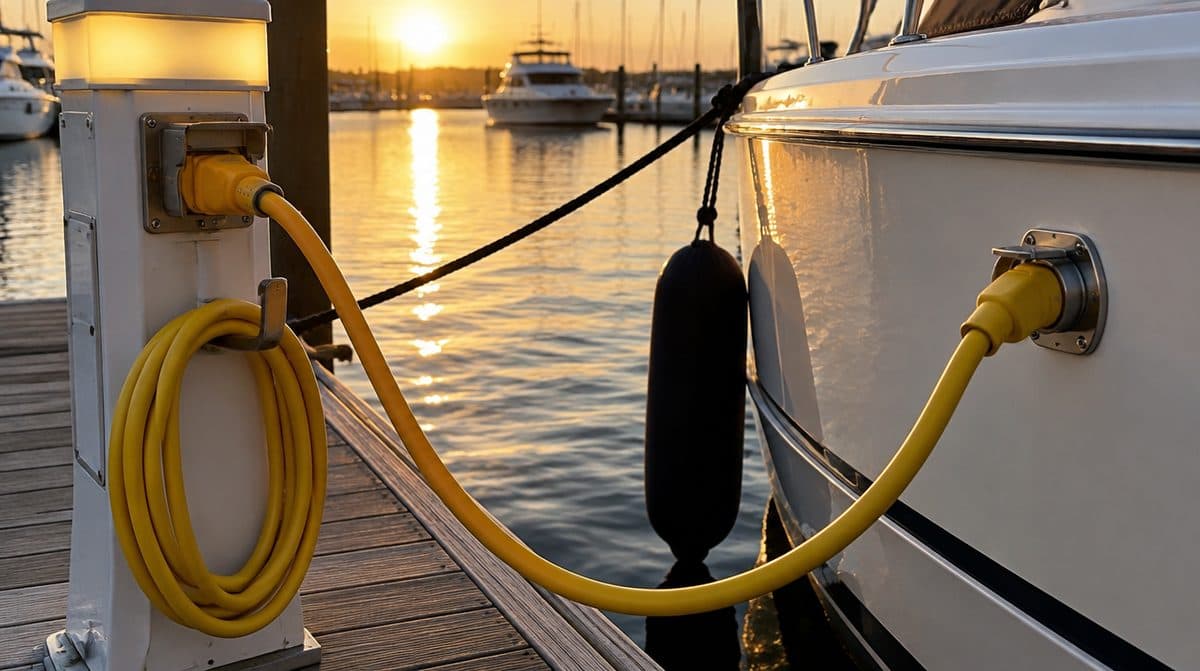
Shore Power Safety: What Every Boater Plugging In Should Know
A warm shore power plug is a failing one. Matching amperage, choosing cord length, and the ten-second habits that keep tired connections from becoming dock fires.
Dock fires and electrical shocks are more common than most people think, and many of them start with a tired cord or a forced connection. Shore power is the one system on your boat that routinely carries household-level voltage through a connector that lives outside, gets rained on, gets stepped on, and gets yanked at an angle every time someone trips over the cord. Treat it with the same respect you give your fuel system and it will quietly do its job for years.
How shore power gets aboard
The chain is short: the marina pedestal, your cord, the inlet on your hull, and the breaker panel inside the boat. Every link is simple, and almost every shore power problem lives at the connections between them. A connection that is clean, dry, and tight barely warms up. A connection that is corroded, worn, or loose has resistance, and resistance under load makes heat. Heat degrades the contacts further, which makes more resistance, which makes more heat. That loop is how a slightly sloppy plug becomes a melted inlet, and occasionally how a melted inlet becomes a dock fire.
Keep that one idea in your head and every rule in this guide becomes obvious.
Match your amperage
Boats use 30 amp or 50 amp shore power. Your cord, plug, and inlet must match your boat's system and the dock pedestal. The connectors are physically different for a reason: they are rated for different loads, and the rating is the whole point.
Adapters exist but should be used correctly, never forced. The right adapter lets a 30 amp boat plug into a 50 amp pedestal and run normally, because the boat's own breaker still limits the load. Going the other direction needs more care: an adapter does not create capacity, so a 50 amp boat living on a 30 amp supply has to actually manage what is running, or it will trip breakers and cook connections. And if a plug does not want to seat, stop. Blades forced into the wrong receptacle at an angle is how burn marks happen.
Cord quality and length
Buy a marine-rated cord in the right amperage and only as long as you need. Marine cordsets earn their price with heavier conductors, jackets that survive sun and salt, and molded ends built for locking rings and weather seals. A hardware store extension cord has none of that and no business feeding a boat.
Length matters more than it seems. Too long coils and overheats, too short strains the connection. A coiled cord under load cannot shed heat, so the leftover loops become a space heater on the dock. A cord that barely reaches hangs its whole weight on the plug blades and works the connection loose with every tide swing. Measure the honest distance from pedestal to inlet, add comfortable slack, and buy that cord. Support the run so the boat's movement flexes the cord, not the plug.
Inspect before you plug in
Inspect plugs for burn marks or corrosion, keep connections dry, and never run a damaged cord. Pull the plug out of the pedestal and actually look at the blades: brown or black discoloration, pitting, green crust, or any sign the plastic around a blade has softened means that cord end is done. Check the boat inlet the same way, and look at the pedestal receptacle too, because a scorched pedestal will happily transfer its problem to your brand new cord. Use the locking rings and weather covers; they exist to keep the connection tight and dry, which is the entire game. Shore power faults cause dock fires, and nearly all of them announce themselves first to anyone who looks.
The plug-in routine
Order matters. Turn the pedestal breaker off, connect the boat end first, then the pedestal end, then flip the breaker on. Unplugging is the reverse: breaker off, pedestal end off, boat end last. The point is to never connect or disconnect under load, because a plug pulled while current is flowing draws an arc, and arcs pit and carbonize the contacts a little more every time. Do it right and the connectors stay clean for years. Do it wrong weekly and you are buying new ends by next season.
Galvanic isolation
A galvanic isolator or isolation transformer protects your underwater metals from stray dock current that accelerates corrosion. The same green safety ground that protects you also electrically connects your boat to every other boat on the dock, and that connection quietly eats anodes. It is worth it anywhere you keep the boat plugged in. We break down how the device works and how to size one in our galvanic isolator guide.
Signs the connection is failing
A warm plug, flickering power, a breaker that trips without an obvious load, discolored blades, or any electrical smell near the inlet all mean the same thing: stop and fix it now. Heat damage spreads in pairs, so when a plug burns, replace both sides of the connection; a scorched plug has almost always damaged the receptacle it lives in, and a new cord plugged into a burned inlet inherits the problem on day one.
From the Water
Feel your shore power plug after it's been in use a while. If it's warm, the connection is failing and needs attention now. Make it a habit on your way off the boat: hand on the inlet, hand on the pedestal plug, ten seconds total. A healthy connection under load runs cool, so warmth is never normal, and it is the cheapest early warning system on the dock.
Where to Get It Everything in this guide is stocked at Boat Supplies Direct, the Nautical Network marine parts store.
In stock as this guide goes up: - SmartPlug 50 Amp Stainless Steel Combo Kit - Marinco 30 Amp Power Cord Plus Cordset, 35 Foot, Yellow - SmartPlug Weathercap
Browse the full range: - Shop shore power - Read the full buying guide, including FAQs
More from the Wire
 Buying Guides
October 18, 2026
Starting vs. Deep Cycle: The Battery Mistake That Strands Boaters
Starting, deep cycle, or dual purpose, and flooded, AGM, or lithium. How to pick the battery type that will not leave you stranded.
Read more Buying Guides
October 18, 2026
The Onboard Charger: Cheap Insurance for Expensive Batteries
Batteries die young when they sit half-charged. How to size an onboard charger by amps, banks, and chemistry.
Read more Buying Guides
October 18, 2026
Battery Switches and Isolators: Never Get Stranded by a Dead Battery
The switch and isolator setup that keeps your starting battery ready while the house bank runs your gear.
Read more