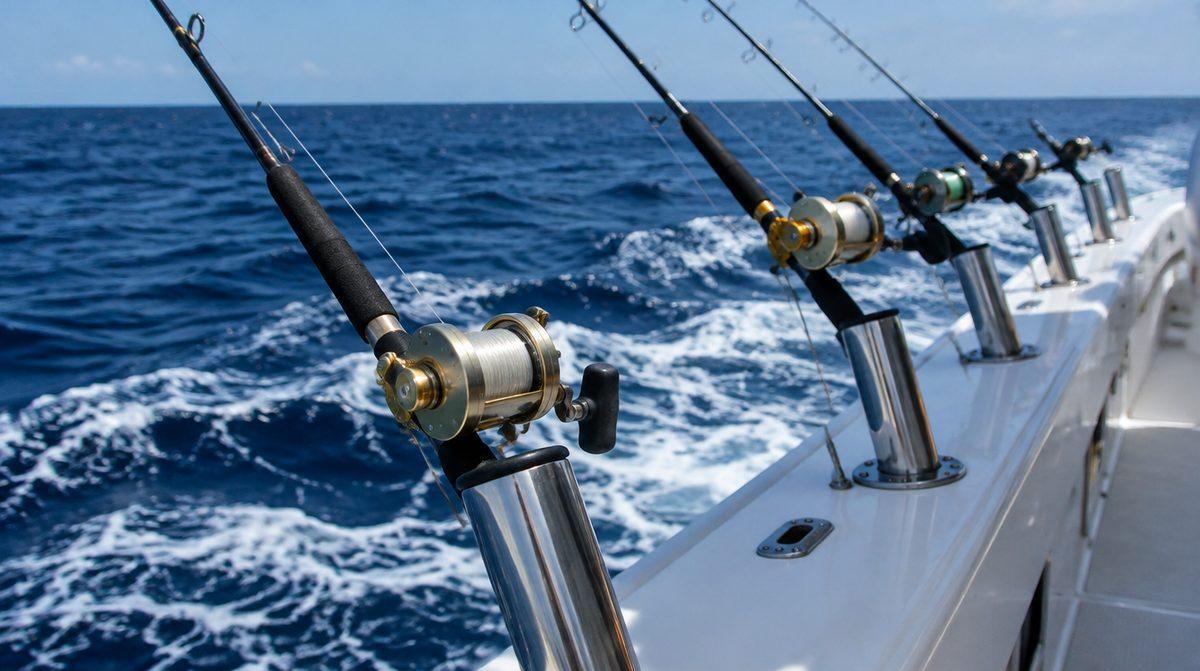
Rod Holders: Stay Organized and Stop Losing Rods Overboard
Most rods go over the side at idle, not on a strike. Flush mount, clamp-on, rocket launcher, or adjustable, and how to place and back each one so it holds when a fish tests it.
Every angler has a story about the rod that went over the side. Usually it isn't a giant fish, either. It's a rod leaned against a gunwale during a bumpy idle, or balanced across a seat while somebody reached for a sandwich. The right rod holders keep gear secure and your spread organized, and they're one of the cheapest upgrades that changes how a boat fishes.
Here's how to pick the right type, judge strength honestly, and place them where they'll earn their keep.
The Four Main Types
- Flush mount: built into the gunwale, clean look, fixed angle. The classic choice for trolling and bottom fishing, and they're out of the way when you're not using them.
- Clamp-on/rail mount: attach to rails, adjustable and removable. No holes to cut, which makes them the easy answer for pontoons, rented slips, and anyone nervous about taking a hole saw to a gunwale.
- Rocket launcher: multiple rods on a hardtop or leaning post. Part storage, part trolling station, and they keep a whole quiver organized and off the deck.
- Adjustable/removable: angle and stow as needed. Drop them into a base or clamp, set the angle for the technique, and pull them off when you want clean rails.
Most serious setups end up with a mix: flush mounts in the gunwales for fishing, a launcher up top for storage and extra lines, and a couple of adjustable holders for whatever the day demands.
Material and Strength
Stainless steel and reinforced composite handle big fish loads. For offshore trolling, strength and backing matter, since a hooked fish puts real force on the holder.
Think about the physics for a second. A trolling rod in a holder is a lever, and the fish is pulling on the long end. The load at the holder is multiplied far beyond the pull at the rod tip, which is why a flimsy holder doesn't bend gracefully, it snaps or tears out of the fiberglass. Stainless steel is the offshore standard. Good reinforced composite holders are lighter, kinder to rod finishes, and plenty strong for inshore work. Thin unreinforced plastic belongs on a dock cart, not in your gunwale.
Just as important as the holder is what's under it. A flush mount is only as strong as the glass and backing it's bolted through, so offshore holders want a backing plate spreading the load under the gunwale. The best holder in the catalog can't help you if it leaves with a chunk of deck attached.
Angle and Placement
Trolling holders are often set at angles to spread lines. Storage holders keep rods vertical and out of the way. Plan placement around how you fish.
Angled gunwale holders fan your lines away from the boat so you can pull more baits without a tangle. Vertical holders are for stowage and for techniques where the rod waits straight up until something happens. Before you drill anything, stand in the cockpit and mime fighting a fish from each spot: can you clear the rod without fencing with your crew, and does anything block a hatch, a cleat, or the ladder? Tape the locations and live with them for a trip first. Tape moves. Holes don't.
If you troll deep for suspended fish, holders also pair naturally with downriggers, and our downrigger guide covers that side of the spread.
Installation Realities
Flush mounts mean cutting a sizeable hole in your gunwale, so measure twice and check what's underneath before the hole saw touches gelcoat: wiring, fuel fills, and steering runs all love to hide exactly where you wanted a holder. Bed the flange in marine sealant so water can't wick into the core, and through-bolt with a backing plate rather than trusting screws in fiberglass. Clamp-on holders skip the surgery, but snug the fittings properly and check them each trip, because rail hardware loosens with vibration.
Maintenance and When to Replace
Rinse holders with fresh water after salt trips, especially flush mounts, which collect everything the deck sheds. Replace any holder that shows cracks around the flange, wobbles in its mount, or has corrosion past the point of polishing. A holder that moves under hand pressure will not survive a drag-screaming strike, and that is precisely when you'll find out.
Mistakes to Avoid
Buying before planning the spread: placement decides whether holders help or collect dust. Mixing metals carelessly: stainless hardware on an aluminum rail needs isolation or you're building a corrosion experiment. Trusting a storage holder with a trolling load: vertical stowage racks are not built for a strike. And undersizing the tube: check that your heaviest rod butt actually fits before you buy, not after.
From the Water
Use a rod leash on your best setups when trolling offshore. A big strike can yank a rod clean out of a holder. The leash costs less than a single good reel handle, and clipping it takes two seconds once it becomes habit. Your most expensive combo should be the first one tethered, not the last.
Where to Get It
Everything in this guide is stocked at Boat Supplies Direct, the Nautical Network marine parts store. Orders ship free all year with Dock Pass, the $49 a year shipping pass.
In stock as this guide goes up: - Scotty Powerlock Rod Holder, Black, with 241 Side/Deck Mount - Lee's Clamp-On Rod Holder, White Aluminum, Vertical Mount, fits 1.900 inch O.D. pipe - Scotty Rocket Launcher Rod Holder with 241 Bracket
Browse the full range: - Shop rod holders - Read the full buying guide, including FAQs
More from the Wire
 Buying Guides
November 21, 2026
Marine Coolers: Ice That Lasts and Drinks That Stay Cold
A boat is the worst place on earth to keep ice. How to size a cooler by trip, when rotomolded is worth the weight, and why electric coolers skip the ice run entirely.
Read more Buying Guides
November 7, 2026
Man Overboard: The Gear and Plan That Bring Them Back
A head in the waves vanishes faster than you think. The gear that marks, reaches, and recovers, and the one crew job that saves most rescues.
Read more Waypoint
October 5, 2026
Marine Air Conditioning in Florida: Why Units Quit in Summer and How to Stay Cold
How raw-water-cooled marine A/C actually works, why failures cluster in the hottest months, the strainer and flush habit that prevents most of them, and when to call a pro.
Read more