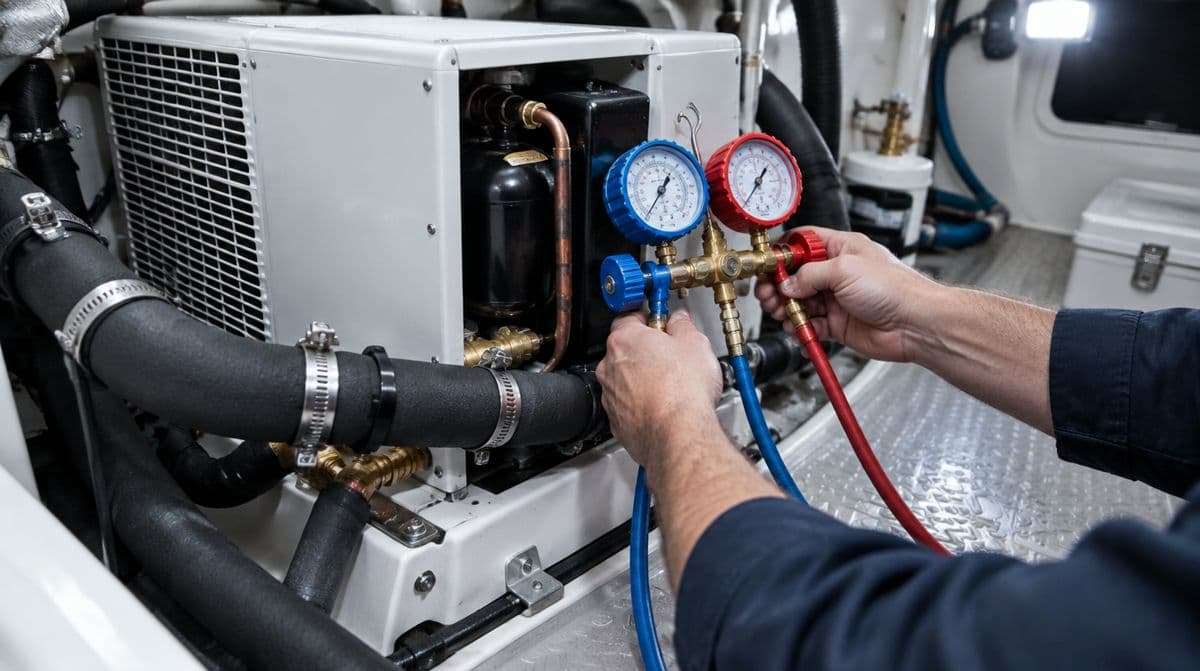
Marine Air Conditioning in Florida: Why Units Quit in Summer and How to Stay Cold
How raw-water-cooled marine A/C actually works, why failures cluster in the hottest months, the strainer and flush habit that prevents most of them, and when to call a pro.
Nothing on a boat is more appreciated and less understood than the air conditioning. In a state where, as the Florida Fish and Wildlife Conservation Commission puts it, the boating season never really ends, the A/C is not a luxury system. It is the difference between using the boat in August and looking at it from the parking lot. Understanding one idea, raw-water cooling, explains almost everything about why these units fail and how to keep yours alive.
How raw-water cooling works
Your home air conditioner dumps heat into the outside air with a big fan. A marine unit dumps heat into the water your boat floats in. A through-hull fitting lets seawater in, a strainer catches grass and debris, a pump pushes the water through the condenser coil where it picks up the heat from the refrigerant loop, and the warmed water exits overboard through a discharge fitting you can usually see trickling at the waterline. That steady overboard stream is the system's pulse. Strong flow, healthy system. Weak or absent flow, trouble coming.
Why units quit in summer
Summer is a three-way squeeze. The water the system depends on for cooling is at its warmest, so the unit starts with less help. The heat load is at its maximum, so the unit runs hardest and longest. And marine growth peaks in the warm months, which means the strainer, the hoses, and the condenser coil are fouling at exactly the moment the system can least afford restriction. Marine service guidance is blunt about this chain: sea strainers need checking every few weeks in summer, because a clogged strainer or a growth-lined water loop under maximum load is precisely how A/C failures cluster in the hottest months. The unit that hums along all winter dies on the Fourth of July for a reason.
The strainer and flush habit
The good news is that the most common failures are the preventable ones. Build two habits. First, the strainer check: open and clean the sea strainer basket regularly, every few weeks in the heat of summer, and glance at the overboard discharge every time you are aboard with the unit running. Weak flow means the blockage conversation starts now, not after the compressor overheats. Second, the seasonal flush: running a descaling solution through the raw-water loop dissolves the scale and growth that a strainer cannot catch, the layer that quietly insulates the condenser coil until the unit cannot shed heat anymore. Add the simple stuff, a clean return-air filter and unblocked vents, and you have eliminated most of the ways these systems die young.
When to call a pro
Some jobs are yours and some are not. Strainers, filters, and flow checks are owner work. Refrigerant is not: sealed-system work takes certified technicians with recovery equipment, and a unit that is low on refrigerant has a leak that needs finding, not just topping off. Call a pro for repeated breaker trips, short cycling, ice on the evaporator, a pump that will not prime after the obvious checks, or any electrical smell. And if the unit is old enough that parts are a scavenger hunt, ask for an honest repair-versus-replace opinion, because efficiency has moved a long way.
Waypoint lists marine A/C and refrigeration specialists across Florida, every listing checked against the business's own website, with Verified badges on the businesses that claimed and confirmed their profiles. Browse A/C and refrigeration pros near you, and if the system is down with guests arriving Saturday, post it at nautical.network/help and let matching techs come to you. Stay ahead of the strainer, and stay cold.
More from the Wire
 Waypoint
October 13, 2026
The Runaround Problem: Why Finding a Good Marine Pro Is the Hardest Part of Owning a Boat
America has 11.6 million registered boats and a documented shortage of the people who service them. Here is what the numbers say about the runaround, and how we are fixing it.
Read more Waypoint
October 13, 2026
One Search, Whole Boat Day: How to Build a Service Plan in Minutes
Transport Thursday, bottom clean Friday, A/C fixed before guests land Saturday. Here is how Waypoint turns one sentence into a full lineup of vetted pros.
Read more Waypoint
October 13, 2026
In a Pinch Before the Boat Day? Here Is the Playbook
Dead A/C on Wednesday, guests arriving Saturday. The playbook for getting a marine pro moving fast, and what to have ready so they can say yes.
Read more